

I’m “biast” (con): nothing
(what is this about? see my critic’s minifesto)

Full disclosure: I have not seen the “director’s cut” of The Current War that is about to hit US cinemas. I saw the cut that debuted at Toronto International Film Festival in 2017, the version that subsequently got caught up in the collapse of The Weinstein Company, which is also the version that had a UK theatrical release this summer. Unlike many of my fellow critics, I really liked the original cut of the film, and I feel confident in recommending even this new version to you, and here’s why.
Apparently this “director’s cut” adds back in five scenes that had been snipped out of that earlier, Harvey Weinstein–dictated version, yet is also, somehow, ten minutes shorter. It’s difficult to see how any such changes could go very far to addressing the issues that savage TIFF and London critics have had with the film. It’s equally difficult to see that this “director’s cut” stuff isn’t merely a cheap marketing ploy and a bit of a dodge: the “director’s cut” has its own separate page at Rotten Tomatoes, effectively erasing the original cut’s separate page, with its 31 percent Fresh (ie, Rotten) rating; it also means that North American publications probably wouldn’t republish any negative Toronto reviews, because who can be sure, sight unseen, if this new version isn’t better than the old one.

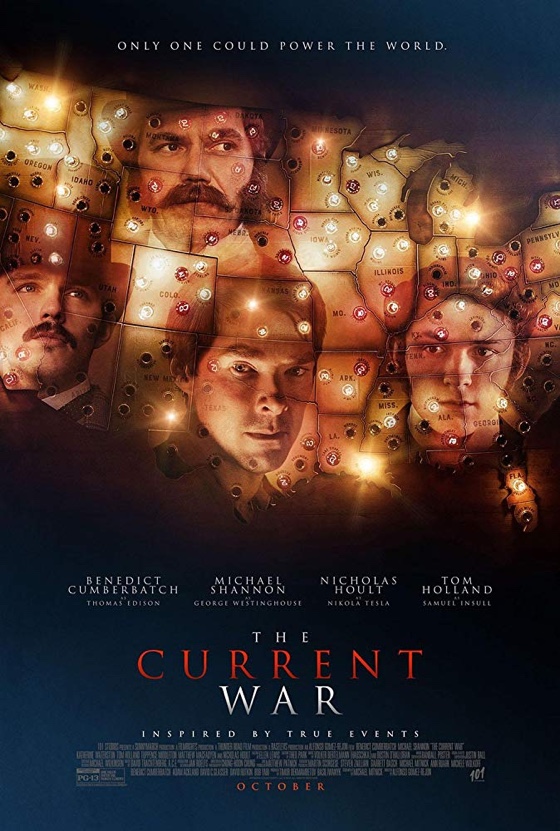
But it’s also difficult to see how a couple of brief added scenes and, it would seem, a couple of judicious cuts would negatively impact the things I liked about the film. Benedict Cumberbatch (Avengers: Endgame, The Grinch ) as Thomas Edison! Michael Shannon (12 Strong, Batman v Superman: Dawn of Justice) as George Westinghouse! (Matthew Macfadyen [Lost in Karastan, Anna Karenina] as J.P. Morgan! Nicholas Hoult [Dark Phoenix, Tolkien] as Nikola Tesla!) In the based-on-fact industrial, technical, and capitalist battle to light up our world of the late 19th century! It is a plain fact that this sort of story told this way isn’t going to be to everyone’s taste, and that there certainly are plenty of valid criticisms to lob at this movie. I love how director Alfonso Gomez-Rejon (Me and Earl and the Dying Girl, The Town That Dreaded Sundown) sidesteps typical costume-drama stodginess with an — *ahem* — electrifying visual style and a decidedly modern flavor to the storytelling, but some viewers might find it jarring or gimmicky. (The screenplay is by Michael Mitnick, whose only previous feature credit it the quite-bad YA sci-fi The Giver.) And it’s also true that there’s more than enough drama and character in this bit of history to keep a prestige-television series going for years. (Tesla is but a minor supporting character here, when he deserves a movie on his own; perhaps this is something the added scenes deal attempt to deal with.)
All that said, it’s rare we get a big movie intended to be a crowd-pleasing night out that is so full of ideas, one that asks us to consider that how the world is, the way our society operates on the most basic daily level, is not the way it had to be — that things could have been different is not something we are often asked to consider. (What if… our world had not been festooned with strung wire hanging from poles? What if we could have had electricity without all that? It seems like a minor issue, but once you begin to think about it, you see how the world might have looked quite radically other than it still does.)

The Current War is not merely about the comparatively minute details about how dreamy, freespirited inventor Edison and the tough-as-nails businessman Westinghouse — Cumberbatch and Shannon are brilliantly cast — raced to test and install radically diverse technological solutions for delivering power for, initially, electrical lighting. (“The world is lit by fire,” and nothing else, we are reminded as the movie opens in 1880.) It’s also about how how quickly a new technology can reach a saturation point so that we can barely remember life before it; at one point (I hope this hasn’t been cut!), Edison ponders that in the future he imagines, one blazing with electrical lights, only rich people will use candles! (That wasn’t quite correct, but it did make me realize that, once the world was also nearly simultaneously taken over by automobiles, mostly only rich people or dedicated hobbyists now own horses. Meanwhile, someone here dismisses electricity early on as nothing but “a hobby of the rich.”) There is also a running motif about the unforeseen side effects such advancements can spin off — no spoilers, but if electricity can kill if you’re not careful, there are deliberate applications of that. And that necessitates a PR battle to craft the public reaction to this new technology. New tech is never just about the tech, not since it started changing our lives so rapidly… and not since there’s been a media to, well, mediate our ideas about the new tech.
Those intrigued by the intersections between science and culture, as I am, may find this a grand geek adventure with plenty of resonance for the world today, almost 150 years later. (Edison is Steve Jobs, Westinghouse is Bill Gates?) I found this is a grippingly told tale of how two wildly different personalities, and the clash and competition between them, had an enormous influence on the world as we know it today… one that also accidentally asks us to consider how the development of technology is shaped by the people who create it, and why a desire for profit should win out over other motives. This may be the way the world is, but by holding it up for our consideration, The Current War — there is definitely some irony in the title — sneakily asks us to wonder why it couldn’t be otherwise.
















It’s worth noting that the idea that not so rich people could own horses too was a relatively recent idea by historical standards. It’s no accident that many foreign synonyms for the word “gentleman” or “knight” involve some form of the word “horse” since ownership of a horse was usually seen as an attribute of the rich or the aristocracy, if not both.
Poor people often had to settle for owning mules or donkeys if they owned any transport animals at all. It was usually the well-off who could afford to own a horse.
Every time I’m inclined to think differently, I remember the time a Mexican girlfriend reminded me of this fact while we were watching a movie about horsemen. And hey, Michael Moore said we Americans are supposed to learn from foreigners. :-)
I’m not sure that portraying Edison as a “freespirited inventor” does the man justice, as he was also a tough as nails businessman in his own right, And such a inclination comes with its dark sides as well. There are plenty of claims that a lot of “his” later inventions were actually not at all the product of any work done by him, but could be wholly attributed to the people who worked for him. He just would take the credit for them and keep the real inventors out of the picture.
Only in comparison to Westinghouse. The film also makes it plain that Edison was a businessman, and also a huge asshole.
Great, I’d have hated for his bad side to be plastered over so as to make him look like the underdog inventor with the heart of gold.
The film does a good job portraying him as a complex man. On one hand, he’s brilliant and very focused and hard working. He’s also driven by making the world a better place. But, as MaryAnn said, he’s also an asshole at times., in large part because he can’t admit that his way of doing things (in this case, direct current rather than alternating current) was no the way to go, so that he’d do anything to win over Westinghouse.
I was perversely amused by the many images of elephants in the movie.
http://edison.rutgers.edu/topsy.htm
There’s probably an obvious joke about the elephant in the room, but I won’t be the one to make it.