

I’m “biast” (con): nothing
(what is this about? see my critic’s minifesto)

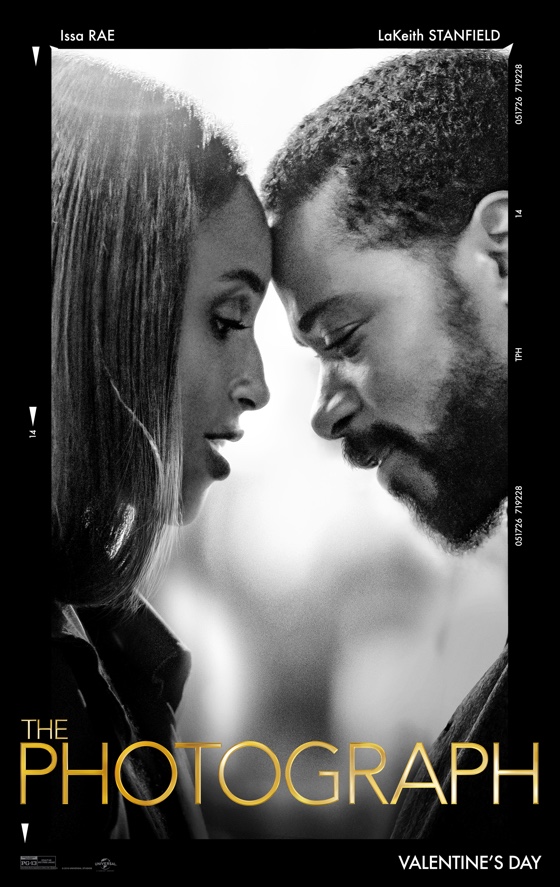
Forget meet-cute. It’s meet-melancholy for New York museum curator Mae (Issa Rae: Little) and magazine writer Michael (LaKeith Stanfield [Knives Out], a particular standout here, wonderfully endearing in a new-to-him role as a romantic lead) when an old photograph — old as in *gulp* from the 1980s — brings them together. It’s part of a feature Michael is researching, about how hurricanes and oil spills have impacted a New Orleans community, during the course of which he stumbles across the mysterious story of Mae’s recently deceased photographer mother, Christina (a steely Chanté Adams in flashbacks) — who escaped to NYC and a celebrated career in the arts — and her connection to Isaac (Rob Morgan [Just Mercy] today; Y’lan Noel [The First Purge] in the 80s), a fisherman content with a simple life.
Writer-director Stella Meghie pulls off an audacious intertwining of the past and present in an effortlessly smooth celebration of confident, complex black women: mother and daughter face similar emotional struggles as they struggle to overcome the limitations of what they learned about love and ambition as children, and as they contemplate the men before them and the vocations they’ve embraced. Is there any room in their lives for passion, or is that too much of a distraction? (The sex scenes, while fairly tame, are — hooray! — decidedly female-gazey.)

Mark Schwartzbard’s luscious cinematography and Robert Glasper’s (Miles Ahead) jazzy score infuse a swanky style to the elegant, pleasingly entangled drama, amplifying the charming chemistry between Rae and Stanfield and underscoring the bittersweetness of grownup relationships, with all their balancing acts: between work and family, between finding the courage to be vulnerable and the strength to know what you want and need out of your life. The Photograph is a refreshing adult take on a genre that all too often lately feels more like adolescent pandering, and finds that delicate balance between the fantasy of romance and the everyday reality in which it exists. If we can make it work for ourselves.
















Sounds like one to watch.
Interested in the notion of the female gaze. While the male gaze is child’s play to identify, the female gaze eludes identification. I mean, sure, you can simply define it as anything that comes from a female director, is intended for women, and depicts the viewpoint of female characters (the obverse to Mulvey’s criteria for the male gaze), but to my mind this is just a sort of genetic fallacy at play.
In some ways, I don’t know if the female gaze is even possible as a sui generis phenomenon in film, since it will always be defined in contradistinction with the male gaze, which has so dominated film writing, directing, and cinematography. It will invariably be seen as “not” male-gaze, in other words.
I suppose, given enough time, there will be a body of work from female creators that becomes sufficiently distinctive to support analysis as genuinely female (contra not-male), but I think we are a long way off from that with 9 out of 10 directors being male and 19 out of 20 cinematographers.
The female gaze exists—just watch the films of female directors–particularly in indie films, and you’re find that there is a difference in how female directors depict certain subjects as compared to how men usually direct films. Women look at the world differently form men, due to how they’re socialized, so yes, there is a female gaze—a way of looking at the world and at certain things men don’t have to deal with. There are far more female directors now than there were in the last decade, so it’s becoming more the norm now. Film isn’t some strange, eerie thing that only men can make, and woman can’t make plenty of them.
I agree with you that women tend to look at the world differently than men, and that this is borne out in the work of female directors. I also agree that that film is not a strange, eerie thing that only men can make (is there anyone who claims otherwise I wonder?).
But this is immaterial to my point.
My point is that the female gaze resists identification in a way the male gaze doesn’t, and that this may be due to the fact that it is not defined by a set of criteria (as the male gaze is), but is simply parsed as being “not” male gaze. If there is to be a robust sense of what the female gaze is, we would need to unpack the differences in films directed by female directors, so as to identify discernible features. I am not aware of any such systematic attempt…but I may be missing some work that has or is being done.
I don’t recognize anything that you’re saying here.
That’s ok.