
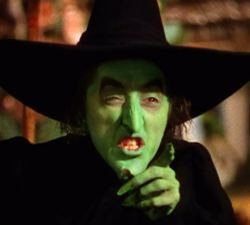
So anti-Thatcher-ites get a song from The Wizard of Oz trending on U.K. pop charts last week, in the wake of the death of former prime minister Margaret Thatcher. “Ding Dong the Witch Is Dead” got all the way to No. 2… and BBC Radio refused to play the song during its usual countdown because it might be perceived as “disrespectful.” Potentially hurt feelings over criticism of a controversial political figure are a good reason to not play a pop song on the radio.
Okay, then.
At exactly the same moment, the BBC is defending the act of hiding one of its journalists and a small film crew among a group of London School of Economics students visiting North Korea, for an installment of TV documentary show Panorama. From the Guardian:
[BBC director general Tony Hall] is understood to have said the documentary would go ahead as there was a clear public interest in reporting on the escalating situation in North Korea.
Hall is also understood to have said that the BBC had considered the risks involved and made sure the students on the trip were able to make an informed decision about the potential danger.
Foreign journalists cannot get visas to enter North Korea but overseas academics and students can.
And from the Evening Standard:
[BBC head of programmes Ceri Thomas] defended the action and said the documentary was a “very, very important piece of public interest journalism”, telling the same programme the access the trip provided – which would not have been given to a journalist – justified putting the lives of the students at risk…
“I would say that the only people we deceived in the making of this film was the North Korean government and we did that because we thought it was a necessary condition to get in to this country which is hidden from view and is absolutely essential to world events at the moment.”
I am of two minds about this. I can understand why people are upset at the thought that they were exposed to extra risk, but I also agree that it’s important that the rest of the world know just what the hell is going on in North Korea.
What I cannot fathom, however, is a media institution as respected as the BBC believing that it’s both acceptable to endanger lives to get a news story and that delicate sensibilities must be protected from a bit of harmless satire.
Serious, Beeb, what the fuck?














My current favorite porn blogger, Jasun Mark, has posted the suggestion of everyone requesting the Boy George song “No Clause 28” for the more direct approach or going sorta sideways and asking for “Everybody Rejoice” from The Wiz.
If “Black Boys on Mopeds” made it into the top 40 this week, I would be okay with that.
Me, too. Or “Iron Lady” by the Ragga Twins.
I find the North Korea incident more problematic, only insofar as, while I admire them for putting themselves at risk, putting other people unwittingly at risk strikes me as journalistically unethical.
As for the “Ding dong” episode, they didn’t refuse to play it, per se. They played a seven seconds of the 51 second recording (I’m guessing the chorus). So the message was sent. Also, and I say this as no fan of Thatcher, the whole thing strikes me as a bunch of people being douchewagons, and I don’t think any broadcaster is under any obligation to facilitate people being douchewagons. Now, if BBC Radio had refused to play any of the myriad anti-Thatcher pop songs of the ’80s in the wake of her death, that would be different. But c’mon. “Ding Dong the Witch Is Dead”? Grow up, people.
Actually, I’ve always hated that song as it puts witches in a bad light. I know several and none of them would want to be associated with Thatcher.
In complete agreement wrt the N Korean episode.
This whole Thatcher thing makes steam come out of my ears. I have very little respect for the woman’s political ideology, but holy fuck these people celebrating her death are arseholes.
It’s not ‘delicate sensibilities’, MaryAnn, it’s about human decency and respect – she was a mother, she had a family. They are grieving. How would these anti-Thatcherites feel about people singing ‘Ding Dong the Witch is Dead’ about the death of their mothers? At least let the family grieve before crowing over her death.
I disagree with you about Thatcher. Sure, she was a mother, but she was also a politician who had a very dramatic impact on the UK, and not for the better for many people. She is not being vilified for the job she did as a mother but as the leader of the country.
Were their mothers public figures?
If those who are praising her to high heavens hold off on deifying her, then sure. But they’re not going to do that. So if her detractors don’t speak up now, those who want to anoint her with sainthood get to set the conversation about her legacy. Which isn’t right and isn’t fair.
It’s the same “debate” we have in the US about when it’s “appropriate” to talk about gun control after a mass shooting. Both sides are having a political conversation… but one side gets accused of politicizing something that shouldn’t be politicized, while the other is free to continue.
All that said, the question here really is: Isn’t it hypocritical for the BBC to be so sensitive in this Thatcher matter while far more risky in the North Korea one? Are people’s lives more worth risking than some hurt feelings?
Does having a parent who is a public figure mean that you have no right to some basic decency from your fellow humans?
I hate the fact that people say ‘oh, s/he’s in the public eye, they deserve what they get’. Politically, criticise her all you want. ‘Ding dong the witch is dead’ is not political criticism. It’s low, personal bullying of someone who’s dead and can’t fight back, and it’s got to be painful for her family.
If her political detractors were being political about it then fine, go ahead. Like I said, I have very little respect for her political ideology. Her detractors have every right to criticise her politics but they aren’t, they’re having parties in Trafalgar Square (and never mind that half the attendees weren’t even born when she was in power). They’re making themselves look like arseholes.
And yeah, I know Margaret Thatcher was a politician who had a very dramatic impact on the UK – I am from here, after all.
I think that “basic decency” isn’t in question here – if a protest group had written an offensive song with explicit lyrics then we would have a clearer issue to deal with. Appropriating a children’s song is a rather “mild” form of protest, and the demographic who listen to the chart show mainly didn’t know what all the fuss about Thatcher was until the BBC were forced to explain it to them. So most of the anti-anti-Thatcher figureheads have only themselves to blame for giving protesters the oxygen of publicity.
What we are dealing with here is protest. Since a decision was taken to have a public funeral, with all state trappings, then public reaction and public protest is justified and appropriate. I think that the proposal for people to turn their backs on the funeral procession is symbolic, measured and extremely disrespectful.
That is perhaps what many people find so difficult to take – a deliberately communicated and targeted disrespect in response to the work and actions of a specific individual in circumstances when celebration of the deceased’s life is the social norm.
I have a lot of sympathy with Isobel’s posts on this subject-the whole ”Witch” thing, and the street parties are just puerile, personalised nastiness, largely indulged in by arse-holes, but I think you have said something equally vaild- all of this could have been avoided,if there had been no arrangements made for a publicly funded, ceremonial funeral. Basically, a lot of people are having to pay for something that they want no part of, without being asked first, and that is almost bound to result in some protest. Many of Thatcher’s staunchest defenders, and admirers were against a state, or ceremonial funeral for her, for this very reason.
However, I also have the uneasy feeling that a precedent is being set by these ”protestors”. How are we going to feel when a group of fun-loving white suppremacists decide to arrange public events celebrating the death of Nelson Mandela, or even organise a Facebook campaign to get ”Zip pe de do dah” into the charts for the week of his funeral? Where will this end?
It always comes down to this: It’s unpopular free speech that needs to be protected, not the popular speech.
Somehow I doubt, however, that absent the almost-state funeral that will happen tomorrow, the protesters wouldn’t be quite so vociferous. I think they would be.
You know, though – I’d have far less problem with measured, symbolic protest – at least it’s actually protesting the problem (as Bob notes, below). It’s the personal, juvenile aspect of the ‘protests’ like the song, and the street parties that wind me up. It’s mainly people who don’t have any understanding of the Thatcher years and their effect on the country taking the opportunity for a bit of group bullying and I just find that it makes my skin crawl.
Fair enough. So you think how the BBC handled the music-chart show was appropriate, then?
I think a lot of people might ask, Where was Thatcher’s basic decency toward her own people?
So here’s a question: How awful does someone have to be before it’s okay to be obnoxious and criticize them after they’ve died?
But the real question I’m trying to get at with this post (and perhaps I did not make myself clear enough) is this: Isn’t it hypocritical of the BBC to be so circumspect in this particular case of not playing a charted song on a music countdown show, and so cavalier in the North Korean-Panorama thing?
I’ll say it again. I have no problem with actual criticism of Margaret Thatcher, and what she did politically. This isn’t that, and it’s not ever appropriate. It’s demeaning for everyone involved.
Are you sure? Doesn’t some of this depend on how it’s reported? When I first heard about it, I assumed things were pretty much as you describe. Then I read a Guardian article that interviewed a number of protesters, and I felt they expressed their views cogently and decently. But I very much doubt that the protests were reported in that manner in other outlets. Ifthere are 50 legitimate protesters and 3 arseholes, the Daily Mail will report about the arseholes only.
I’ll answer this.
As someone who was the child of people who took public stands on things (not well-known outside of their political circles but, at least my father was somewhat influential in his position beyond his immediate circle) AND who was raised in an awareness that because of their public involvements I was potentially under threat, I’d say that the fact that a person is a public figure means that other people get to have an opinion and, no, I don’t think that the ‘public’ owes me anything as regards my grieving process or my blood relationship.
On the other hand, I think parties are stupid. The person is dead, her legacy isn’t.
———-
Edited to add: I also was at a school with a young woman whose father was notorious and, as a former head of a country, far more well-known than mine. I wrestled with this very question. In the end, there is the option of being courteous to the individual, but the courtesy is limited only to actions to and about the child. The parent took actions to put himself in a position where he was responsible and therefore answerable. The child is not entitled to be sheltered from that. Bear that in mind if you ever have political ambitions. Your family is NOT off-limits.
I agree that there is a large arsehole quotient amongst the celebrants. What should not be overlooked however is the blatant attempt to lionise the woman by the current Tory party, which may actually be contributing towards the unrest. I read now that Big Ben will be silenced for the first time since Winston Churchills funeral – I have to say that my first reaction was “Oh FFS, have they no shame!”
Can’t be much worse than the canonization of Saint Ronnie when he finally passed.
I have to admit, I kinda liked the way Saturday Night Live handled it: they did a wonderful little rock mocumentary about an old punk rocker named Ian Rubbish who, back in the early 80s, at the height of his career, for some reason adored Margaret Thatcher, thus pretty much screwing up his career. You just cannot be a punk rocker and like Margaret Thatcher, and this guy was writing her love songs. One minute he was screaming bleeped lyrics about the Queen or how much he hated the cops, the next minute he’d start crooning one of these odd punk rock love songs to Thatcher, his appalled friends and audience looking on in horror. The wonderful look on the other (now aging) punks’ faces when they are interviewed about Ian Rubbish and his courtly love for Margaret Thatcher.
So essentially SNL got to insult Margaret Thatcher, but they did it in a very sweet, funny way.
First of all, it’s not exactly heroic to pick on a dead person. Especially if it’s a dead politician who has been out of power for years and who spent her last few years of life suffering from a disease that few people would wish on their worst enemies. Second, it seems a bit hypocritical to observe such a juvenile reaction to the death of a former world leader after all the criticism Americans received two years ago for their response to the death of Osama Bin Laden. I don’t kid myself that the late Mrs. Thatcher was above criticism, but it does seem a bit rich to imply she deserves less respect than Bin Laden. Third, if Bill O’Reilly or Rush Limbaugh had done the same thing in the wake of an American politician’s death, he would rightfully be called a twit. Fourth, even if she deserves it, it is very hard to insult a dead woman this soon after her passing without looking like a schmuck.
I didn’t say it was heroic, and perhaps those picking on her are schmucks. It would be interesting to debate who did more damage, Thatcher or Bin Laden.
The question is, Is distastefulness in the name of satire or political criticism a bigger issue than pushing boundaries and taking risks in the pursuit of journalism?
And I’m hearing in this thread that it is.
Thatcher.
As for Bin Laden, we did it for him. Remember “The Monsters are coming on Maple street”? or whatever the title of that Twilight Zone episode was.
Plus, she was a freaking public figure. Also, if you don’t respect someone who is alive, it’s B.S. to pretend to do so when they’re dead!
Tonio I don’t often agree with you, but your second point is cogent.
Thank you, Doctor Rocketscience–I think. For what it’ s worth, I thought your posts on the North Korean story were a lot better than my initial reaction to the same story.
It’s interesting that you have to qualify your third argument by specifying US politicians: it is apparently perfectly fine for them to rejoice in the death of a foreign political figure. The tone of obit/eulogy pieces for US politicians bothers me though, as, for instance, I can’t help but feel that an arch bigot like Jesse Helms gets a free pass. Meanwhile, an anti-establishment figure like Malcolm X often found himself portrayed by establishment media like the New York Times as “an extraordinary and twisted man” with a “ruthless and fanatical belief in violence [that]… set him apart from the responsible leaders of the civil rights movement and the overwhelming majority of Negroes” and who “turn[ed] many true gifts to evil purpose” and who “strangely and pitifully wasted” his life, or by Time magazine as “an unashamed demagogue” whose “gospel was hatred.” In short, I just don’t buy it.
Given the fact that my post was inspired by MaryAnn’s remarks about the death of a foreign political figure, I am rather surprised that you made that assumption. Ideally, I would like to see a world where no one rejoices in the death of another. However, my practical side is always going to have more sympathy for those who applaud the death of terrorists and dictators than those who applaud the death of civilians and elected officials.
Eh, i just thought that it was interesting that you would restrict the field to US political figures rather than just saying political figures without qualifying it in any manner. I have to say that, in principle, I agree with you: ideally, no one would ever rejoice in the death of another.
That being said, I have to question the accuracy of your claim regarding what would happen if someone were rejoicing an American political figure’s death. The fact of the matter is that not just guys like Rush Limbaugh, but also the so-called respectable press frequently do act in a manner that I consider extremely unbecoming following the death of an outsider and if they pay a price for behaving this way, it’s so small as to be insignificant. When it’s an insider that dies, well there is this mournful, respectful tone that I find wholly inappropriate if the deceased spent their entire political life being a lying warmongering crook who threw others under the bus when the chicken came home to roost. So instead of being described as “a lying warmongering crook who threw others under the bus when the chicken came home to roost”, they get described as feisty polarizing figures who inspired controversy but were ever respected even by their adversaries as a clever and resourceful political opponent who managed to bounce back from political setbacks. I find this type of sanitization as tasteless as the hatchet jobs that use weasel words and insinuations for character assassination.
I thought about commenting on this but then I read this
article and knew that I had nothing much to add to the conversation.
(http://jewishworldreview.com/0413/steyn041513.php3#.UWzvS8ri5S4)
Few of the best quotes:
“Mrs. Thatcher would have enjoyed all this. Her former speechwriter John O’Sullivan recalls how, some years after leaving office, she arrived to address a small group at an English seaside resort to be greeted by enraged lefties chanting “Thatcher Thatcher Thatcher! Fascist fascist fascist!” She turned to her aide and cooed, “Oh, doesn’t it make you feel nostalgic?””
…..
” Useless as they are, British socialists were at one point capable of writing their own anti-Thatcher singalongs rather than lazily appropriating Judy Garland blockbusters from MGM’s back catalogue. I recall in the late Eighties being at the National Theatre in London and watching the crowd go wild over Adrian Mitchell’s showstopper, “F**k-Off Friday,” a song about union workers getting their redundancy notices at the end of the week, culminating with the lines:
“I can’t wait for
That great day when
F**k-Off Friday
Comes to Number Ten.”
You should have heard the cheers.”
…..
So if someone wrote a new anti-Thatcher song, and it charted, and a pop-music countdown show refused to play the song, would that be a problem?
Nope. Freedom of speech only means that the government can not prosecute you for saying something. It doesn’t entitle you to have media outlets distribute your opinion. As a conservative Political Science student I am used to hearing opinions (and facts for that matter) from my professors that I don’t agree with. But I also understand that everybody has their own ideas about what is and is not acceptable to say. Personally I’m a fan of Thatcher’s.
As far as the BBC’s actions via North Korea, it all depends on the degree to which the students were made to understand the risk that they were put at by the reporters. Then again, whenever anybody goes to a psycho state like the DPRK, they take their own lives into their hands.
I want to ask you a question: If Gloria Steinem died and a group of right wingers played “Ding Dong the witch is dead,” Would you be so sanguine?
Yesterday was a significant public holiday not only in Boston but also in North Korea. No doubt the BBC was aware of that when they decided to go ahead with this provocative act. It’s not beyond the realm of possibility that the Marathon was targeted as an act of retaliation. The BBC needs to relearn the meaning of social responsibility.
Really tempted to delete this as trolling, unless you can support this somehow. North Korean bombers? Seriously?
Would also love to hear you explain how much we should kowtow to those who might threaten us or wish us harm. Is it socially irresponsible for journalists to pursue important stories?
There is so much wrong with this post. I’m just going to say this: even if the Boston attack was the result of N. Koreans retaliating for the BBC’s report (I feel ridiculous just typing that sentence), the BBC would still not be responsible. In fact one of the things that infuriate me about the media is their willingness to reward terrorism by restricting the things they say i.e. refusing to display or satirize the prophet Mohammed the way they do to other religious figures.
I assume that you’re referring to the whole incident with the Danish magazine that did publish Mohamed cartoons all the while the very same magazine, a few months earlier, had refused to print a cartoon satirizing Jesus because it was deemed offensive. Fact of the matter is that there is plenty written and said about Islam in the media that is offensive to Muslims. Even if your claim were accurate, not saying something that is offensive to Muslims is hardly the same thing as rewarding terrorism: it’s about as much a reward as not getting told “fuck you” by someone.
It seems obvious to me that the BBC will be more sensitive to the criticism about its treatment of the Conservative party than almost any other issue, because they are the ones with the power and the motivation to destroy the BBC. North Korea, on the other hand, merely have the power and motivation to destroy the world.
I’d say you’re likely wrong on both counts. Evidently the mood in South Korea is one of eyerolling, since they’re pretty sure the North has no real desire to start a war they’d very quickly lose.
Exactly. As juvenile as I think this protest is, censoring it is an even more inappropriate reaction. It’s even more complicated because the BBC is a publicly funded entity, supported at least in part by what amounts to a tax. Such an entity ought to be subject to even more stringent rules and pressure to protect speech. But I don’t really know exactly what kind of legal protections for free speech exist in the UK. It seems that they are not so comprehensive as they are in the US, from this casual observer’s point of view on the other side of the pond.
I’m not seeing this as censorship. Do you really think anyone actually wanted to listen to the entire recording of “Ding Dong” on the radio? I doubt it. What they wanted was to get the song – entirely for its title – onto the charts, and to have that acknowledged. That’s exactly what they got. In fact, they got it all the way to number 2. They even got BBC Radio to actually play the chorus of the song. Ha ha, very cute, mission accomplished, there, children, are you happy now?
Maybe there was some consideration about “delicate sensibilities” – or maybe, as Isobel is saying, normal human sensibilities – but I think mostly the decision on only play a clip stemmed from the impression that the whole thing is fucking stupid and childish. I mean, all those iconic British bands in the ’80s produced all those anti-Thatcher songs, and these people want “Ding Dong the Witch is Dead”, and they still have the nerve to cry censorship when only a snippet of the song is played? Please.
A re-release of ”Shipbuiding” would have been an appropriate and measured response to the almost state funeral, and would have balanced out the eulogies better-and I supported the military action in the Falklands, and still do. There was a price, though, in both British and Argentinian lives.
You’re right-there isn’t really any comprehensive protection for free speech in the UK. We have no written constitution. There is the Human Rights Act, but most of the rights that it supposedly makes legally enforceable are extensively qualified by nebulous concepts like” proportianalit”y, rendering much of it difficult to rely on. Many, if not most, of the BBC’s decisions in areas such as this seem to be almost completely arbitrary, and made by people with no accountability to the poor saps who pay their wages, via the licence fee. However, every time I get too annoyed with the BBC, I just take a look at the dire state of commercial TV, and that reminds me that, whatever their faults, they are the only game in town when it comes to decent programme making.
I would have openly and spontaneously rejoiced and burst into song if Thatcher’s legacy had died instead.
Malcolm X died in 1965. Jesse Helms died in 2008. Perhaps journalists’ attitudes changed over four decades.
I don’t think that it’s journalistic practices that changed in the intervening years so much as the general (white) public’s perception of Malcolm X: if the perception had stayed the same as in 1965, the reports I quoted would look pretty neutral, like reporting that the sky is blue or that 2 and 2 make 4. Simply put, such writings would seem even-handed -and probably did so to the authors who probably cobbled something together based on loose bits of predigested information- because it was an oft repeated trope. For more current data, take a look at the reporting following the death of Hugo Chavez – though I grant you that he’s not an American political figure per se.
http://fair.org/take-action/media-advisories/in-death-as-in-life-chavez-target-of-media-scorn/
http://www.fair.org/blog/2013/03/08/nyt-debates-hugo-chavez-minus-the-debate/