Where Are the Women? Charlie’s Country

Where Are the Women? Charlies Country

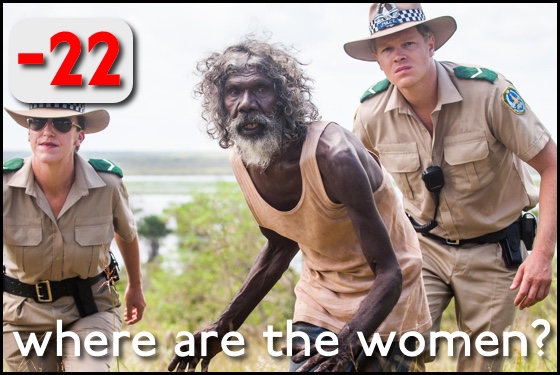
A perfect illustration of how men’s stories are intended to be universally applicable to all people, even as they ignore the unique challenges women face.

BASIC REPRESENTATION SCORE: 0

[no significant representation of girls/women]

FEMALE AGENCY/POWER/AUTHORITY SCORE: +6

+1
Is there a female character with insignificant screen time in a position of authority? [why this matters]
+1
More than one? [why this matters]
+2
Is there a woman whose role could easily have been played by a man? [why this matters]
+2
More than one? [why this matters]

THE MALE GAZE SCORE: 0

[no issues]

GENDER/SEXUALITY SCORE: -15

-5
Is there a female character who is primarily defined by her emotional and/or sexual relationship with a man or men? [why this matters]
-10
Does a man police or attempt to police a woman’s sexual agency? [why this matters]

WILDCARD SCORE: -13

Is there anything either positive or negative in the film’s representation of women not already accounted for here? (points will vary)

-5
The only Aboriginal woman with any significance in the film — and only a small one, at that — is present solely for the negative impact she has on the male protagonist’s life. (She is banned from buying booze, and he gets in trouble for buying some for her.)
-3
The only women in any positions of authority here are white, in the white culture (a cop and a lawyer, who appear only very briefly). While this wouldn’t normally be a problem when it comes to the representation women overall (though of course it is problem regarding the representation of women of color), it is notable — in a negative way — given that this film is about the impact of white culture on Aboriginal peoples. There are women of authority and influence in at least some Aboriginal cultures (such as healers), but there is not even the whiff of an indication of that here.
-5
It is hinted that the male protagonist has turned a corner toward a potentially happier life by deciding to teach traditional Aboriginal dance to youngsters. All of the youngsters are male. Perhaps it’s the case that dance is segregated by gender in this culture… but his turnaround could have been indicated by a decision to pass on something that both girls and boys could take advantage of.

TOTAL SCORE: -22

IS THE FILM’S DIRECTOR FEMALE? No (does not impact scoring)

IS THE FILM’S SCREENWRITER FEMALE? No (does not impact scoring)

BOTTOM LINE: This film is a perfect illustration of how men’s stories are intended to be universally applicable to all people, even as they ignore the unique challenges women face. Charlie’s personal journey is meant to be illustrative of how white European culture has damaged Aboriginal societies. But it fails to even hint at the extra impact that colonialism has had on Aboriginal women (such as astronomical levels of physical and sexual abuse they suffer at the hands of Aboriginal men, driven by poverty, unemployment, alcoholism, and cultural displacement). So this film cannot hope to be as universal as it would like to think it is.

Click here for the ongoing ranking of 2015’s films for female representation.

NOTE: This is not a “review” of Charlie’s Country! It is simply an examination of how well or how poorly it represents women. (A movie that represents women well can still be a terrible film; a movie that represents women poorly can still be a great film.) Read my review of Charlie’s Country.

See the full rating criteria. (Criteria that do not apply to this film have been deleted in this rating for maximum readability.)


This rating is brought to you without paywall restrictions by my generous Kickstarter supporters. If you missed out on the Kickstarter and would like to support this project, you may:

become a monthly or yearly subscriber of FlickFilospher.com
make a pledge at Patreon
• make a donation via Paypal

share and enjoy
               
If you haven’t commented here before, your first comment will be held for MaryAnn’s approval. This is an anti-spam, anti-troll, anti-abuse measure. If your comment is not spam, trollish, or abusive, it will be approved, and all your future comments will post immediately. (Further comments may still be deleted if spammy, trollish, or abusive, and continued such behavior will get your account deleted and banned.)
If you’re logged in here to comment via Facebook and you’re having problems, please see this post.
PLEASE NOTE: The many many Disqus comments that were missing have mostly been restored! I continue to work with Disqus to resolve the lingering issues and will update you asap.
subscribe
notify of
4 Comments
oldest
newest most voted
Inline Feedbacks
view all comments
bronxbee
bronxbee
Fri, Jun 05, 2015 6:21pm

shouldn’t the “no significant representation of women” get a -25 all on its own to start with.

MaryAnn Johanson
reply to  bronxbee
Fri, Jun 05, 2015 7:01pm

I’m trying to be fair to movies that legitimately take place in all-male environments. They may be rare, but they do exist.

David C-D
David C-D
reply to  MaryAnn Johanson
Fri, Jun 05, 2015 11:52pm

In what sense is this an “all-male” environment? Is Charlie just the only significant character in the film? Or does the cultural environment limit his interactions to men somehow?

MaryAnn Johanson
reply to  David C-D
Sat, Jun 06, 2015 7:58am

This isn’t an all-male environment. I was explaining why “no significant representation of women” doesn’t get negative points on its own. bronxbee was suggesting that I should have deducted more points from this film. Maybe she’s right… but this is how the criteria have been operating so far. I can’t change it now.