
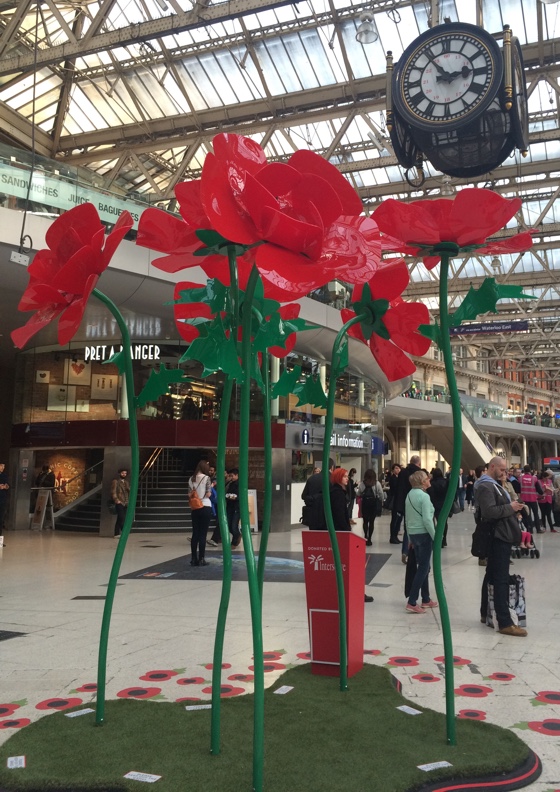
This weekend is Remembrance Sunday in the U.K. — basically the equivalent of Veterans Day in the U.S. — which generally means poppies, poppies, poppies everywhere. Typically paper or cloisonné ones on people’s lapels. I’ve never any like these enormous ones at Waterloo Station before.
From above:
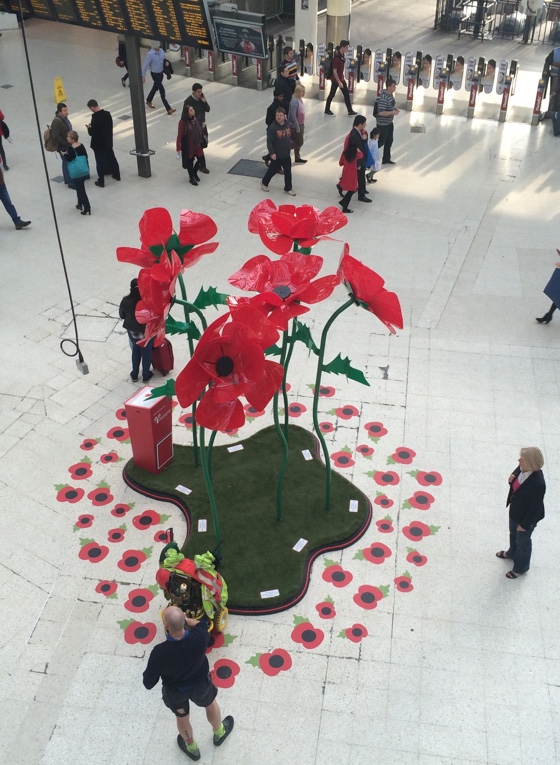
I think they’re pretty cool…














sort of like the ones that were around the Tower last year.
Except way bigger. And made of some sort of plastic, I think.
They’re beautiful. It would be nice if they could stay there.
It occurred to me that in Britain they mean a lot, and nobody would question their significance, whereas in America you just don’t see poppies any more. When I was a kid they were around, people planted them in their gardens (at least down here) just like any other flower. You hardly even see single flowers any more, like zinnias or daffodils, unless they’re in landscaping. Too bad.
When I was a kid, I’d see them sold at cash registers and by VFW people at shopping centers and train stations. Now? Hard to find. Veterans’ Day is Wednesday, I doubt I’ll see any and I work across from Penn Station. If I were to find someone selling them, I would think it would be here, ya know?
about a week before Veteran’s Day (which i used to get off from school and work, but not anymore. like columbus day, election day and two presidential holidays….) there used to be gentlemen from the VFW and other veterans’ groups selling paper poppies on every street corner. i don’t see them anymore. maybe vietnam and first gulf war vets don’t ascribe to the poppy symbolism.
There still is something with the Buddy Poppies, but it seems to not be as distributed as it was before.
I don’t ever remember poppies for sale in the US.
When I was little in San Francisco (lots of guys coming back from Vietnam got off the ship there and never got any further than the Mission District), my mother would always get me a poppy to wear on my navy blue wool coat from a vet on Market Street. She put one on her camel hair coat’s lapel. The rest of the year, he sold pencils.
they may have been an urban density thing… we have lots of VFW posts all over the city (or we did) and it might have been less prevalent on LI but it was every street corner here. and, of course, you are very young.
Lololololol
I wonder if the poppies’ endurance as a symbol has to do with how much more devastating an impact WWI had on the UK compared to the US. The war had been going on for years and had already destroyed an entire generation in the UK before the US even joined in the fighting. The UK lost around 2 percent of its population to all war deaths, but the US lost only 0.13 percent (according to Wikipedia). Percentages were even higher on the Continent, of course.
Sounds very likely.
Here in the U.S., most people usually associate poppies with either The Wizard of Oz or the Beatles song “Penny Lane.” Unless they’re very educated — in which case they probably think of The Wizard of Oz or “Penny Lane” first but they’ll also think about opium as well.
It says something about how rarely other associations are brought up on this side of the Atlantic that despite all the British films and TV shows I’ve seen and all the British writers I’ve read, this is the first mention I’ve come across about poppies being associated with Remembrance Sunday. Then again Remembrance Sunday is rarely mentioned in much of the British stories I’ve read or the British movies or TV shows I’ve seen.
Remembrance Day and poppies in the lapel were in an episode of Doctor Who…
D’oh! I must have blanked out during that particular episode.
Mea culpa.
well, not everyone is as weirdly obsessive aboutDW as me — and the mix with the WWI references (Family of Blood) makes it even more memorable for me. also, the “poppy” poem wasn’t recited in that episode, it was a poem called “For the Fallen” by Laurence Binyon.
I grow poppies in my garden. I love them.
I’ve never heard of them being used as a symbol of war remembrance in America, and only just learned about it last year in the U.K. Why do they use them? I suppose I could look it up.
because during the battles in the first world war, the only thing that sprung up in the bombed out gassed fields were poppies… and a canadian physician, Lt. Col. John Macrae wrote a poem about it…
In Flanders fields the poppies grow
Between the crosses, row on row,
That mark our place; and in the sky
The larks, still bravely singing, fly
Scarce heard amid the guns below.
We are the Dead. Short days ago
We lived, felt dawn, saw sunset glow,
Loved and were loved, and now we lie
In Flanders fields.
Take up our quarrel with the foe:
To you from failing hands we throw
The torch; be yours to hold it high.
If ye break faith with us who die
We shall not sleep, though poppies grow
In Flanders fields.
some people think it is a peace poem, but that’s because they don’t read all the way through. it was written very early in the war, like 1915 or so, and was used as propaganda. macrae used the poppies, which had also been noted as growing over war fields even during the napoleonic wars. and certainly when i was a kid, here in the US, anyone who had grandparents (as i did) who fought in the first war, knew poppies were a symbol of the war dead. it may not be as well known here in the US any longer — but certainly in the British Commonwealth and in France they are still a very potent symbol. you should look up the poppy display that was at the Tower last year (100th anniversary of the Great War) http://www.npr.org/2014/08/16/340649115/a-sea-of-ceramic-poppies-honors-britains-wwi-dead.
sorry to have gone on so long — it’s a topic very close to my interests.
oh, and additionally, it was a woman US professor at Columbia University who first thought of using the poppies as a symbol of the war dead. so at one time, the poem and the notion of the poppies was once very well known here.
as a matter of interest, the American Legion Poppy program is still in effect and seems to be alive and well in the US: http://emblem.legion.org/Poppy-Program/products/746/
I’ve seen that. And that, too, is why it surprises me that I don’t find paper poppies next to cash registers in neighborhood stores.