
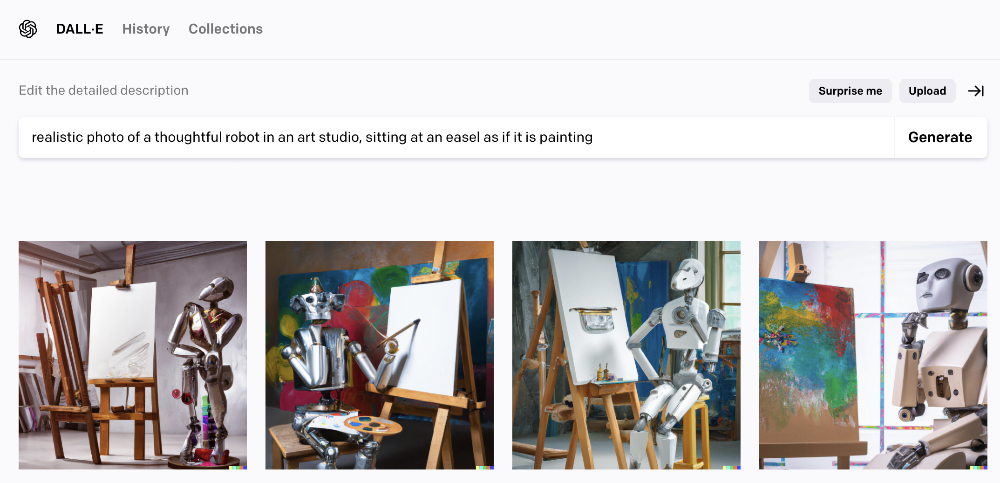
AI, or artificial intelligence, as it exists — to the degree that it does — at the moment is not making a very good argument for itself. It’s being used to create deepfake porn to abuse and harass real women. AI-fueled image generators such as Midjourney and DALL-E have been accused of copyright infringement, because they are trained on the work of human artists. (I used DALL-E to make the images above, with some trepidation, because I do not wish to infringe upon the efforts of creative humans.) With AI text generators now coming online, I’m pretty sure that my own work — the thousands of film reviews at this very site — are getting digested as examples of essays written by a human being.
But let’s brainstorm a better future for us meatbags as well as the AIs:
What are some positive, definitely not evil, hopefully helpful and creative uses for AI?
Go as far-off sci-fi pie-in-the-sky as you want, or stick to near-term plausibility if you prefer. But give us reasons to be optimistic…
(You can also discuss this at Substack or Patreon, if you prefer. You don’t need to be a paying subscriber to comment, but you will need to register with either site to do so.)














What’s currently being sold as “AI” is just reshuffle of existing material. I’ve joked often enough about the “Script-o-Matic 3000”; I’d like to see this used to take over the soul-killing grind of writing, directing, acting in, the generic films for which the public seems to have an endless appetite, to free up the humans to do something that needs actual creativity. But these days I find it very difficult to be optimistic.
I read an interesting argument the other day, about how our expectations for the quality of AI-generated works are unrealistic. Like, if we criticize AI for producing a mediocre poem or a mediocre script — the same is true of most poems and scripts written by humans. If humans are already producing the generic films you dislike, what makes you think those people will suddenly be able to create higher-caliber work when AI takes over making generic films? All those mediocre people would just lose their jobs — they may not have been the most talented, but they DID have mouths to feed. :-/
I’m going to push back on the question and say that inventing optimistic fantasy reasons to embrace this technology, despite all those present, tangible, real-world harms you sketched out, is playing into the hands of the companies that have foisted it upon us without conceiving or demonstrating actual, valid utility beyond vague gestures at these unrealized imaginary futures. A solution in search of a problem, built “because we can”—can fire up investors and make loads of money off it in the short term, and hype it until everyone believes the thinking, feeling robots have finally arrived to serve and comfort and delight us. It’s the move fast and break things approach, and the thing that’s being broken is people’s already tenuous hold on the difference between fact and fabrication, the livelihoods and cultural context of artists, and the corpus of the whole messy, spammy, but human-authored internet that is already beginning to be replaced by the “blurry jpeg” of itself.
I’m afraid I don’t like the posture of “well it’s here, so let’s find out how to make the best use of it.” Now is a time to call out the fantasies for what they are, draw attention to the harms, and set cultural boundaries about what we will tolerate and invite into our lives and practice and communities. Resist, in other words. Games actually did this pretty successfully when every company with dollar signs (or cryptocurrency symbols) in their eyes started trying to slip NFTs and related bullshit into their games to make them worse and more profitable, and players and developers and communities made a stink and shouted them down so decisively that the plans were quietly scrapped and mostly no one tries it any more.
Sorry if that doesn’t answer the prompt! But I think that that act of resistance, at this juncture, is actually more optimistic than just accepting that these tools are here to stay so we may as well find something to like about them.
It reminds me of a focus group I once participated in for a smart TV that had apps and a browser and Twitter so you could livetweet shows and all that. At one point I basically said “I just don’t want any of that stuff. Tv is a solitary, immersive experience for me, not a social one, and I don’t want a tv that’s a computer.” The exasperated researchers running the group kind of rolled their eyes and said, “Ok, but say you *had* to have a tv like that, what features would you want?”
I say no! I don’t want a smart tv, and I don’t want AIs making my art and writing my news and lulling me into complacency by auto completing strings of words or pixels into something that resembles plausible meaning until I can’t tell the difference. Let’s draw some lines and envision the future we actually want, not the one we’re being told to have. Up with humans! Down with bullshit! Ars gratia artis! Who’s with me?✊🏻
First off, have you all been following the saga of Microsoft’s Bing (a.k.a. Sydney)? It’s WILD. Latest updates here:
https://wapo.st/3ICMizz
https://apnews.com/article/technology-science-microsoft-corp-business-software-fb49e5d625bf37be0527e5173116bef3
I’m not sure which is more disturbing: the likelihood that the new chatbot technology is very good at sounding like an unhinged person, or the possibility that it actually IS sentient and unhinged.
I’m having trouble thinking of good uses to which it CAN be put. At best, I think it should only be used for initial drafts — of art, of writing, of analysis, etc — with the requirement that it should always be indicated when AI is used, and that the work generated should go through a couple of levels of human scrutiny and intentionality before it’s released to the public.
They’re talking now about having AI teachers and AI doctors for people who can’t afford otherwise, which sounds like all kinds of horrible, for many different reasons.
Sorry, I’m not answering the question right.
It is already used in positive ways, such as
language translationImage recognition is used to recognize weeds so that herbicides can be applied directly where needed rather than spraying the whole field.Improving weather prediction and climate models