
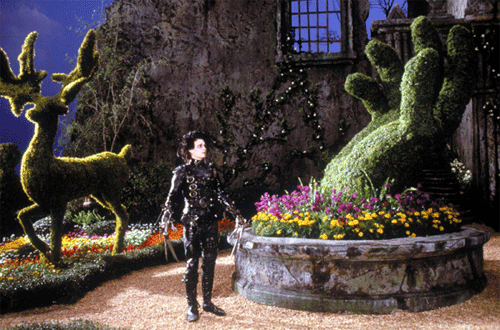
The Museum of Modern Art in New York City will be presenting a major retrospective on the artistry of Tim Burton, starting in November and running through April 2010. The show will feature:
Hundreds of Artworks Never Before Exhibited Illuminate the Creative Vision Behind The Nightmare Before Christmas, Beetlejuice, Batman, Edward Scissorhands, Charlie and the Chocolate Factory, and Sweeney Todd, Among Numerous Other Artistic Projects
It sounds very exciting:
The Museum of Modern Art will present a major exhibition exploring the full scale of renowned filmmaker Tim Burton’s career, both as a director and concept artist for live-action and animated films, and as an artist, illustrator, photographer, and writer…. Tracing the current of Burton’s visual imagination—from his earliest childhood drawings through his mature work in film—the exhibition Tim Burton will bring together over 700 examples of rarely or never-before-seen drawings, paintings, storyboards, moving-image works, puppets, maquettes, costumes, and cinematic ephemera, and includes an extensive film series spanning Burton’s 27-year career. The exhibition explores how Burton has taken inspiration from sources in pop culture and reinvented Hollywood genre filmmaking as an expression of personal vision, garnering him an international audience of fans and influencing a generation of young artists working in film, video, and graphics.
I think I’m gonna have to check this out.
Besides Burton, what other filmmakers have transcended cinema so that their work deserves to be shown alongside paintings and sculptures? What filmmakers’ work belongs in art museums?
(If you have a suggestion for a QOTD, feel free to email me.)














Terry Gilliam.
But seriously though, when it comes to an influential visual style that is immediatley recognizable to even those who don’t LOVE films, no else can compare to Burton.
He’s a born artist. But the fact that he’s not the best story-teller limits his ability as a filmmaker.
Wes Anderson!
Guillermo Del Toro. Ridley Scott.
Alejandro Jodorowsky, Stanley Kubrick, Fritz Lang, Chuck Jones, Michelangelo Antonioni, Akira Kurosawa, Ray Harryhausen . . . to name a few.
Yes, I know Harryhausen wasn’t the director of most of his films, but nobody said we had to limit our thinking to directors.
If we’re not limited to directors, then I nominate special effects wizard Stan Winston, whose craftsmanship is on view in the Terminator films, the Alien films, Jurassic Park, Iron Man — and Edward Scissorhands.
I actually saw one of the Iron Man suits in an exhibition at the Met Museum, on superhero-inspired fashion. Also on view were the costumes from Chris Reeve’s Superman, Spiderman, The Dark Knight, and Wonder Woman. Quite a trip.
douglas trumbull (http://en.wikipedia.org/wiki/Douglas_Trumbull)
john dykstra (http://en.wikipedia.org/wiki/John_Dykstra)
george pal (http://en.wikipedia.org/wiki/George_Pal)
ub iwerks (http://en.wikipedia.org/wiki/Ub_Iwerks)
max and dave fleischer (http://en.wikipedia.org/wiki/Fleischer_Studios)
that’s just the tip of the iceberg.
Hayao Miyazaki for the win!
But isn’t the purpose of a museum to show art that the public wouldn’t otherwise see, and to preserve art that capitalism doesn’t keep in circulation?
What is the point of going to a museum to see the still frames of an art form that is supposed to be seen in motion and can be rented at Blockbuster?
The original 3 Star Wars movies? Not that they’re particularly artistic, but the museum experts could lovingly restore them to their original condition and the velvet ropes could keep Lucas from replacing Yoda with a streetwise 2-headed rapping fruit.
@Paul:
Seems the Burton exhibition would include not just still frames from the films but also “rarely or never-before-seen drawings, paintings, storyboards, moving-image works, puppets, maquettes, costumes, and cinematic ephemera.” I imagine that any worthwhile exhibition on any of the other suggested filmmakers would do the same.
I think another purpose of a museum is to offer us new ways of thinking about art — even art we think we’re familiar with — and help us form interesting connections and insights we might not otherwise have done. An exhibition about the process behind a filmmaker’s vision fulfills that purpose, I think.
Fritz Lang.
And maybe F.W. Murnau.
I’d recommend Jan Svankmajer and Tarsem Singh. Although with Tarsem, people might mistake it for a normal art gallery, since he takes so much from actual painters like Giger and Nerdrum.
Godfrey Reggio and Ron Fricke are also good candidates for such an exhibit. They worked together on that influential classic of meditative time-lapse cinematography, Koyaanisqatsi.
Many observers have been less impressed by Reggio’s subsequent creative choices in the next two films in his “Qatsi Trilogy,” Powaqqatsi in 1988 and Naqoyqatsi in 2002.
However, anyone who has been deprived of seeing the luminous masterwork Fricke released in 1992, Baraka, is now living in a significantly impoverished version of a modern life.