
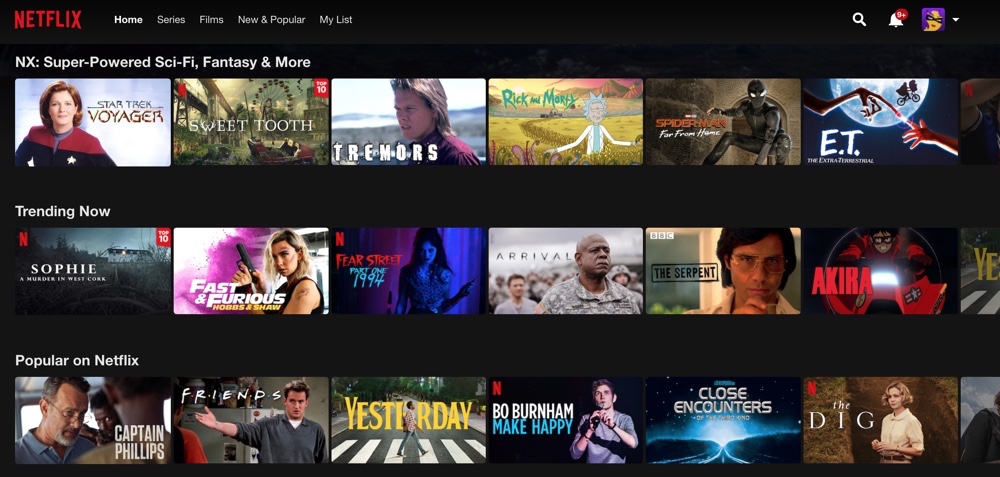
The ubiquity of streaming and the explosive growth of our entertainment options were already fracturing the pop-culture zeitgeist before the COVID-19 pandemic struck, and now it seems as if there is little distinction between movies and other forms of entertainment like TV shows. (We’re gonna have to start calling those something else soon. Back to “serials,” again, maybe?)
Do movies still stand apart? What does it mean for something to be a movie these days? Has what movies mean changed for you in recent years? What are movies for anymore?
(I’m reviving my “questions” posts — just on a weekend basis — as an experiment, to see if there’s any interest in them. I’m also posting these as free posts at Substack or Patreon. You don’t need to be a paying subscriber at either service if you’d prefer to comment at either of them, but you will need to register with either site to comment.)














For me what is distinctively important about a film/movie is that it’s a format, a stand-alone story in a 90+-minute package not designed to be interrupted by dancing rabbits selling you soap every ten minutes. Whether I watch it in an over-loud smelly cinema, or on my big screen at home, or on my laptop or my phone, is a matter of incidental detail.
I realise that many people (including many filmmakers!) would disagree with that. And certainly I won’t appreciate the stunning cinematography as much on a small screen… but a film shouldn’t rely on that to get my attention. Give me stories about people, at least some of whom are at least somewhat sympathetic, whose problems arise from who they are and the decisions they’ve already made, and whose solutions do too.
Explosions are also welcome.
I’ll watch other formats too, obviously: 42-minute 22-ish-episode-season commercial television (with the advertisements cropped out, obviously) can work pretty well (though even that changes emphasis based on whether you’re expected to watch an episode a week or binge them all in a weekend). But the shapes of story that work in a particular medium are determined in part by that medium.
You’ve pretty much summed it up for me; I agree with everything you said.
I’ve often thought about what I’m missing by watching blockbuster action films on my15-year-old 19″ antenna TV. I’m pretty sure that if I had seen, for instance, Avengers: End Game in a theater, I’d appreciate a lot of, let’s call it nuance, that you couldn’t catch on a small screen.But the fact is that I enjoy them (or not) as much as I would in a theater, given that a movie is telling a story and if it accomplishes that well, I’m satisfied. I would probably enjoy the experience of being in a theater – the smell of the popcorn has a lot to do with that, as does being with an audience – but the fact is that I stopped going a long time ago because of the prices. It takes something extra special to get me in a theater, like The Lord of the Rings trilogy (and, yes The Hobbit trilogy, in your eye naysayers).
Now, having said that I am personally satisfied watching at home, does that mean that moviemakers should assume that their efforts are wasted making the blockbuster blow-stuff-up movies, and downsize, for instance to save money? Don’t think so. I love that stuff, and it’s still good on a small screen. There’s your conundrum. Besides, hardly anybody still has a 19″ antenna TV. Sometime soon I’ll go out to my friend Sandie’s house when she has a Lord of the Rings marathon on her great big honkin’ smart TV. As big as these things have already gotten, for some people who can afford them, there isn’t enough difference from a theater. You can make your own popcorn and invite your friends for an audience.
I agree with RogerBW’s comment. “Movies” are a format, and art is often at least partly shaped by the technology that makes it possible at the time. In music, there are historical and technical reasons why pop songs usually clock in at 3 minutes, why albums are the length they are, why music production (and corresponding audience expectations) sounds different across the decades, and why the digitization of music (CDs and now streaming) is once again changing the way music is conceived, made, marketed, and heard. Likewise, movies are around 2 hours on average for technical reasons, and were originally projected on big screens for large audiences because (I’m assuming) that was really the only way to get them out to the public and make a profit. There are other options now, and what matters is less the format than the narrative. Recorded music will survive and be enjoyed whether it’s on an EP, LP, CD, or Spotify; and narrative art will survive and evolve with whatever format allows people to enjoy it.
I’ll say this, though: whatever the technical and commercial reasons that gave rise to “movies” as we know them, what we did get was an art form that we inevitably experienced communally before we had options to experience it alone. Sometimes that matters. Watching a raucous comedy, or a terrifying thriller, or a big sweeping musical like In the Heights, or a cathartic conclusion to an action epic like Avengers: Endgame, is a very different experience when you watch it alone on your phone or in a theater with the buzzing energy of dozens or hundreds of people feeding into, and amplifying, your own response. That’s something I’ll always value in theatrical screenings (even as I increasingly watch narratives on my desktop at home).
…I just had a thought—that the popularity of YouTube “reaction videos,” as well as video compilations OF these reaction videos, is likely due to people wanting to recapture that communal experience. We WANT to know how other people reacted to what we’re watching.
This will almost entirely fail to answer the question, but a few generations back, people could spend most of the day at the movies. They’d watch a cartoon, an episode of a serial, a newsreel, and then the film. With streaming video, it would be possible to do that again, although the newsreel might take a little more effort to recreate.
You can just switch over to CNN for a bit to get the newsreel…
About two years before the pandemic, I started exclusively going to the movies at Alamo Drafthouse (I figure, when you have a choice between a company that actually cares about movies and their presentation and ones that don’t, why ever choose the latter?)
I’ve seen a number of screenings of older movies that I’ve seen many, many times on home video, but not in a theater since their initial release (if I was even alive for that.) I saw A Fistful of Dollars shortly before the pandemic, and Indiana Jones and the Last Crusade.
Leone’s movie came alive for me like it never had before. I had possibly only ever seen it in full on poor quality pan-and-scanned TV versions, but watching it on a big scrreen that fills up your entire field of view, you really get pulled into the movie more, and can see what all the fuss was about.
Indy 3 wasn’t quite as revelatory, but it did strike me how jam-packed with STUFF this movie is, and how skillfully Spielberg keeps it moving. And a lack of distractions keeps you focused on the movie itself and able to notice little details better. It was also fun to see it with an audience (many of whom were kids possibly seeing it for the first time).
Anyway, I’ve become a bigger fan of big-screen moviegoing, especially when you’re going to a place where you can have a beer or two and not have to worry about talkers or people on their phones….
I broadly agree with what many of you have said here, that a “movie” is a discrete, standalone story. The problem with that is, however, that with so many franchises in play now, that is being challenged. Is the MCU a bunch of standalone movies? Is Fast & Furious? Arguably, these are series in the same way that much of what we see on TV is, only with longer episodes.
Of course, there are many truly standalone movies. But those mostly are not the ones that make big box office. In many cases, those are the movies that either head straight to streaming now, or get most of their viewers on streaming after brief theatrical releases.
Well, a “novel” can be a standalone story or part of a longer series. If it’s the latter, it’s still called a novel. What makes it a novel isn’t whether its story is standalone or not, but its format—printed text that runs to a certain length.
Movies are visual narratives of a certain length… that, until recently, were of necessity screened for large audiences in theaters. I guess now they can be narratives of a certain length that can play in several ways, including on TV networks and streaming services.
…But the more I think about it, the more it seems to me that even the length requirement is being challenged by things that are supposedly “episodes” and not “movies.” The K-drama series Crash Landing on You, on Netflix, has LONG episodes with runtimes from 71 minutes all the way up to 112 minutes. The show is essentially a series of sixteen movies. So, episodes can be movies… and, with film franchises, movies can be episodes? I see your point. :-)
The MCU has many movies that CAN be standalone, but with connective narrative tissue, as well as some “mega-movies” that tie a bunch of storylines and characters together. The character-introduction movies can be standalone entry points; other MCU films are clearly for those who’ve been following the overarching story. The same is true of the comics: some titles allow you to enjoy the standalone adventures of a single character or group of characters, while others can be frustrating to read if you haven’t kept up with 15 other titles and decades of backstory. They’re all still called “comic books,” though.
Maybe the real question here is whether movies—or visual narratives, or whatever you want to call them—are increasingly catering to audiences who invest more time in multi-film stories, and even priming audiences to invest time. The MCU wouldn’t work if they hadn’t interested enough people to have an emotional investment in their multi-story arc beyond the standalone entry points. And maybe this is something that carries over from books as well: LOTR, Harry Potter, Hunger Games, and Twilight were hugely successful book series that conditioned a critical mass of readers to expect sprawling sagas spread out over many novels—and therefore over many movies when the books were adapted. And so, here we are.
Given that there exist novel series that you really shouldn’t get into at book 5, and film series the same, I think it’s fair to stay that this is a different storytelling mode that has a physical format in common.
Generally writers make some effort to leave the new entrant not completely lost – after all if someone’s offering you their money you don’t say “go away and read book one instead” – but I’d certainly argue that starting The Lord of the Rings (book or film) with The Two Towers would not be to experience it as it was intended.
(Of course like anything involving life it will defy easy categorisation.)
True. This isn’t a new thing, of course. If I understand MAJ’s question to be, “should serialized storytelling still be called ‘movies’?,” I’d ask: Should Godfather II and III be considered movies? Part III especially can’t exist without the first two, but even Part II relies heavily on Brando’s shadow and what the audience already knows about the characters from the original film. I definitely consider all three of them MOVIES, though.
But maybe I’m stuck on the terminology part of the question. If the question is really, “Is there any space for standalone stories in today’s franchise-stuffed environment,” I guess that’s a different discussion?
There, I’d argue that there is, but not if your production company is run by accountants who care only about maximising financial return.
Film in particular, in part because it’s so vilely expensive, has to be driven that way; one of the reasons television has simply been more interesting for the last couple of decades is that if you’re making a TV programme you aren’t as likely to have the studio on your back. There’s only room for a few profitable big films in a year; there’s room for lots of TV. (And lots of moderately profitable films, but no accountant will fund those when they can go for something that should pay off well instead.)
As I understand it, sequels and tie-ins and so on happen in large part because the financial model rates a known name as a big positive value. Doesn’t really matter whether the film has anything to do with the name, as long as the suckers pay their money…
Oh, I wasn’t even asking that. I wasn’t thinking about semantics at all. I was thinking about whether there is any pop culture now that has the potential to influence the larger zeitgeist in ways that movies used to. Like, everyone knows what “Use the Force” means even if they’ve never seen a single Star Wars movie. Everyone knows (or used to know) what “Of all the gin joints” means and what flying monkeys represent. (Even Steve Rogers got that reference!) If you “dun-nha-DUN-NHA,” everyone recognizes the Jaws music, but more importantly, everyone understands what it means: something dangerous is sneaking up on you.
Movies were a kind of mythology that we all recognized even if we weren’t particularly movie fans.
On the other hand, everyone used to know “Where’s the beef?” and “I’d like to teach the world to sing…” too. So it’s not just movies that have ceased to have a universal feel to them.
I also was not suggesting that no one should make movie series! Movie series have been with us since the beginning of movies, not just the chapter serials — which were more like what TV became — but, say, the Thin Man movies.
This is a huge issue, and I was curious to see what sort of conversation it would prompt (hence the rather vague wording of the question). It just seems to me as if the way we — as individuals and and a culture — consume and interact with movies has changed dramatically in recent years. Maybe it doesn’t mean anything. But it’s definitely happening.
Ah, I see. Yes, I agree that movies aren’t the universal mythology they used to be (though the films that come closest today are probably the big superhero films, our modern myths—think of how ubiquitous the “Wakanda Forever” gesture was at one point, and all the YouTube videos of international theatrical audiences reacting to Endgame).
I think this is just a facet of the larger phenomenon of cultural fragmentation; we aren’t all watching the same news programs, reading the same books, going to the same shows. Of course this is bad for “national cohesion” (whatever that means) in ways that have been much written about. But in some ways this is also a good thing: the era of universal mythologies also tended to be the era of universally white/cis/Christian mythologies, and there seems to be a little more space today for other narratives (that don’t always need to be pitched to the broadest possible audience, risking dilution, appropriation, etc). But yeah, this is a huge and complicated subject.
Pop music still seems to be a powerful influence. You KNOW about Tupac and Beyoncé and Adele and Taylor Swift and BTS, whether you’re a fan or not. You know all the “songs of the summer” that become inescapable for a time, the controversies that Lil Nas X stirs up, etc. That should count for something, no?
Yes, that’s certainly true. But we could (maybe?) have made space for other narratives while also letting those narratives loom large. I’m not sure they do now: that fragmentation means those narratives are often preaching to a choir, so to speak.
Actually, I don’t know who/what BTS is, and while I’ve heard of Lil Nas X, I can’t bring to mind any controversies.
I think there’s a balance to be struck. Certainly it would be good for more diverse stories (and songs, art, practices, etc) to enter wide public awareness, to foster more understanding and empathy. But wider awareness—at least while we live under white supremacy, which isn’t going away anytime soon—also tends to lead to exploitation, appropriation, misunderstanding, and misuse, and there’s a valid argument to be made for “protecting” certain cultural things from easy public consumption. Preaching to the choir (if the choir is a marginalized community) helps the choir survive and draw strength for the battles ahead.
BTS is a Kpop boy band, currently the biggest in the world. Their worldwide army of progressive-minded fans was responsible for buying up huge loads of tickets to the Trump rally in Tulsa so that very few actual Trump supporters were able to attend. Also, their music is really catchy, and their choreography is a joy to watch. :-)
https://www.youtube.com/watch?v=3kRl7gkXdXM&ab_channel=TheLateShowwithStephenColbert
Lil Nas X sang “Old Town Road,” which sparked a controversy in country music world about whether a hip-hop-influenced song by a Black artist could be considered “country.” (Answer: yes it can.) Since then, he’s come out as gay, split his pants on SNL, and has sparked a resurgence of Satanic panic. We love to see it. :-)
And yet, I have never heard of them, even though I am extremely online and extremely plugged into pop culture.
Ah, yes, I do recall hearing about this. And yet, again, this didn’t instantly spring to mind.
Yeah, there’s just SO MUCH in the world these days that it’s easy to miss a lot, even if you pay attention to a lot.
FWIW: I’ve heard of Tupac, Beyoncé, Adele, Taylor Swift, and BTS, as well as Lil Nas X, and I could even tell you a few biographical facts about their lives, but I recognize almost none of their songs (with the exception of Adele, who shows up incessantly even on the folkie radio station I listen to). I also know that I’m supposed to know the phrase “hot girl summer,” but I have no idea where it came from.
When an artist reaches a certain level of cultural impact, I’ll usually make an effort to listen to them. (I watched the “Lemonade” video shortly after it came out, for example.) Otherwise, I don’t hear the songs until they inevitably show up in a commercial or on a TV show. I just heard “Shake It Off” for the first time last week, because a folkie DJ was trying to throw listeners off guard. But I knew it was Taylor Swift by the time she got to the chorus, because I’d heard the lyrics quoted over and over again in newspaper and magazine articles and on social media (and probably by you, when your daughter was still a big Taylor Swift fan).
That’s the kind of cultural osmosis MAJ was talking about, I think—the equivalent of non-Star Wars fans recognizing the phrase “Use the Force.” So, yes, pop music is still a powerful influence on the zeitgeist? :-)
I’ve been thinking about N5 on the 2017 Bingo card. It says:
It was mentioned not too long ago in a thread about—among other things—Newt Scamander and the documentary The Reason I Jump.
http://disq.us/p/2hus3bd
The fallacy behind N5, I think, goes something like this: “Movie characters are just imaginary, so they don’t have any impact on the real world or any meaning in your life.”
This, of course, isn’t true. The main purpose of fictional characters, in most stories, is to make people care about them, and feel that they know them, so they’ll have a reason to follow the story to the end. Some characters have had a huge influence on our society, and on the myths we live by: Harry Potter, Superman, Cinderella.
Arguably, these are all the same story, about hidden abilities and unexpected achievements.
Newt Scamander hasn’t been nearly as influential, and there are reasons for that. People have said that his character is underwritten, that Eddie Redmayne’s performance isn’t very engaging, and that the script is unfocused. (MaryAnn said most of those things in her reviews.)
And yet, surprisingly, Fantastic Beasts and Where to Find Them has become one of my favorite movies of all time (the first film, at least), in spite of its flaws. I’d even admit, hesitantly, that I love Newt Scamander. I love his compassion, his ingenuity, and his curiosity about the world. I can even defend Redmayne’s performance.
One of the videos in the Pop Culture Detective series argues that Newt is an important, essential alternative to the male leads in most stories, because we don’t often see men who are so nurturing and compassionate. It also talks a bit about whether he belongs on the autistic spectrum:
https://popculturedetective.agency/2017/the-fantastic-masculinity-of-newt-scamander
The question I’m supposed to be answering is: What are movies for?
If you’d asked me the question five or ten years ago, I might have said that I go to movies for the spectacle. Until recently, I saw most new films in a theatre with a large screen—enormous, if possible—so the movie felt almost like a natural wonder, like a waterfall or the Grand Canyon.
And I might have said that one of the functions of stories is to create empathy, to help us understand the lives of people who aren’t much like us and to feel the things that they feel. I still try to believe that, but it’s gotten much harder the past few years.
The Star Wars movies are about rejecting anger and hate. Avatar: The Last Airbender is about finding compassion for your enemies. But many fans of those series make angry, bigoted attacks against people who disagree with them.
From time to time, fiction creates the opposite of empathy. Look at The Turner Diaries or the skewed interpretations of 1984 by Trump supporters.
Why do I watch movies now? Sometimes I watch them for characters like Harry Potter and Superman and Cinderella. (I especially like Ever After, with Leonardo da Vinci as a sort of fairy godfather.)
I watch them for characters like the Black Widow. In about half her films, she’s written badly, but in half her movies, we get the character MaryAnn described this week in a review of the solo film:
Sometimes a movie allows me to believe, however briefly, in people like Newt Scamander, who really try to make a connection with endangered creatures and—as difficult as it may be—with other people. Movies make me believe in the possibility of compassion and intelligence and heroism and, even now, hope.
This might be a form of escapism. People like these might be no more realistic than the production design in a Wes Anderson film or the martial arts in Crouching Tiger, Hidden Dragon. But I still watch movies not only for moments of impossible beauty, but to find something I can aspire to. Empathy may be rare, but it’s possible, even when so many people are working against compassion and intelligence and heroism and hope.
If you asked me right now what movies are for, during a week when I’m feeling dispirited about most things in the world, I might give you an uninspiring answer: Movies make the world a little more bearable. But I might also say that the little flicker of empathy people feel while they watch a film, the tiny bit of admiration they feel for the characters, means there’s a chance, however slim, of actual change. And in 2021, at least, that makes movies worth watching.
Yes. And of course, there’s a difference between why that is on the bingo card and what that commenter in the Reason I Jump thread thought s/he was catching me out on. S/he thought I should change my opinion on completely different movies based on his/her interpretation of those movies, even though my reviews of those other movies had absolutely nothing to do with his/her interpretation.
We don’t often see men like that, it’s true. But you could also argue that the depiction of Newt shows that nurturing, compassionate men are bungling, ineffectual idiots. A huge part of my displeasure with the Fantastic Beasts movies is Newt doesn’t even seem to be their protagonist!
I’d love to see a Newt story that’s actually about all that, and in which those qualities of his serve the story rather than feeling entirely off to the side of it.
But back to the question:
I think this is ONLY what movies — as in the big-screen outings — will be for from now on. We’d already been heading there for many years now, but the pandemic seems to have accelerated that trend. I think “going to the movies,” as opposed to streaming movies at home, will even more so become the domain of serious cineastes.
And maybe all the stuff we stream at home will start to converge, as already seems to be happening: serial dramas are getting more and more cinematic, and movies are getting more and more serial. Maybe in 50 years (or less), we won’t make as much distinction between filmed storytelling any longer.
Maybe movies will go the way of vinyl records. They aren’t extinct, and you could argue there’s even a resurgence of LP’s, but they’ve become the province of connoisseurs while everyone else opts for the convenience of streaming.
And it IS a convenience, not least economically. If you stream Black Widow today at home, you’re paying $30 for your whole family and/or friend group to watch—as opposed to shelling out $15 or more per person, plus snacks and drinks, plus maybe the fast food or restaurant dinner before or after the show, plus fare for the subway or gas and parking. A night out at the movies could easily cost you over a hundred dollars. At a time when so many people are in economically perilous situations because of the bullshit way the world is set up, streaming your entertainment may be the cheaper and thus more appealing option.
(The real solution to this is: raise everyone’s wages, so that people CAN afford to go to the movies and support theaters and adjacent businesses.)
You DO lose some of the things that make moviegoing great—the shared experience with a big crowd of strangers (there’s a good recent article about “collective effervescence“), the theater ambience, the larger-than-life visuals and sound. It was similarly hard to imagine people giving up the warm, full sound and tactile experience of playing vinyl for the relatively shallow and tinny aural landscape of CDs and the intangibility of MP3 files. But here we are anyway. :-/
This has some interesting insights. It also makes me wonder if A.O. Scott reads your website for article ideas. :-/
https://www.nytimes.com/2021/07/15/movies/streaming-theater-hollywood.html