
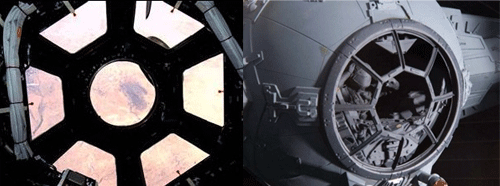
Surely I am not the only dork who, upon seeing a picture of the new observation module astronauts just installed on the International Space Station, thought, “Holy crap, they turned the ISS into a TIE fighter!”
And I thought that was pretty nerdy. But it’s not much compared to the lengths some film geeks will go in indulging their . Check out this collection of the best movie scenes set on bridges, or this ode to the science fiction corridor, which is currently my favorite post on the entire Internet.
How movie-nerd-a-riffic can you get? What weird things do you latch on to while watching a movie that you figure no one else even notices?
Things I cannot help but notice: When an actor has pierced ears or is wearing contact lenses that are inappropriate in a period film. Like how Michelle Williams has two holes in one ear in Shutter Island — she’s not wearing earrings in either of them, but to me, the holes in her lobes were obvious. Like how in Theoden’s death scene in The Lord of the Rings: The Return of the King, the camera gets close enough in on Bernard Hill’s face that you can tell — or I can, at least — that the actor was wearing contacts.
If I were gonna do a “I love it!” compendium like the ones about corridors and bridges, I might do “amazing New York apartments,” just out of sheer real estate lust.
Your turn…
(If you have a suggestion for a QOTD, feel free to email me. Responses to this QOTD sent by email will be ignored; please post your responses here.)














Ahaha! I love it. Now, given the fact that most astronauts will be proper geeks at heart, I wonder how long it’ll be before one of them is caught peering out of that window and muttering “I’m on the leader!” in a deep voice.
I can’t help noticing anachronisms in period films, so much so that it rips me out of the movie sometimes (even though they’re often funny):
– My favorite is in the Hammer film Horror of Dracula, which takes place in London in the 1880s, but which nonetheless features Van Helsing (Peter Cushing) making reference to a “Teddy bear.”
– I swear that I saw Brad Pitt’s smallpox vaccination scar in a scene in Troy in the movie theatre, but I haven’t cared enough to go back and check for it since.
– The Lord of the Rings movies are peppered with inappropriately modern language that would have made Prof. Tolkien scowl. The worst of these is Theoden’s line, in the middle of an otherwise beautiful scene: “No parent should have to bury their child.” That took me right out of the movie: A king of a patriarchal, pre-modern warrior society based on old Anglo-Saxon culture and language utters a phrase that (a)uses the gender-neutral (and Latin/French-derived!) “parent” in place of “father,” (b)likewise uses the awkward neutral substitute “their” instead of “his,” and (c) expresses a feeling that’s anathema to the society he’s supposed to live in — parents would expect to bury a fair number of their children in a medieval society, especially when said children happen to be soldiers.
Brad Pitt does have a very visible smallpox vaccination scar on his left upper arm. I look for it in all his movies.
I’m obsessive about spotting the film crews reflections in windows, car doors, shadows, etc. Even great movies/TV has these scenes.
My father and I like figuring out who the killer in a mystery is by the dramatic/production values instead of the evidence provided. It’s often faster and easier.
And I am the only one who squirms whenever a noble born ruler speechifies about defending freedom?
The thing I spot the most is bad editing. For example when a leading actress’ bangs keep changing position or a glass of wine sinks and rises. I mean Come ON! The entire job it so cut scenes together seamlessly.
I tend to get obsessed by classic music tunes or other instrumental music that sounds familiar but isn’t really Top 40. I spent half of Kill Bill wondering where I had heard that tune the Daryl Hannah was whistling and part of me still highfives myself for having recognized a Liszt tune in a Baz Luhrmann movie.
I also get obsessed with references to sci-fi short stories that seem to be well-known but never get referenced by any sci-fi movie buff apart from me. I still wonder whether or not it’s a good thing that visual science fiction (movies and TV shows) rarely acknowledge written science fiction (short stories and novels), even when the “creators” of the former are stealing ideas from the latter.
I’m nerdily obsessed with scientific realism in movies and tv.
I get a little thrill of satisfaction every time I spot a film maker’s nod to reality, but it frustrates the hell out of me when I see something that’s scientifically inaccurate.
It should come as no surprise then, that I have a lot of stored up hatred for Armageddon and CSI (especially Miami).
Ha! Yes, this is something I notice, too. It always drove me *insane* that Kira Nerys on *Deep Space Nine* had a smallpox vaccination scar even though she was born on a different planet…
What makes you so sure they weren’t vaccination scars for German measles?
My pet peeve is with hair and makeup jarringly out of place in period films. Especially big hair in 60s and 70s Westerns. What rancher’s wife or saloon “hostess” had cone head dryers to set their bouffants?
And I can’t really see pioneer women (or men for that matter) saying, “Excuse me, can I just grab my Aqua Net before you toss me over your saddle and ravish me at your grungy mountain hideout?”
I always notice when the language is off in period films – especially those set in the late 1700’s and early 1800’s, when they have characters say things like ‘do you not’ (i.e. ‘do you not think he is handsome?) in an attempt to be archaic. People in the 1700 and 1800’s said ‘do not you’ (‘do not you think he is handsome’) – it’s where we get the contraction ‘don’t’ and it’s such a simple thing to get wrong!
The hairstyle and clothing thing can apply equally to future settings. Nothing dates the wardrobe of a science fiction movie quite like period of production fashion elements. Flares or big hair might make a comeback one day, but for now they just scream 70’s.
You are all amateurs compared with this guy (and I am too):
http://www.ms-studio.com/typecasting.html
Kenny, you’ve seen “Miami, We Have A Problem” then? I must admit it’s not often I get belly-laughs out of CSI Miami.
I have to say that there aren’t a lot of ways to brace a bubble window with a central pane, and six panels vs eight panels is a reasonably significant engineering difference. But hey, just call me Roger the wet blanket.
I bow to the superior nerddom of typeface expertise.
When I watch people driving in movies or shows I notice the view through the car windows to see if the scenery is moving at the right speed. Usually it passes by so slowly as if they’re going about 20 miles an hour when they’re supposedly going 55. Also if their hair blows when riding in convertibles or on motorcycles. I also look at scars, moles or any other deformity like pigeon toe, cankle or bow-leggedness etc.
I’m sure other people have noticed this over the past 63 years, but the opening scenes of Alfred Hitchcock’s “Psycho” establish that the story begins in “PHOENIX, ARIZONA” and that the date is “FRIDAY, DECEMBER THE ELEVENTH”; in other words, it’s only two weeks before Christmas. And yet the whole movie doesn’t contain a single reference to Christmas or anything connected with the holiday.
I’ve always assumed this wasn’t an error and that Hitchcock intended something by choosing this date–perhaps his way of saying it doesn’t really matter when the story happens? Or perhaps December 11th held some special significance for him. December 11th fell on a Friday in 1959, the year before the film’s release date, so perhaps that’s the reason. Anyway, I’ve always found the date and the lack of any corresponding Christmas references in the film puzzling.
Tom —
Hitchcock noticed the town’s Xmas decorations showing up in the exterior scenes. He didn’t want viewers to be taken out of the film by wondering why there were such decorations up during a non-holiday time. It WAS a holiday time but Phoenix didn’t get snowy and Christmassy in December.
Thanks, Beowulf, for the clarification.