
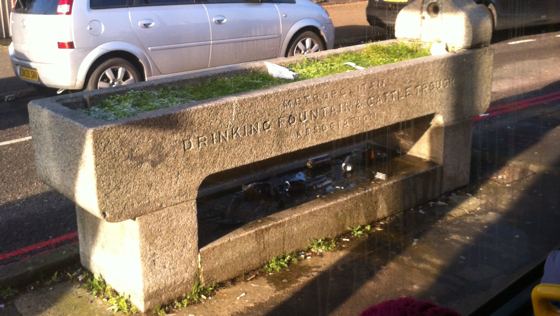
There is a cattle trough in Morden. It’s at a bus stop. (Maybe cows get off the bus there.) It is courtesy of the “Metropolitan Drinking Fountain & Cattle Trough Association.” Which is a real thing.
London photo of the day: cattle trough (yes, really)
share and enjoy














What, you think bus-riding cows don’t get thirsty?
And, lacking opposable thumbs, they can’t unscrew the top off a bottle of Perrier.
These troughs were really for horses, which were still a common sight in the streets of London until the early 1960s. There are similar troughs all over London. I can remember when they had water in them – they seem mostly to contain flowers nowadays. Also – as the Wikipedia entry puts it – “Morden in 1926 was a rural area and the station was built on open farmland”. The Morden cattle trough pre-dates the buses and underground. The Metropolitan Drinking Fountain and Cattle Trough Association was set up by MP Samuel Gurney in about 1860 to provide free and wholesome water to people and animals. London had been struck by colera in 1854 and water in those days could not always be relied upon to be wholesome. There is a lot of history behind that trough!
Well, cattle too – that one’s even labelled as such. Animals had to get themselves to Smithfield…