
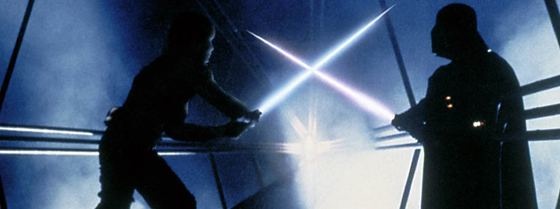
We all know how it works: The winners write the history books. But that doesn’t necessarily mean that the losers were bad guys. You’re familiar, I’m sure, with the famous scene in Kevin Smith’s Clerks in which the case is made that Luke Skywalker is a war criminal… as he certainly would have been cast had the Rebellion failed.
That may be the best known application of thinking outside a hero/villain narrative as presented to us. Let’s add some more examples.
What if the villains were actually the good guys? Pick a character whom pop culture has cast as a villain and tell us what not-very-evil thing he or she was actually up to that has been perverted by the winners’ propaganda. You know, like: Was Sauron merely hoping to unite all of Middle Earth under his benevolent rule?
Have fun!
(If you have a suggestion for a QOTD, feel free to email me. Responses to this QOTD sent by email will be ignored; please post your responses here.)














This is like the fourth time you’ve incorrectly referenced the Clerks discussion. The argument was that Lando was a war criminal due to the presence of subcontractors on the incomplete second Death Star. They agreed the first Death Star was a legitimate military target, and that’s the one they blew up.
Anyway: A race of untermenschen follow a charismatic leader to fight back against the racist, monarchist rival nation that wishes to commit genocide and exterminate their entire people. I call it: Lord of the Rings.
Edit: Damn, I didn’t see you already used LotR.
Your LOTR comment reminded me of this article I read about an apparently famous piece of fan fiction that does just that:
Another thought: I love the reversal that Neil Gaiman pulls off in “Snow, Glass, Apples.”
I realize I’m citing others rather than coming up with my own stuff. Sorry. Fuzzy brain this morning. :-)
Gaiman’s good at that. “A Study in Emerald”, a Sherlock Holmes/Lovecraft mashup, the great detective is hunting a killer intent on ending the rule of the Old Gods.
After being abandoned and left for dead on a wasteland planet, then watching his wife and most of his friends die in its remorseless deserts, a brave rebel commandeers a starship and exacts retribution upon the military leader of the galaxy’s most powerful empire who led him to this fate. His name? Khan Noonien Singh.
There’s an interesting discussion about whether Orson Scott Card’s _Ender_ books, about the genocide of an alien race, are an apologia for Hitler. Card denies it strenuously, but he would, wouldn’t he? http://www4.ncsu.edu/~tenshi/Killer_000.htm
The cop had a near fatal ear infection, and Mr. Blonde immediately took action to save the day! The infection made the cop irrational, so Mr. Blonde had him held in restraints for the procedure to be done safely. The tape around the cop’s mouth was to keep him from reflexive biting during the procedure.
If only Mr. Orange had understood that. But, he was delirious with blood loss. Had he only he had put the gun down, Mr. Blonde, with his field medic knowledge, could have tended to him too.
Mr. Blonde: a martyred humanitarian.
(please delete my other similar post. I was half asleep when I typed it)
Blake’s 7 practically foregrounded this: the reason for the oppressive government’s secret hidden control centre is, um, to prevent an external invasion, and the rebels’ destruction of it has led directly to the deaths of millions of people.
Those who participate in the Left Behind deconstructions have often pointed out that in that series the supposed heroes rarely do anything good (or anything at all), while the satanic villains are all about ending wars, providing help to the people injured by God-sent punishments, and so on. Well, and nuking a bunch of cities because of moustache-twirling evil.
(nods) And the classic anime Gunbuster eventually reveals that the supposed “Aliens” are actually a sort of galactic antibody, doing their best to halt mankind’s rapid and infectious stellar colonization. This raises the possibility that human victory would simply start the clock on universal armageddon.
This is, oddly, the second-most fascinating concept Gainax introduces —
the first being chin-mounted antigravity generators.
The Master wanted to unite the universe under the benevolent joint rule of himself and the Doctor.
wait. Am I allowed to say that? Because I didn’t make it up. He said so in “Colony in Space.”
I’m counting down the minutes until someone suggests that God was the villain in most of the famous Bible stories.
But, of course, as a religious person, I would never suggest it myself.
I wouldn’t suggest such a thing: God doesn’t exist.
Psst: Sauron, Darth Vader, and the other villains in this thread don’t exist either. It’s okay to suggest fictional characters. ;-)
It seems to me that the only reasonable alternative interpretation is “God is so much smarter than us that we’re simply incapable of understanding how this act is a right one even though it looks villainous”. Which some people are happy with, of course.
Well, I’m one of the people who’s happy with that explanation, but I can think of a number of religious leaders these days who are outright villains.
Already done in Good Omens by Pratchett and Gaiman.
I was just thinking that:
A serpent, seeing an innocent girl under the rule of an omnipotent master, decides to give her a forbidden (albeit supposedly wonderful) piece of fruit. She is released from the Utopia as a punishment for disobedience and she starts a new life: with ambition, free will, and independence. The new society created has hardships, but life is interesting and problems are solved.
Thousands of years later, the serpent looked up from his punishment at the human race and saw it was good.
(Crowley backstory- I think)
The Dark Knight: a disfigured guerilla fighter combats an armed to the teeth billionaire rogue vigilante who spends his spare time going into impoverished neighbourhoods to rough up and intimidate the local populace with his cutting edge, high-tech military grade armor and equipment and kidnapping foreign nationals on their own soil.
The question of the day isn’t “what if the good guys were actually the villains”, but rather “what if the villains were actually the good guys”. But hey, if it tickles your fancy to imagine a slight that hasn’t happened yet, be my guest.
Okay, how about this? The Tower of Babel was built by rebels who hated God’s cruel manner of running the world. (The Flood, in particular, horrified them.) They had a dream of uniting all the people of the world and declaring war on Heaven. When the battle was over, they hoped, everyone in the world could live in peace, speaking a common language.
God was genuinely frightened. “If, as one people with one language for all, this is how they have begun to act,” God said, “then nothing that they may propose to do will be out of their reach.” And so God put an end to the rebellion before it even started. But, on the positive side, it ended up creating the field of linguistics.
Doesn’t the second question imply the first?
Also, I believe you may have missed the humor in Danielm80’s comment, in which he suggests something by saying he would never suggest it.
I thought it did tangentially. In any event, yeah, I must’ve missed the humour. Sorry.
Didn’t they already speak a common language and the “curse of diversity”, God’s punishment for building the tower? ;-)
Well, sure. I thought that “If, as one people with one language for all, this is how they have begun to act…” made that clear. Sorry if my post was confusing.
Eh, I got it immediately after I wrote my reply and facepalmed at my reply. *sigh*
Dr Manhattan wasn’t actually responsible for the attacks on the world’s major cities, but decided to accept the blame so that the humanity might unite against the common enemy.
Radical idea, I know. But it’s not mine – I read it in the New Frontiersman.
It’s been years since I saw *Clerks.* Sorry.
Eve Forward’s novel “Villains by Necessity” is a classic example of this trope. Too bad it is not more popular.
I thought Wicked was ‘best known application of thinking outside a hero/villain narrative as presented to us.’
“We all know how it works: The winners write the history books. But that doesn’t necessarily mean that the losers were bad guys. ”
Yep, like Richard the Third
A young orphan is taken in by a cynical, power-hungry, and manipulative wizard. Eventually he chafes under the constraints placed upon him, and rises up against his former master, and the society that has repressed him. Due to the circumstances of his upbringing, he has seen the grave harm wizards cause to non-wizards, often without even realizing it, and, along with his allies, advocates keeping the two groups separate. Eventually a war breaks out, and the government takes extreme measures against it’s own population, imprisoning innocents who are merely suspected of working with the young man. They also form an ‘Order’ of Wizards dubbed the Phoenix to destroy him. During a battle against the Order, the powerful young orphan is defeated, but not destroyed. The war is over.
Several years later the same cynical, power-hungry, manipulator takes in a war orphan and begins to manipulate him to hate the hero of our story, setting him on a path of vengeance and retribution. Eventually, when our hero rises again, this puppet will destroy him for good, leaving the wizarding world forever in the hands of a corrupt, uncaring, dictatorial government.
I give you Harry Potter.