
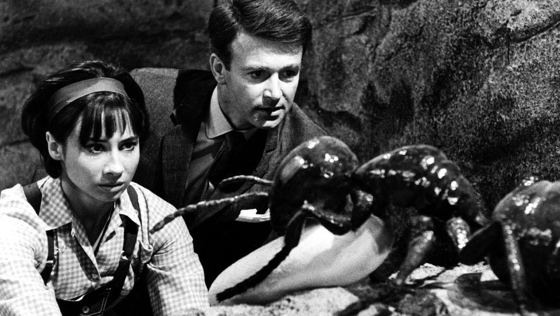
Fascinating interview with Carole Ann Ford — who played Susan, the Doctor’s granddaughter, in the earliest episodes — in The Telegraph about how the role destroyed her career, why she’s jealous of companions on the new show, and more.
One intriguing tidbit is about how Susan was originally intended to be quite different than she ended up onscreen:
What did give way were the promises she had been made about her character. “I was a very good dancer and had been an acrobat. They told me Susan was going to be an Avengers-type girl – with all the kapow of that – plus she would have telepathetic powers. She was going to be able to fly the Tardis as well as her grandfather and have the most extraordinary wardrobe. None of that happened.”
Ford was told to make Susan more like an ordinary teenager. “All my differentness was cut out. They made me wear horrible little trousers, not even funky jeans. Horrible little flat shoes. I don’t know why they did this to me.”
Love this, too:
It’s also striking how much of the modern Doctor Who can be traced to those first shows – from the theme tune to enduring ideas about who the Doctor is and why he is travelling. Remarkably, many were made up on the spot by herself and William Hartnell, who played the lead. “Bill and I put together a back story because we had to. You can’t act something unless you know what is behind it. We created the fact that he had done something to annoy the other Time Lords and they decided he had to go.”
Read the whole long intereview at The Telegraph.
(If you stumble across a cool Doctor Who thing, feel free to email me with a link.)














Why did they get rid of Susan Foreman being a badass?
Because little girls never get to be badasses, thanks to the patriarchy controlling the media!
We’re a little bit better about it now in the post-Buffy era, but that was the early 60s still: Buffy was 30 years away.
In England in 1963, a badass was a naughty donkey.
Charles Perrault published “Donkeyskin” in 1695.
(http://en.wikipedia.org/wiki/Donkeyskin)
She was very naughty. I’m sure the fairy tale was available in England by the 1960s, and she was a better role model than most of the women on television.
I’ve only experienced the awesome Catherine Deneuve “Peau d’âne” film version of the story, and she wasn’t naughty at all! Her father-the-king was pretty damned naughty for insisting on marrying her because she was so like her recently-deceased mother. She was quite correct, proper, and heroic in hiding out from him under his nose under a magical donkey skin. ;)
Well, “naughty,” in this context, is an obscure French word that means “awesome.” But try watching Jim Henson’s version from the Storyteller series. It was adapted as an episode called “Sapsorrow.”
in any century, a badass would not care.
The timing must have been very close – up to the point where Who started broadcasting, Cathy Gale was just one of three interchangeable secondary characters in The Avengers. I think one could argue that while later female companions may have been stronger characters, the show didn’t get a real “action girl” until Leela.
In my recent re-watching of the early stories it’s been very clear to me that there was an informal continuity that mostly didn’t make it into the scripts – where the Doctor was human, from the far future – which mostly got forgotten about when the Time Lords were invented (for The War Games, many years after Ford had left the series).
With little inconsistencies like that early mention of Time Lords I fear that this interview can’t be taken as absolutely accurate, though it may well be Ford’s present recollection of things that hapened fifty years ago.
From what I have seen of early Who, the women were always being told to calm down or sit down – bad Timelord from the future!
That’s kind of a trope, isn’t it? Girl or woman originally meant to be a badass is softened into someone “nicer”, so that the audience will “like her”. As if we didn’t adore Mrs. Peel (originally written to be a male character, btw.) But now that I think about it, they may not have softened Mrs. Peel, but her replacement, Tara King, was pretty much that character, made softer and nicer so the audience would like her more.
Off the top of my head, Jenna and Cally on Blake’s 7 and Audra Barkley on The Big Valley come to mind. It’s like the Chickification trope mixed with Character Derailment (careful, if you go to tvtrope.org to read up on this, you may never leave.)
Ooh, I edit to add “99” from Get Smart. She started out very sharp; she was meant to be a super-competent contrast to Maxwell Smart. By the end of the series, she had his twins or triplets or something. There as no hope the kids would have any intelligence as she’d been softened into someone as ineffectual as he was.
I edit again to add Wilma Deering on Buck Rogers in the 25th Century. In an interview in TV Guide, the creators of the show revealed that they felt the joke about Wilma outranking Buck had run its course and it was time for the audience to get to like her.
TG, the history of The Avengers is slightly more complex than that. Series 2 had three interchangeable secondary characters, of whom two were female; the scriptwriters didn’t always know which would be available, so wrote “generic” scripts (i.e. for male characters). That’s what Ford would have know about in September 1963.
Season 3 had Cathy Gale (Honor Blackman), one of those three characters, full-time. For season 4, to replace her, the writers invented Mrs. Peel (“Emma Peel”, “M. Appeal”, someone whom the men in the audience would like).
I do quite agree with you on Tara King, whose principal characteristic compared with the earlier two was her lack of competence.
HEY, whaddayamean incompetent?! Girlfriend used to hit the bad guys upside the head with her shoulderbag! Then coquettishly open the bag with a cute tilt of her head to heft the brick when Steed looked shocked at the flattened bad guy!
Yeah, that’s pretty damned sad.
I actually noticed, as a pre-teen, that Mrs. Peel was referred to as “the woman” (as in “We have to stop Steed and the woman!”) and Tara was referred to as “the girl” (as in “We have to stop Steed and the girl!”) I was so young that the two characters seemed equally old and not-a-girl to me. Of course, later on I read that the actress playing Tara was 18 or 19, her casting was an attempt to woo a young demographic.
It was many, many years before I stopped to think how odd it was that Steed always got called by his name and they didn’t.
Idiots! Didn’t they know that The Woman was Irene Adler?
In a simialr way – I heard that the woman who played Erin on CBBC’s Young Dracula was unhappy with the character because she changed form being a lot more, for want of a better word, badass in the audition scripts and what she sounded like to being far far less.
“Read the whole long intereview at The Telegraph.”
I would love to but unfortunately I have exceeded their suicidal 10 article limit – so I shan’t be able to get my “laughing at all the right wing racist morons” fix for a while.