BASIC REPRESENTATION SCORE: -10
FEMALE AGENCY/POWER/AUTHORITY SCORE: +4
THE MALE GAZE SCORE: -25
GENDER/SEXUALITY SCORE: -10
WILDCARD SCORE: -3
Is there anything either positive or negative in the film’s representation of women not already accounted for here? (points will vary)
Similar to the issue of “femininity used as a joke” [why this is a problem], here we have the male protagonist’s female sidekick, who is a lesbian and is constantly being mistaken for a boy, which everyone seems to find hilarious.
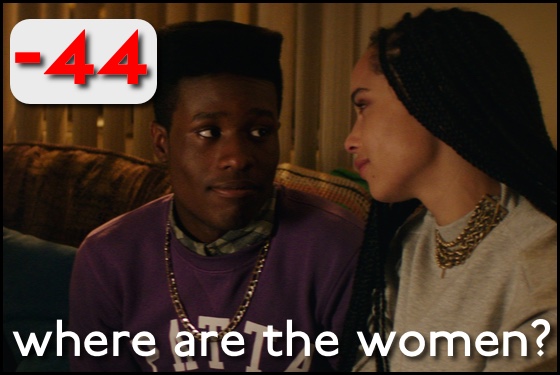
TOTAL SCORE: -44
IS THE FILM’S DIRECTOR FEMALE? No (does not impact scoring)
IS THE FILM’S SCREENWRITER FEMALE? No (does not impact scoring)
BOTTOM LINE: All of the girls and women in this film function solely as support for the male protagonist as he goes on a life-changing personal journey: as a friend who happily helps with even the most dubious and dangerous of schemes, as an object of love or lust, as a wholly understanding mother. Even the one character who might have offered a more progressive portrait ends up serving as reinforcement of the male-dominated status quo: the female friend who is a lesbian only underscores the film’s objectifying male gaze as she joins the male protagonist in ogling women.
Click here for the ongoing ranking of 2015’s films for female representation.
NOTE: This is not a “review” of Dope! It is simply an examination of how well or how poorly it represents women. (A movie that represents women well can still be a terrible film; a movie that represents women poorly can still be a great film.) Read my review of Dope.
See the full rating criteria. (Criteria that do not apply to this film have been deleted in this rating for maximum readability.)
This project was launched by my generous Kickstarter supporters. You can support this work now by:
• buying some Where Are the Women? merch
• becoming a monthly or yearly subscriber of FlickFilospher.com
• making a pledge at Patreon
• making a one-time donation via Paypal