
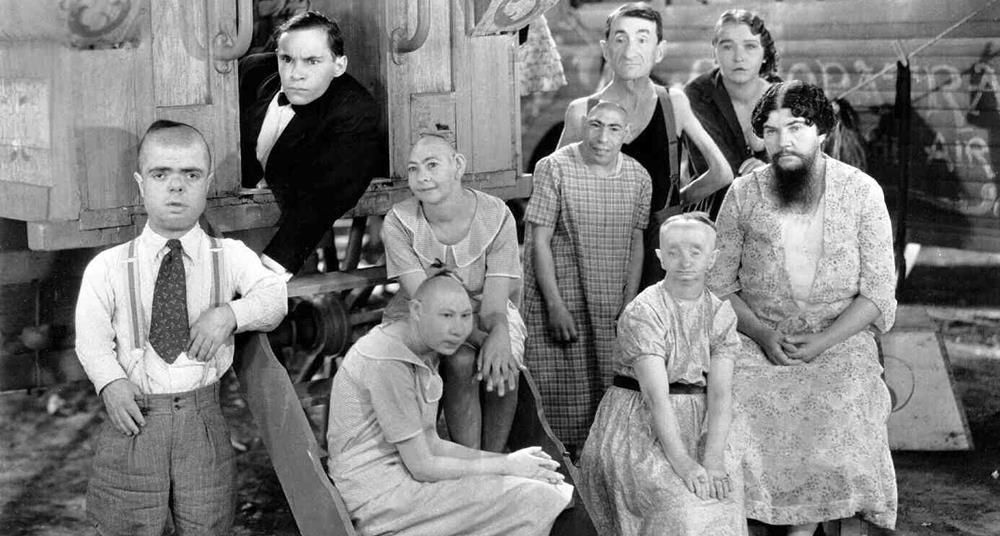
I’ve been having a fascinating conversation this evening with @Richard_Amm about representation of disabled people in media. He contacted me because he’s developing a test for such representation akin to my Where Are the Women? test. During our chat it occurred to me that it might be useful and interesting to think about what positive representation of disability exists in movies (and TV, too).
What are some films with good representation of people with disabilities?
Honestly, it’s tough to think of many films that do a good job of this! Richard suggested Tod Browning’s controversial 1932 film Freaks (pictured), and I agree that that one is, at least, better than many others.
One TV character that comes to mind is Kerry Weaver on ER, who walked with a limp and used a crutch for support: her disability was far from the totality of what defined the character, and for a long time on the show, it was barely even mentioned. But on the downside, actor Laura Innes, who portrayed her, was not herself disabled.
I’m very curious to hear what you come up with…
(You can also discuss this at Substack or Patreon, if you prefer. You don’t need to be a paying subscriber to comment, but you will need to register with either site to do so.)














It is a melodrama, and possibly one of the most obvious from the period, but Best Years of Our Lives with Harold Russell?
Peanut Butter Falcon?
The Sea Inside?
I mean, I found all of these movies to be moving and memorable in different ways, although I wasn’t sure about what felt like objectification of Russell’s character in BYOOL.
Thoughts?
I think there’s been increasingly better representation of Deaf people through the years. There’s Children of a Lesser God, of course, starring Marlee Matlin who went on to play recurring character Joey Lucas on The West Wing. More recently, there’s Eternals, with Lauren Ridloff as the MCU’s first Deaf superhero — and CODA, which won Best Picture this year (with Troy Kotsur winning Best Supporting Actor). On TV, there was Switched at Birth, which had a lot of storylines involving the Deaf community and starring Deaf actors (including Katie Leclerc in the central role). More recently there was Hawkeye, featuring not only Clint Barton coping with hearing loss but a new character, Maya/Echo, who is Deaf and has a prosthetic leg, played by an actor (Alaqua Cox) who has those conditions.
For representation of people with Down’s syndrome, the 90s show Life Goes On comes to mind, featuring an actor with Down’s (Chris Burke) in the central role. More recently there were wonderful characters in Stumptown and Never Have I Ever, played by actors with Down’s (Cole Sibus and Lily D. Moore respectively).
Michael J. Fox has been doing a terrific job in his occasional role as a lawyer with Parkinson’s in The Good Wife and The Good Fight; his performance demonstrates that a character with a disability doesn’t have to be “nobly suffering,” but can be a devious asshole as much as anyone else. That’s positive, right? :-)
I imagine there are conversations to be had about whether (or to what degree) it’s good representation to have a character with a disability but then pretend that disability doesn’t exist. Is having a disability in an ableist society like being a woman in a sexist society or being nonwhite in a racist society, in that it’s important to have that experience inform our understanding of the character?
What are the parameters for what should be considered “disability”? Are all mental conditions included, like, say, OCD or depression or dementia or PTSD? Should the condition be permanent/chronic, or are we including, say, having and recovering from cancer? That would open up a whole bunch of other films.
It’ll be interesting to see how the project goes. Best of luck to Richard!
I don’t think that’s what ER did — I think it was more that it was just a part of who she was, and that her disability didn’t define her. Which is an important thing for representation, that people are treated as people first, and not their skin color/religion/whatever.
Yup, there’s a lot of scope here. Perhaps Richard can answer that as far as his representation test is concerned…
can we differentiate between a story about people with disabilities versus a story with characters whom just happen to have a disability?
for example, “X-Men: Days of Future Past” had a character played by peter dinklage who just happens to be a dwarf, but it is not about that. versus, the movie referenced in maryanne’s picture, “Freaks” which was very much about their disabilities.
it goes to how characters are written. is a story about a black person or a person who happens to be black? is a story about a female person or a person who happens to be female? is a story about a disabled person or a person who happens to be disabled?
I think as far as representation is concerned, ideally we would have stories that do both things: that are about disability and what that means, as well as stories in which disability is incidental.
Dinklage in X-Men is a great example of the latter!
Richard Amm here, Freaks was made in 1932 but still holds the record for the most disabled people in a film. What struck me about it was how thoroughly humanized the disabled characters were, you saw them experience community and connection and relationships and marriage and sex and births, their lives and wellbeing were valued and they were empowered to make choices. You got to know them as people. All of those things are incredibly rare to see in relation to disability in film today.
For me the highpoint of representation so far is in a recently made hour long BBC Drama called “When Barbara Met Alan” which is a love story which tells the tale of disability rights campaigners in the united kingdom in the 90s, when we secured the right to access public busses. Its not just good representation, its also filthy, funny, well paced and has an excellent soundtrack. Its thoroughly entertaining and engaging in its own right, which is hardly surprising considering it was made be Jack Thorne, who has worked on a range of very well known projects like Harry Potter, Shameless and His Dark Materials.
For a good overview of disability tropes I recommend the documentary “Code of the Freaks”
Please feel free to find me on twitter if you have questions. I am currently interviewing people who are experts on both media and disability as part of my MSc project to build a tool to improve how disability is portrayed in the media.
Hi MaryAnn! Long-time reader and fan (I actually even won a DVD copy of Spielberg’s DUEL from you, many years ago). I have cerebral palsy and am now the co-chair of the Disabled Writers Committee at the Writers Guild of America, West.
Disability representation in narrative projects is pretty abysmal in the industry. We found that, in 2020, there were only two projects made by and about disabled people, and both were documentaries: CRIP CAMP and DEAF U.
THE STATION AGENT is good, and I find a lot of the best disabled representation actually comes from international projects, for reasons too complex to get into here. Disabled folks confront a strong hiring bias in the industry, and disability itself is rarely folded into diversity conversations alongside race and gender. There are also very few disabled reporters in the US — I almost never see any on screen — but Kristen Lopez of Indiewire is a great follow.
SANCTUARY (an Irish film) and PEANUT BUTTER FALCON are worth checking out! Happy to talk about this with you, further, if it’s helpful!
You should probably get in touch with Richard Amm if you haven’t already. I bet he’d love to hear from you.
Just a quick shout-out to Matt Murdock in DAREDEVIL. They don’t shy away from his disability, but it doesn’t define him.