
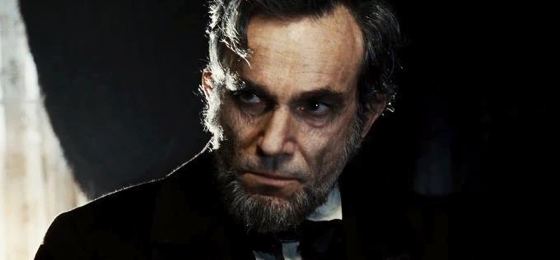
There’s always some grumbling when a fact-based narrative film takes liberties with the way things really happened, but there’s slightly louder grumbling at the moment, with three of this year’s Oscar nominees for Best Picture — Argo, Lincoln, and Zero Dark Thirty — coming under criticism that they’re not entirely as factual as they might be. From the AP (via Boston.com):
Filmmakers have been making movies based on real events forever, and similar charges have been made. But because these three major films are in contention, the issue has come to the forefront of this year’s Oscar race, and with it a thorny cultural question: Does the audience deserve the truth, the whole truth and nothing but? Surely not, but just how much fiction is OK?
…
Carson Reeves, who runs a screenwriting website called Scriptshadow, says writers basing scripts on real events face a constant problem: No subject or individual’s life is compelling and dramatic enough by itself, he says, that it neatly fits into a script with three acts, subplots, plot twists and a powerful villain.
‘‘You just have to get rid of things that maybe would have made the story more truthful,’’ says Reeves, who actually gave the ‘‘Lincoln’’ script a negative review because he thought it was too heavy on conversation and lacking action. He adds, though, that when the subject is as famous as Lincoln, one has a responsibility to be more faithful to the facts.
Screenwriter and actor Dan Futterman, nominated for an Oscar in 2006 for the ‘‘Capote’’ screenplay, has empathy for any writer trying to pen an effective script based on real events, as he did.
‘‘This is fraught territory,’’ he says. ‘‘You’re always going to have to change something, and you’re always going to get in some sort of trouble, with somebody,’’ he says.
…
Mark Boal, [Zero Dark Thirty]’s screenwriter, said in a recent interview that screenwriters have a double responsibility: to the material and to the audience.
‘‘There’s a responsibility, I believe, to the audience, because they’re paying money, and to tell a good story,’’ he said. ‘‘And there’s a responsibility to be respectful of the material.’’
(Click back to Boston.com for details on the liberties taken in the three Oscar nominees.)
So:
Is a filmmaker’s primary responsibility to the truth or to a good story? Or is it somewhere in the middle? Are there liberties that go too far, even if it’s made perfectly clear that a story is fictional, not factual?
(If you have a suggestion for a QOTD, feel free to email me. Responses to this QOTD sent by email will be ignored; please post your responses here.)














Never let the truth get in the way of a good story. I work in a class of 5 year olds, they know the difference between fact and fiction – the rest of the population should be able to do likewise.
I’m boringly binary on this. Either tell the real story, or say “this is fiction inspired by the real events”. I think people are forgetting that anything not explicitly claiming to be a documentary (and many things that are, but that’s another story) are works of fiction and will not get even major details right.
How do you tell “the real story”?
Where do you get your information from? From prior stories, of course. With all the biases, conflicts and discrepancies that that implies.
I think there is an essential level of complexity here. And I’m writing this while halfway through Walker (a big shout out to La Sargenta, for finally nudging me to watch it). The movie is quite deliberately fictionalized, and the intrusions into it of modern props (Newsweek, a Mercedes-Benz etc) reminds the viewer of that. But it is also inspired by the real events, and it does an interesting job of representing those events in a simplified form (all presentations of history are simplification) while simultaneously drawing attention to their modern relevance.
A history textbook or documentary is not in binary opposition to such a presentation. It is also a simplified representation, with its own positions, assumptions, biases. Even a full blown work of scholarly historiography does this, though what marks it as scholarly is the extent to which the historian tries to recognize, acknowledge and compensate for such biases.
Truth is important. It’s also, usually, difficult.
Ah, the banality of truth.
It all depends. I have problems with how history is taught for many of the same reasons as I have problems with how historical events/characters are depicted in film: they both serve to glorify the present state of things and thus act as reinforcers of the status quo. When you’re making stuff up to make a person seem more heroic or villainous, or to cast events in a manner that alters their meaning substantially, then yes, I find it problematic. If it only changes things in a manner that doesn’t change the tone of the event, but increases its emotional impact, then no, I don’t have a problem with it. If the film clearly presents itself as a historical fantasy, then almost anything goes.
Honestly, I often have a bigger problem with what’s omitted from films than what’s there: the way films are shot often focusses on the heroic individual and omits the contribution of the many who made their accomplishment possible. Another example of omission is having war films that only shows one side of the war and/or focus on the fighting to the detriment of context such as economics, politics, etc. While I suppose that it makes for more viscerally gripping viewing, decontextualizing war makes it more palatable.
I don’t think it’s possible to tell the complete and whole truth, anything is going to be a compromise, and not everyone is going to agree with those changes.
We’re lucky enough to live in the age of the internet, where access to research and argument is much easier. Better the filmmaker to note the discrepencies outside the picture frame, and let the critics, historians and fans comment there.
I’d say they have little to no responsibility. They’re filmmakers not history teachers. I’m not going to get into a twist over Oliver Stone’s JFK in regards to its historical accuracy. It’s a one of them most compelling cinematic narratives I’ve ever seen and ditto for his Nixon film. However, I was pleased he put a disclaimer at the beginning of Nixon about dramatic license.
The responsibility falls on the viewer to use critical thinking skills and have the presence of mind not to glean their historical knowledge from the multiplex.
I agree completely.
Yeah, but I wish JFK didn’t convince too many viewers that it was the truth instead of a steaming pile of …. conspiracy nut theories.
I have the same problem with JFK. For me, the difference between JFK and other historical fiction films is that Stone has in front of some audiences presented JFK as the truth about what really happened. Considering Stone’s beliefs, I believe he means it when he says JFK is the truth and not when he says it’s just a movie.
Personally, I’ve always been leary of “true” stories. I tend to go out of my way to avoid seeing them. They bother me. I’m distracted by wondering what is true, and what is made up. I know damn well that the story has been manipulated to make it more palatable to the movie-going audience.
Entertainment will almost always win out over truth. I would prefer the latter, but I’m not an executive looking for profit.
Aren’t you the guy who so often complains how modern movies pander to the stupidest members of their audience? It sounds like now you want film makers to literally spell out the idea of dramatic licence in big, bold letters. I also wonder what your take is on the Coen brothers’ use of the “Based on a true story” title card at the beginning of the entirely fictional Fargo?
I am constantly amazed at how scandalized ostensibly educated adults will get at the realization that the dramatic production they are watching is not a word-for-word, event-for-event reproduction of the historical record… as if the “historical record” was 100% reliable.
But there’s an honest attempt to tell the real story, and then there’s just lazy rewriting of history. The example that springs to mind is Alan Moore’s comic “From Hell”, which posits an identity for Jack the Ripper. Of course Moore doesn’t KNOW, but it’s a well-researched argument respects its audience and the facts, even where it strays from reality. Whereas the movie adaptation just made shit up because it was ostensibly entertaining (i.e., more conventional).
I have to jump in here, as Alan Moore’s comic (I haven’t see the movie) is an example of an allegedly historical work that drives me batty. You see, he did just make shit up, and he’s doing the same thing in it (with much more talent) that Stone was doing in “JFK.”
The Masonic conspiracy theory about Jack the Ripper is even more thoroughly exploded than the various silly theories about Lee Harvey Oswald. But for an Englishman of Moore’s generation, the theory of an evil conspiracy hiding a Royal indiscretion is just too good to pass up.
What’s horrible is he seems to totally believe the story, and there is no evidence that you can give that will convince him. Rather like the Oliver Stones among us.
For all the book’s footnotes, historical arcana and self-annotations, it is, at heart, untrue.
But in this case, there is a definite sense of who gets hurt by this stuff. The descendants of Gull are none too pleased to keep having to answer questions about him, after having brought forth a great deal of information that Moore didn’t mention, and which establishes very firmly that his work was a fiction.
Boy, I’ve been arguing this one with friends for literally years.
I think that while filmmakers and storytellers don’t have to get every detail right, not being historians, they *are* responsible for the overall truth of what they show and tell. This is important, because movies have become the furnishings of memory for most of us as to what happened in the past. And people act on those views.
Did “Lawrence of Arabia” leave a bunch of details out? Most definitely. As complicated and deep as that movie is, life is more complicated still and the story of Lawrence had more to it than was shown there. (Read Michael Korda’s book “Hero,” for a good layperson’s account.)
But was it true to what is generally accepted as having happened? Again, most definitely. Even skeptics about Lawrence agree that he had an ability to get the fractious tribes to work together no one else even approached, had a charisma that everyone who met him, for however short a time, remembered, that Lawrence had some rare ability to get people to do more than they would on their own and to excel themselves, and that the overall story of the Arab revolt of WWI was what the movie showed; i.e., the English provided support to the revolt promising the Arabs independence, and then cynically tried to carve up post-war Arabia between themselves and the French, in which they mostly succeeded.
“Lawrence of Arabia” makes these points by simplifying events, putting characters together, and using dramatic license in what to show and what not to show. So some of its specifics are wrong, but its overall truth is the essence of what did happen.
My prime examples for mis-reporting history, getting the essence wrong, as it were, are “JFK” and “Anonymous.”
“JFK” and its complete disregard for history and truth have been much discussed. I hate the film and hate Oliver Stone for making it, but even I am forced to admit that it is, as Patrick wrote earlier, a compelling work. It is brilliantly organized and presented. However, its main point–that there was some big, evil conspiracy that killed JFK–is completely and utterly and PROVABLY wrong. (Read Gerald Posner’s “Case Closed,” particularly for its expose appendix where he goes over the evidence that had been faked up by the conspiracy theorists. Some of that exploded, faked stuff were things Stone showed in “JFK.”)
Anyone who tells you that it’s just one man’s point of view is using a cheap intellectual laziness.
When I was in high school, in the 70’s in Texas, one of my history teachers told us the Ku Klux Klan was the means that southern white men NEEDED to pursue to regain their political rights after they’d been taken from them by the North in the Civil War. He also explained, at great length, how the War was all about state’s rights and NOT about slavery. (And I am Marie of Romania.) It was just this one man’s, this teacher’s, point of view.
Not all points of view are equal, and I think Oliver Stone’s in “JFK” is as wrong as my old 10th grade history teacher’s.
“JFK” is the first edge of a wedge, between common sense and what we now have for political discourse in the US. Stone wants us to accept his overarching story of an evil, shadowy, conspiratorial Establishment that Rules the World, behind the scenes, and he is not going to let any facts get in his way.
This week, John Boehner, in an op-ed in the Wall Street Journal, lies completely about the origins (just a few months back!) about the origination of the sequester that his party foisted upon the nation in their created-crisis about the debt. His staff actually had to remove material from his website which contradicted what he wrote. This amount of lying and disagreement about observable facts is what accepting crap like “JFK” has led to.
“Anonymous” is another kettle of fish. It is a silly movie, with an extraordinary recreation of Elizabethan England in it. It was not an effective argument for its thesis, which was that Shakespeare didn’t write the plays, because it showed how silly the thesis is, in its most extreme formulations.
But it shows another danger to not having any responsibility to the truth.
The only way you can accept a theory that Shakespeare did not write the plays is to do two things.
First, you must accept a theory that has no evidence in its favor. Edward de Vere? Christopher Marlowe? Francis Bacon? Yeah, maybe, but there is NO evidence, not for any of them.
Second, you must dismiss a mountain of evidence against it. Marlowe died before most of the plays were written. Bacon’s credited writing is bone-dry, pedantic stuff with a vocabulary less than a tenth of what Shakespeare’s plays demonstrate, and the theory that he wrote the plays was put forward by a descendent of his, who had therefore an interest in wanting the credit for her family. DeVere’s credited work shows none of Shakespeare’s grace and wit, and he died before the last third of the plays were written. And there are many, many references, from various folks, from different strata of Elizabethan society, that the writer was Shakespeare.
So why do I pick on poor, silly, “Anonymous”? Because of that formulation: to believe in this shit, you have to give the artist (and I feel I am stretching the term using it for Roland Emmerich, who made “Anonymous”) no responsibility to the truth. so that he’s free to believe something for which there is no evidence AND for which there is counter-evidence against that belief.
And if you can do that, you can believe anything, whatever you want. The Civil War was all about State’s Rights. The Vietnam War was a noble enterprise made unwinnable by Liberals who wouldn’t let the army get in there and get the job done. There were Weapons of Mass Destruction in Iraq. Whatever crap you want to believe, whatever you want to sell folks.
Finally, a plug for the most enjoyable film book I know of, George MacDonald Fraser’s “The Hollywood History of the World,” an entire book devoted to how Hollywood has gotten history right–and wrong. Worth reading just for the throwaway lines that sum up whole categories of films. (e.g. “Ancient Egypt has meant two things to Hollywood, Cleopatra and walking mummies.” “…it was a knavish piece of work, set in the Highlands of Lake Tahoe…” “There was the obligatory flogging, without which no sea movie is complete…”)
Very well said. Like it or not, there is a level of responsibility implicit in telling stories based on real life. Drift too far off track and you become a de facto propagandist.
Of course, that’s not to say creative people aren’t free to twist real events in interesting ways. You’d have to be a real churl to nitpick Tarantino for killing Hitler in “Inglourious Basterds”, at least partly since anyone with a 2nd grade education should know that it didn’t happen like that. And if anything, Tarantino’s contributing to the general awareness of how fast-and-loose movies can play with history by doing so. But there are other, subtler ways of warping history that are acceptable, as long as the filmmakers *are doing it towards a higher creative purpose*. I mention Argo down below, whose totally fictional climax could be considered acceptable because it ties in with the movies’ larger themes. But simply changing something to make it more superficially dramatic, or more in tune with how the mass audience thinks it ought to be (as, for example, Lincoln’s voice in every movie except Lincoln) seems more like it’s contributing towards ignorance.
What I always say is, if you’re basing your story on real events, real life is basically doing the heavy lifting, story-wise. To then turn around and change it simply to make things more exciting is spectacularly lazy and exploitative. Either tell the truth, or write fiction, or fictionalize the truth in an amiable way that respects the audience. Don’t claim to be a chronicle of events and then do whatever you feel like. That’s having your cake and eating it too.
You bring up a good point with “Inglorious Basterds,” which I thought was a hoot. Maybe I was generous with it because it isn’t really claiming to be really historical.
But one of my favorite movies is “Time Bandits,” which also–intentionally–plays fast and loose with history, as part of a put-on.
“He adds, though, that when the subject is as famous as Lincoln, one has a responsibility to be more faithful to the facts.” This seems backwards to me. Shouldn’t filmmakers be most accurate with a lesser known figure, since the movie might be the first audience members have heard of the person?
As well-made as Argo was, it BUGGED THE CRAP out of me in its finale, where (SPOILERS) the flimmakers completely manufactured a ridiculous plane chase. The real climax was slipping through customs, and it was more than tense enough; there was no need for a bullshit chase scene.
Except…after thinking about it as I was leaving the theater, I realized that the movie is about how Hollywood bullshit saved the day, right? So having the movie basically go full ADAPTATION and have the script turn into Hollywood bullshit has a certain thematic neatness. The only problem is that Affleck spends way too much of the movie playing down the Hollywood aspect–he clearly didn’t want to make it seem like the Hollywood guys were the Real Heroes for fear of looking like a self-congratulatory douchebag, but unfortunately I think he stripped out a lot of the thematic potential in doing so…which means what we’re left with is a “true story”, and thus the made-up ending becomes hard to defend.
The tension made for an interesting movie, and I sure as hell can’t claim Affleck didn’t direct the hell out of it…but I kinda wish he’d been willing to have a little more fun with it and not adhere so much to “realism”.
Personally, I’m outraged at how Lincoln irresponsibly left out so many critical facts. No mention of the vampires whatsoever.
I don’t think there are any rules. I’m willing to grant Quentin Tarantino and Aaron Sorkin the flexibility to change some details. Oliver Stone hasn’t earned that level of trust.
But there is one thing I know for sure. When the commercials for Snitch say “Based on true events,” something has gone horribly wrong.
As a rule, I stay away from any “historical” movies for this very reason. All history is through the lens of the historian, so, even with ‘facts’ there are ‘lies’. It gets even worse with so-called re-enactments. I only watch True Story Fiction when pressed to do so by others. I do my best to hide my begrudging feeling (generally successfully). That said, and even knowing the story behind Argo, I enjoyed that movie for the craft of it.
Prior to seeing Argo, I read the book Tony Mendez wrote about the mission and I found it to be spectacularly anti-climactic. All the fuss about the fake identities and back stories, while important as a back up, did not come into play when the houseguests were leaving Iran. They just left, and never had to prove they were who they said they were. The Iranian militants were never thisclose to figuring out who they were, let alone nearly busting them as the plane departed.Sure, the situation was tense, but not terribly exciting. Affleck did leave out a whole lot relating to the extreme lengths the Canadian government and ambassadorial staff went to manage the release of the Americans camping out there, which I think should have been included for accuracy and fairness to those involved. But Affleck’s version of the tale was simply a better movie, even if it took an wide berth around the actual facts of the rescue.