
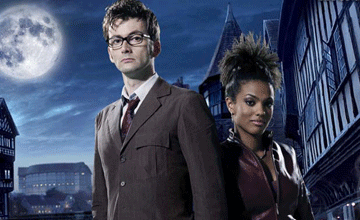
(Don’t miss the introduction to my Doctor Who drooling…)
(previous: Episode 1: “Smith & Jones”)
Ah, now here we have the genuine thrill of traveling with the Doctor: visiting the past. The future is cool and all, an undiscovered country, but history… ah, history is a storied place we never get to visit. Unless we’re with the Doctor.
I love Martha. She asks all the questions we would ask, the questions the Doctor’s companions should always have been asking: How does the TARDIS travel in time? What makes it go? She doesn’t get any answers, but that she asks is important, I think. Her curiosity about the Doctor is far more intellectual than that of almost any of the other human companions. She instantly fall in love with the Doctor, sure, and what better reason to keep hanging around with him, but she would be genuinely fascinated by the situation she finds herself in on its own even if she weren’t. Her questions about stepping on butterflies and killing one’s grandfather… this is a woman — dare I say it, a geek — who has thought about the implications of time travel before. She’s an excellent stand-in for us.
And never more so than when she finds herself in bed — if entirely innocently so — with the Doctor. Oh, poor Martha, so intimately face to face with him, and he’s thoroughly unaffected by it.
Still: she’s a practical gal, not one to go all screamy and girly at the first sign of something icky. Like the evidence for the lack of indoor plumbing that gets dumped at her feet. How the hell cool is she, anyway?
And how the hell cool is Will Shakespeare, too? He’s not taken in by the Doctor’s psychic paper, he catches on to the truth about the Doctor and Martha, and the power of his words is more than something metaphoric. There’s a steely backbone in this episode that seems to be a kind of standing up for its own silliness: words have the power to change minds, and “entertainment for the masses,” as the Doctor points out that Shakespeare was in his day, can be so much more than mere simple diversion. Will is the greatest genius of all humanity, Harry Potter Book 7 made the Doctor cry, so it’s okay if we’re getting way more caught up in Doctor Who than we should, right?
There’s a lot of meta going on here, actually. Like here, the Doctor urging Will to give up wasting time hitting on Martha at least until they save the world:
“We can all have a good flirt later!” — the Doctor
“That a promise, Doctor?” — Will
“Oh, 57 academics just punched the air…” — the Doctor
Now, c’mon: that’s gotta be a meta reference to the TV audience watching this episode — who else is listening? Whom else could the Doctor be referring to?
There’s a lot of meta going on throughout the entirety of this new Doctor Who. Pop culture references, for one, were never tossed around on the old Who — oh, maybe there was the occasional mention of Blue Peter, the BBC’s long-running kiddie show, but that’s about it. Sarah Jane Smith never dropped a quick allusion to how she was reading Roots or that she sometimes felt like Annie Hall; Jo Grant never complained she was missing an episode of Are You Being Served?. But now we have, in this one episode alone, references to Harry Potter, Back to the Future, and the Marx Brothers, all by the Doctor himself, not his human companion (although arguably his usage of the fake place name Freedonia is more generic than a nod to Groucho).
I’m tempted to say this is evidence of the influence of other recent TV science fiction like Farscape and Stargate SG-1, with their pop-culture-snarking heroes, but I think it’s the other way around. It’s not that you can’t make shows like these in the Aughts without featuring a hero who drops pop culture references left and right and so Who had better imitate that attitude if it wants to succeed; it’s that if you’re making this kind of show in the Aughts featuring a 30something hero, a hero you want to appeal to 30somethings (like the 50something Jack O’Neill), or a hero who at least appears to be 30something (like the Doctor in ), it’s inevitable that pop culture snarking will come into it, because that’s who we 30somethings are today. It’s simply natural for the Doctor (or, really, the 30something writers) to drop in nods to movies, TV, the Internet, because that’s what we all do these days. I don’t have memories of the Seventies that extend beyond my own limited kiddie experience to the world at large, but I find it easy to believe that grownups, on the whole, simply weren’t as obsessed with pop culture then the way grownups are today. If Jo Grant missed an episode of Are You Being Served?, well, that was it: it was missed. She couldn’t have TiVoed it to watch later, or gone online to read a wrapup at Television Without Pity, or Torrented the missing episode. But surely the Doctor can simply have the TARDIS tap into the satellite communications of the global TV networks if he misses an episode of Lost.
Of course, the Jon Pertwee Doctor could probably have popped forward to 2007 and simply bought Jo Grant a DVD player and a box set of Are You Being Served?… if only the writers at the time knew that.
Random thoughts on “The Shakespeare Code”:
• The Doctor failed his test to fly the TARDIS? Or was he kidding?
• On witchcraft: Once again we see that any sufficiently advanced technology is indistinguishable from magic.
• Expelliarmus! Tee-hee!
• There’s power in a name? What does that say for the fact that the Doctor has no name, or at least one that he won’t reveal? What’s the power in his name that he’s afraid of?
• Ah, so Martha was Shakespeare’s Dark Lady!
• We had the Bad Wolf arc back in Season 1. And the Torchwood arc in Season 2. And now fans have decided that Season 3’s arc is “Mr. Saxon.” (Don’t read this link unless you want spoilers.) But I’m seeing some interestingly arc-ish stuff in the fact that many of the “bad guys” in this season are creatures from the dawn of the universe, from the “old times” or “dark times.” Like “Runaway Bride”’s Racnoss, the Carrionites here, and other antagonists to come. I’ll be keeping an eye on this.
• The Doctor imprisons the Carrionites in the crystal ball — they’re not dead, but they are eternally captive by his doing. This is a grim theme that will repeat later on…
(next: Episode 3: “Gridlock”)














I can’t help but comment that the “power of names” as illustrated in this episode rings strongly of LeGuin’s classic cycle, Earthsea. The power of Earthsea‘s wizards is derived from the power of words, with the power of names being magic of the oldest sort. Wizards renounce their given (true) names and assume new names upon learning they have the ability to use magic. This is because learning the true name of a wizard grants a person supreme power over the wizard, just as it would with any object. As a result, wizards guard their names very carefully and often never reveal them – even to their closest companions.
Leguin explores this concept to great effect and I’m not surprised to see her influence here as justification for the mystery of the Doctor. The power of words is, of course, hardly a unique theme. Still, I found the parallels between these works unmistakable.
Your thoughts welcome.
Barbara, Ian, Vicki and the First Doctor watched the Beatles on the Time-Space Visualiser in the Tardis, in the 60s serial “The Chase“.
The Doctor failed his test to fly the TARDIS? Or was he kidding?
Didn’t he steal the TARDIS from a repair shop in Gallifrey, and that’s why it got stuck in the police box shape on Earth? I think that was established back in Hartnell’s era, but I could be wrong.
I too loved this episode, especially Shakespeare. I’m a firm believer in “Shakespeare wrote his own plays, damnit!” so I was glad to see the DW writers believed the same (even though they did have someone else write at least a portion of one of his plays, which was a nice reference to the other theories out there). Yes, the witches were waaay over the top, but hey–it’s Shakespearean witches on Doctor Who, they have to be over the top!! That younger witch was suitably dramatic and a reasonably threatening villain.
The end of the ep was great: “Elizabeth the First!!”
“Doctor! Execute him!” Or whatever. His confusion over why she would be pissed at him was hilarious.
I know all that about the Chameleon Circuit (remember when #4 temporarily repaired it about the time that they brought back the Master?), but I could swear that the established canon said that the Doctor had stolen the TARDIS (an older model either in the repair shop or being stored in a warehouse, which is why Romana dissed it for being so old-fashioned in her first ep) from Gallifrey, which is why he was not such a great pilot and couldn’t control where he landed with precision, especially in the first few seasons with William Hartnell.
Yeah, I remember that, too: that the Doctor stole the TARDIS, and the fact that there was supposedly something wrong with the TARDIS was the reason why it didn’t always land where the Doctor wanted it to land. But that wouldn’t necessarily preclude the Doctor having failed his TARDIS-piloting exam, either…
I think I’ve fanwanked it as he failed his TARDIS-piloting exam, but still had the jones to travel, so decided to engage in some Grand Theft TARDIS.
I LOVE this episode. I’m completely new to the world of Doctor Who (am catching up on S1 and 2 thanks to the internet) and I’ve fallen quite in love with it. Though if I wasn’t already in love with the Doctor this episode would have made it happen. Specifically this:
“We can all have a good flirt later!” — the Doctor
“That a promise, Doctor?” — Will
“Oh, 57 academics just punched the air…” — the Doctor
That made my entire weekend and I’m still giggling about it.
The bit you brought up about the Doctor and his name is really interesting and something I didn’t really catch but it’s incredibly intriguing.
I’m so ridiculously hooked right now.
Welcome, Katie, to the world of Who. :->
“what we learn from it is that the Doctor does, in fact, inhabit a continuously-recalculating, single-timeline, no-paradox Universe. Just because something happened in the past doesn’t mean that it WILL happen”
This is expanded on a little bit in “Blink,” which is, I think, the best episode of the season and, perhaps, the best episode of the new series. The idea is that time is not a line at all, but a big mass that we intepret as a line – it’s all very new cosmology. It’s also probably why Bad Wolf made so much sense. The past is as hard to predict as the future.
On the other hand, one wonders about the officious time monsters in “Father’s Day.” If everything self-corrects somehow – whether in the past or future – then why did they have to bother?
Anyhow, this episode was written by the same dude who wrote the pilot for “The Sarah Jane Adventures” and it had the same spirit to it – so much fun.
Welcome, Katie, to the world of Who. :->
Thanks. Very happy to be here.
On the whole, I liked this episode very much.
Of course Martha shouldn’t freak out too much over gross stuff – she’s a doctor, after all!!
My only complaint is that, here and there, Martha asks questions that a doctor would probably know the answer to. There was one early on (forgot what it was now – maybe a comment about the humours?) and one later on about Bedlam. Unless the doctors in England don’t study “History of Medicine?” So here and there, she sounded a little much much like Rose. Yes, of course she should be asking lots of questions about the TARDIS and the like. But she seemed a little slow on some issues of London history. And I think the costume she wore was all wrong – people in London might not have given a black woman a second look, but a woman in a revealing top and tight trousers??
Obviously, they’re part of the self-correcting mechanism!
“Obviously, they’re part of the self-correcting mechanism!”
I wonder where they came from, anyhow. Are they one of the creatures from the beginning times of the universe as well? I can’t remember how – or if – they were explained. I wonder who’s in charge of them . . . they’re like the drug-sniffing dogs of the spacetime continuum.
Regarding the “57 academics” comment, I interpreted it differently: Because Shakespeare seemed pleased with the idea of them *all* having a good flirt later, I thought the Doctor was commenting on the fact that the theory that Shakespeare was gay—or at least bi—appeared to be true. Hence the academics punching the air in vindication of said theory.
Yes, I understand all that, Laura. But to whom was the Doctor referring? Those 57 academics couldn’t have heard Will’s statement… unless they were *Doctor Who* fans watching this episode!
It’s kind of like “so-and-so rolled over in their graves”.
i took the “57 Academics” remark also to mean those who are convinced that Shakespeare was either gay or bi… and i thought it was almost as if he’d had the discussion with the academics himself, or had heard a lecture at the Oxford Union on the subject (oh. oh. fan fiction…)