
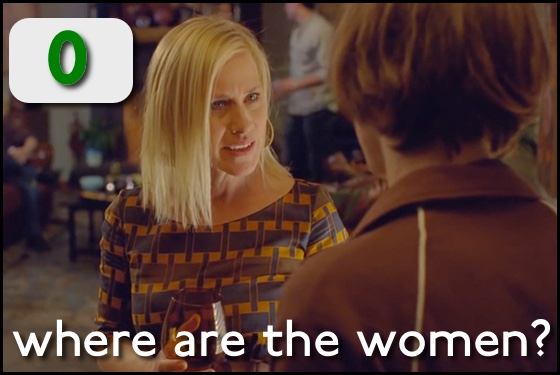
BASIC REPRESENTATION SCORE: 0
FEMALE AGENCY/POWER/AUTHORITY SCORE: +5
THE MALE GAZE SCORE: 0
[no issues]
GENDER/SEXUALITY SCORE: -5
WILDCARD SCORE: 0
Is there anything either positive or negative in the film’s representation of women not already accounted for here? (points will vary)
No.
TOTAL SCORE: 0
IS THE FILM’S DIRECTOR FEMALE? No (does not impact scoring)
IS THE FILM’S SCREENWRITER FEMALE? No (does not impact scoring)
BOTTOM LINE: I wonder if it ever occurred to Richard Linklater to make a film called Girlhood, especially since it clearly did occur to him to cast his own daughter in a supporting role where he would capture her growing up across a dozen years. Still, his decision to turn Patricia Arquette’s mother character into such a dynamic depiction of a woman’s life — including her life beyond her motherhood — is fantastic, and saves the film with regards to its female representation.
Click here for the ranking of 2014’s Oscar-nominated films for female representation.
NOTE: This is not a “review” of Boyhood! It is simply an examination of how well or how poorly it represents women. (A movie that represents women well can still be a terrible film; a movie that represents women poorly can still be a great film.) Read my review of Boyhood.
See the full rating criteria. (Criteria that do not apply to this film have been deleted in this rating for maximum readability.)
This rating is brought to you without paywall restrictions by my generous Kickstarter supporters. If you missed out on the Kickstarter and would like to support this project, you may:
• become a monthly or yearly subscriber of FlickFilospher.com
• make a pledge at Patreon
• make a donation via Paypal














Girlhood should have been the companion piece that he filmed concurrently with Boyhood. I would’ve seen ’em both.
There’s a brilliant French film called *Girlhood* now playing in limited release in the US. It’s not the female flip side of this film, however.