

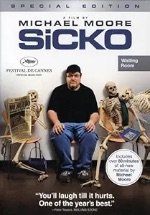
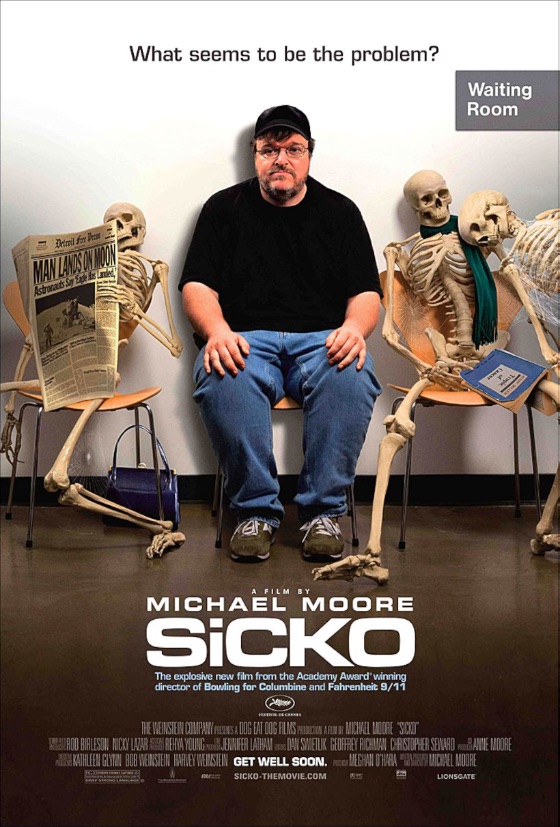
I can’t imagine a more important movie being released this year. I can’t imagine another movie making me feel so ashamed for America as a whole, or doing so with more justification. Damn you, Michael Moore, and bless you, for having the temerity and the guts and the balls to do what hardly anyone else is doing these days: yelling from the rafters that we are supremely fucked up as a nation, hollering about the very viable options we have to fix the mess if only we grew some backbone, and screaming with sincere conviction that it’s long past time to revolt.
Make no mistake: Sicko is an explicit call for revolution, and it is a profound and horrifying one. I’m ready to take up arms — I’m just not sure what that means at this particular crisis point. Among the many, many shocking and disheartening hard truths laid bare here, the most difficult one to parse is the one that wonders where and how to fire an effective first shot. But Sicko is, nevertheless, deeply satisfying in its own way, as if someone, finally, pointed out the 800-pound gorilla in the room, dared to laugh at the emperor’s nakedness, at long last said, “Fuck this shit.” Not that lots of folks haven’t been saying and doing these things for a long time, but here it is in one wonderfully brazen, wonderfully eloquent package.
The thing is this: Our health-care system in American is sick. Truly, madly, deeply sick, because it is geared toward ensuring obscene profits for the corporations in the health-insurance racket and not toward ensuring that people are hale and hearty. Moore (Bowling for Columbine, Fahrenheit 9/11) starts off by demonstrating that it is indeed a racket, with horrific tales of the crimes of HMOs, of all sorts of people being told they are “not eligible for insurance” because — get this — they’re sick. How evil is that? That insurance companies can deny coverage to people merely because those people would cut into the corporations’ profits? (Without ever using the phrase that “conservatives” seem to think justifies any and all corporate perniciousness, Moore points out that the “free hand of the market” is usually a slap in the face to most of us ordinary schmoes.)
The testimony from former HMO employees, who quit their jobs because they were so disgusted by what they had to do to keep people from the health care they needed, is absolutely ruinous to all the filthy CEOs who have allowed their fellow Americans — their fellow human beings — to wallow in unwell misery and to die miserably over mere dollars. Is there anyone more despicable? Why, yes, there is: the politicians who enable this demented system. Some of those obscene profits, Moore shows us, go to into the pockets of members of our Congress and Senate; it’s all a matter of public record, but Moore plays it up with his usual satirical flair… and he goes hard on both sides of the political aisle, lashing out particularly at Hillary Clinton, that once-champion of universal, government-run, noncorporate health care; apparently even she can be bought. Moore isn’t afraid to call it what it is: corruption at the most powerful inner sanctums of our national “leadership.” These people do not serve us: they serve their corporate overlords. Why do we stand for this?
But Moore is just beginning: we’ve all dealt with the horror that is our health-care system, and he doesn’t need to waste a lot of time telling us what we already know. So he heads to Canada, to Britain, to France, for Christ’s sake, to show us the alternative: systems in which wellness is a priority, everyone is looked after as needed, and doctors are free to actually care for their patients instead of wondering what services they are limited in providing because of some blood-on-his-hands CEO wants a new yacht. With wit that is as devastating a takedown as any angry rant could be, Moore makes fun of the image of “socialized” medicine that has been sold to us by, yup, those corporations with their obscene profits. And in the far larger context, he shows us how the American character has faltered under our system of “health care”; the inevitable next question he leaves us to ask is, How do we find the energy for a revolution when we’ve come to such a frail and feeble state in both body and soul? That’s the depressing crux of Sicko.
I laughed till I cried, sitting through Sicko, and I don’t mean that as a metaphor — I was taken down by wracking sobs of shame and pity for we Americans by the end of the film, when Moore takes a handful of 9/11 emergency responders who cannot get the medical help they need after their selfless work in lower Manhattan to Cuba, where they are treated with such kindness by Cuban doctors in the free hospital that it is heartbreaking, and mortifying. How have we Americans let such things come to pass, that the best and bravest and most altruistic among us are treated as disposable garbage? (And how we treat our weakest and most vulnerable is even worse, Moore has no hesitation in showing us, too.) How can we live with ourselves?
And that is Moore’s question. Though he tweaks his own notoriety more than once here, he doesn’t shy from being as aggressive as necessary in asking it: How can we live with ourselves?
















I’m so happy you gave this flick a great review. I work in pharmaceutical billing on behalf of Assisted Living patients with Alzheimer’s and a variety of other ailments and every day I beat my head against a brick wall when it comes to trying to make sense of their varying “private” insurance plans and try to get them the coverage for the medications their doctors prescribe and which these most vulnerable among us trust are supposed to be covered.
The prescription drug insurance industry is a farce in the USA. There is little relationship between drug costs to the consumer, reimbursement to the pharmacy, and the actual cost of manufacture.
I have been looking forward to this flick ever since MM said he was going to make it and I’m thrilled that my favorite online reviewers are giving it such high recommendations. People really don’t know what’s going on. You think single payer will lead to rationing? Catch a clue America–rationing is already happening. It’s just not happening in a rational way.
I watched the movie last night and it’s great
what’s more interesting about it for me is all that is not about health care, that old english man explaining how if you keep the people depressed they won’t protest and they will just accept whatever they get and never ask for more, and how the english would revolt to the very idea of not having what they take for granted, and it’s utopic in america
and how clear and obvious is that politicians speak against universal health care or socialize medicine not because they have dissenting political or ideological opinions, but because they are being pay for it, it’s just sad that people believe them (and that make people responsable for the situation aswell)
and also interesting is how people react to michael moore, of course is easy to criticise him for lots of reason, but who else is doing anything about it? who else is trying to make the least bit of diference?
if you don’t like how he says things produce your own movie to make a world a better place
That’s absolutely right. It’s about how our problems with health care are merely a symptom of how America has gotten derailed.
Yes, the English man gave some of the best part of the film. I also was moved by some of the stories that were told. I still don’t think the message is getting across well enough though. I think that part of the problem is that, in my opinion, an effective documentary should not seem staged. There are moments in every Moore movie that are obviously staged. Here, some of stuff taking place in France was obviously staged, such as the government woman doing the laundry for the family. Even if it is true, it loses its effect in the film because you know that Moore and his crew were there telling people what to do before they started filming.
And MaryAnn, you mentioned in another post about this film that you did not think it was as Anti-American as I did. Yet, in your first sentence you state that no other film this year would make you ashamed for America as a whole. I have heard responses from people saying that, after seeing clips from this movie, they want to move to Canada or France. Go ahead and do that. You will encounter a whole new set of problems. Utopia does not exist. For this film to have been successful it should have concentrated on the American system and how it can be changed. Instead, Moore spends probably 75% of the film explaining how other countries have it better than we do
So, if I’m ashamed of the mess my country has become, and I would like it to be better, that makes me anti-American?
Well, I guess disgust and shame are very strong words for me. Is this country fucked up in some ways? Yes. Do I still believe it’s the best country in the world? Yes. Just one more question MaryAnn, although I know this will start another firestorm of comments that will go on forever. And I don’t want to put anyone down, I am just interested in your response to the following question…
Were you ashamed of this country before January of 2001?
Myself, I can’t say I am any more or less concerned now than I was before Bush took office. It’s just that many people blame all of the countries problems on the current administration.
It’s all robbing Peter to pay Paul.
Look. People do blame all the countries problems on the current administration, but (like this film proves) the problems have been in our government for quite some time now.
Personally, corruption is going to run completely rampant in an age where companies can give money (among other things) to the members of the highest levels of goverment in order to influence their decisions. How is this legal? Why hasn’t anybody tried to stop this? This is key, in my opinion.
Recently, Sallie Mae (and other financial aid companies) have come under fire for “paying off” college financial aid counselors, with trips to exotic places and money, all so that they will sell their high interest private loans to students. Now, these companies have lots of lawsuits to deal with as a result of the suffering that they cause to these college students.
Why did I bring this up? Well, if it’s not okay for Financial Aid companies to pay off their customers (they pay off members of Congress too, by the way), then why the hell is it okay for ANYONE to pay off members of Congress! These are the people that make our laws! It’s a no brainer that things are very fucked up in this country right now.
I just applaud the fact that there are people out there that are trying to stimulate peoples minds and get the message out there like Michael Moore. We need more of this stuff, and it’s great that Moore has the reach that he does to be able to release his movies across the Nation. At the very least, it gets people like me and you talking about very important issues.
About some things, sure. And now there’s a ton more stuff to be ashamed about.
Where did I do that?
I’m certainly no bleeding heart, but I’m less concerned about Bush being in office than I am the fact that Bush was VOTED into office the SECOND TIME. After we already knew that he was going to listen to Rummy et al instead of Powell. I guess I should say something about the movie. Shame on people for letting Moore manipulate them, whether healthcare has a problem (it does) or not. That is no excuse for continuing to let this guy keep doing this.
Why a ton more things to be ashamed of MaryAnn? I have to say there was a shitload of stuff that I was displeased with 10 years ago, and about the same amount now. What really got me 10 years ago was the facade that was presented that we were a nation at peace. Now, there’s too much concentration on the fact that we are not at peace and little being done to correct things. I think Will explained things better than Moore did in his film.
Vergil- It’s true that Moore puts out propaganda. Any documentary, or anything with a message, can be described as propaganda. There’s nothing wrong with that. That’s not Moore’s current problem. He should be focusing on bringing out change instead of making these films with little substance. The world would be a lot better if the Michael Moore’s and Ann Coulter’s of the world actually used their power for something constructive. Moore can make constructive cinema. He has certainly done so in the past. He just needs to step off his high horse now and stop believing that it’s his opinion that matters most. It’s the countries opinion and well-being that matters most.
MaryAnn, apologies if you thought I was pointing you out for saying all of our problems are because of the current administration. Many others do think that way though. Too many people contribute whats good or bad in this country to the current president, administration. In the 90’s, we had a good economy and it was told to us it was solely because of Clinton. BS. Not only do economic policies take years to show signs of progress, Clinton did not do much at all to improve the economy.
One thing I will give Moore credit for with Sicko is that, unlike 9/11, he does not ignore facts so much that he places all of the blame on Bush. He also puts it to the Clinton’s here, and Nixon. He could have made a whole film about the mistakes of different administrations. With 9/11, it was almost laughable how he was trying so hard not to include anything that would make the Clinton’s look bad.
I work with refugees and see firsthand some very funny (and not the ha-ha kind) dealings going on with the healthcare system. It’s time for a change. I hope people know we can make it happen.
Thanks for the review; I can’t wait to see it.
Folks, I don’t know how to tell you this, but Moore has zero, and I mean ZERO credibility. He was caught in lie after lie, manipulated families in Columbine for his purposes, and was sued by people he lied about. Please understand that you “people” who liked this movie are simply fools. He may have had some good points, but don’t you care if he arrived at them honestly? Stop whining and go to Cuba if you hate here so much.
How about the millions and millions of people who voted to *reelect* Bush when it was already clear what an incompetent boob he is?
*bangs head on desk*
The first step in bringing about change in convincing people that change is possible, and that there are alternatives to the current mess. Moore and *Sicko* are not about Moore thinking his opinion matters most — it’s about him trying to change the nation’s opinion, which, as you say, needs changing. Didja miss the whole bit in my review where I say Moore is calling for revolution? When Thomas Jefferson wrote the Declaration of Independence, do you think he knew how the revolution he was calling for would shape up? That it would even succeed? Jefferson didn’t include the U.S. Constitution in the Declaration… would you have criticized him for not doing so?
(I’m not comparing Moore to Jefferson, by the way, just making an analogy about how changing minds is the *beginning* of change, not the end. Hell, it’s not even the middle…)
I really do wonder about people who are so terrified of dissent that they only response they can muster is this kind of nonsense. It’s clear these supposed “patriots” don’t have the first idea what is so important and so unique about the United States of America.
Oh, I’m not the least bit terrified of dissent – didn’t mean to confuse you. I was being a bit over the top. As to not knowing what’s great about America – it’s freedom. Not a communized, socialized society. Your vague reference to to me being unamerican is not effective or constructive.
What is great about America to you? Having the government control every aspect of our lives? Please, elucidate…
Also worth noting is that you didn’t address ANY of my points about Moore’s credibility. Pretty pathetic.
I have not yet seen this movie, but I agree
with your larger themes. This wealthy and heroic nation’s being consumed by a metastatic cancer (fueled by greed and racism?) where caring for others is often sneered at, spit upon and given pejoritive labels…So where do these trends eventually lead? My guess is that in folding into the mix other powerfully destructive global cross-currents the worlds population will be taken down
by more than half as the worlds billionaires and some select others retreat into bubble fortresses while those outside are left to slug-it-out. If there is a revolution, it may be to determine who gets in the bubbles.
Don’t bother arguing with Tigger, MaryAnne.
Some parts of American have long since made up their minds about Moore.
His next flick could be about how cute puppies are and conservatives will think he’s attacking the U.S.
another thing about michael moore that seems imposible to understand for some people:
a false friend will always tell that you’re doing great, that everything’s fine and you should keep it up
but a real friend will tell you the things you’re doing wrong even if you don’t want to hear it, he won’t lie to you and he will try to make you change for the better and that’t because he CARES
michael moore cares about his country, so goes out of his way to point out what’s wrong with it so it can be corrected before it’s too late (if it’s not too late already)
but I guess that’s too complicated and contradictory for some people
I’m not an american but michael moore is the only american I know about that I would call a patriot
Cry havoc, and release the dogs of Freeper war.
You may regret your decision to go to blog format before this thing dies down.
Anyhow, I’ll see it this week–thanks again for the intriguing review.
So then you’re for privating the police, courts, schools, and all our other “socialized” public services, are you, Tigger?
Perhaps Moore has zero credibility with you, Tigger, but he doesn’t for lots of people. And the cool thing about what Moore is telling us in his films, including this one, is that you don’t have to take his word on the facts he presents — you can independently verify them yourself. Like how numerous organizations like World Health and such are the ones who will tell you that the U.S. has the lowest life expectantcy and highest infant mortality rates of any Westernized, industrialized nation. And yet we spend way more on “health care” than any of those other nations where people are healthier and life longer.
For anyone who cares about the quality of life in the country, that’s something to be ashamed about.
And I hate to burst your litigious bubble, Tigger, but anyone can sue anyone. The fact of a lawsuit does not mean anything other than someone filed a lawsuit.
Ok, how do you know that the high infant mortality (not counting abortions, I assume) are due to the lack of socialized medicine and not irresponsible doctors ,parents, hospitals, etc. Where is the causation? Does waking up in the morning cause the sun to rise, or are there other factors at work??
Tigger Nitties writes:
“Ok, how do you know that the high infant mortality (not counting abortions, I assume) are due to the lack of socialized medicine and not irresponsible doctors, parents, hospitals, etc. Where is the causation?”
You may well be right, Tigger: America may well have a truckload of irresponsible doctors and hospitals to account for the high infant mortality rates.
What really bothers me is that – instead of being horrified about these damning statistics in one of the supposedly richest countries in the world – you’re acting as if irresponsible doctors and hospitals are none of our concern. Seems that you’re fine with any amount of infant mortality, so long as the blame for it is not placed on the current administration.
But maybe I misjudge you. My question is this – if irresponsible doctors, parents and hospitals are responsible for all this infant mortality, do you consider it’s society’s job to correct them, or do you think society should leave them alone?
Should they be allowed to carry on making those fatal mistakes, just so that we can boast that this country is free from regulation?
BOWLING FOR COLUMBINE delivered a powerful message, but we’ve never even bothered closing the gun-show
loophole. Likewise FAHRENHEIT 911 hit hard but the
war goes on…Also AN INCONVENIENT TRUTH, has a critically important message, but unless industry itself writes the legistlation and says “Here Congress, regulate us” it’s unikely to result in
a meaningful reversal of greenhouse gas emission.
And now SICKO. Yes if decades ago instead of JFK’s death, single-payer universal coverage would be reality today? Another guess is that the CIA
knew DR.STRANGELOVE’s release date [Dec.’63] and
took action before that movie could move public
opinions support for military desecalation…And finally, playing the “If you don’t love America, leave it” card is itself un-American. This nation was founded on the principle that reason and due process should trump force. For example the military is to be under civilian control…Tradgedy is when temptation’s too great, we all fall from grace… Comedy is EVAN ALMIGHTY-See it now!!!
William,
You are correct. It is Un-American to say that “if you don’t support America, leave it.” It totally ignores what makes this country great. I never said that those that do not love this country should leave it. What I said is that those who keep claiming it is better somewhere else, and threatening to leave, should do so instead of just talking about it. ‘Sicko’ is mostly a collection of information about how Canada, France, and Cuba are better than America. I have watched a majority of the film and very little concentrates on the US. That was my problem with the film. I expected an insightful look at our own crisis and instead got Moore’s Pro France agenda.
Perhaps we need to get industry out of our legislative bodies.
Moore does not threaten to leave. He shows us how things are better in other places, and asks us why we can’t make them better here. That is absolutely explicit in the film, Josh. But it does come in the last 16 minutes of the film, which you say you haven’t seen.
Well, I know I should refrain from complete judgment until I have seen the whole film. I was just commenting on the fact that a good majority of the film I saw seemed to not concentrate on this country but elsewhere. If that was the point of the film, Moore succeeded. If the point of the film was to open up debate on our own health care system, I think he could have done a better job. You’ve seen the film in its entirety though so I trust you know more than I do
I am not an American so please take these comments in this context. Healthwise, the US is looked at as the most dangerous country in the world to visit as a tourist – not because you are any more likely to get sick – but because the slightest injury could bankrupt you without hefty travel insurance.
So, when the Clinton administration came to power with a mandate to reform healthcare we all thought, “Great! The US is finally going to get its health system back in order.” We all stood by in amazement then while spurious arguments about socialization and nationalism weren’t countered by rational debate and hard figures available from any other western country. It looked like the administration wanted this initiative to fail.
If Moore spends a lot of time talking about foreign healthcare models it is simply to counter the boiling frog syndrome. ie: How do you know it’s hot if you don’t know what cold is? Moore would be the last person to nominate himself for sainthood. If he has over dramatized sequences in his films it shows a lack of confidence in his own ability to persuade – not a desire to deceive the public.
Sure, nobody should be claiming they have the perfect health system. What you do see from Moore’s foreign examples, however, is a very different balance of power between patients and their healthcare system. Here in Australia we have a mix of both public and private healthcare and health insurance. Of course the insurance companies see the US as their Nirvana and lobby the government to move in that direction while patient lobby groups push heavily for the British model. As long as both groups have equal power the scandals each uncovers in their rival’s operations server to simply keep everybody honest rather than bring down the system.
This is the heart of the matter when you put aside the figures and the politics and the social theory: who has the power? Any system, whether it’s socialized, privatized or just public will work if all the parties involved have enough power to keep the others holding to the bargain. After all, that’s why the American system worked so well for so long.
I will not give my opinion on this or any film until I see it. Makes perfect sense, doesn’t it?
Hey Josh, maybe you should wait to give your opinion of this film until you see ALL of it.
If this the last few minutes I have not seen of the film change my opinion, I will let you all know.
Josh Gilchrist said, a few days ago:
I always wonder about sentiments like this. What makes the United States a “better” country than any other modern democracy? How, specifically, is it better than Canada, New Zealand, Australia, Sweden, Switzerland, Spain, and Norway? How many other countries have people who believe that the USA is the “best” country actually lived in?
Oh, you expected reason and logic from a nation where a ridiculous percentage of the population actually believes the fairy tale of Biblical Creation?
What it really boils down to is this: Do we consider health care a basic human right? America doesn’t seem ready to acknowledge that the concept of a decent civil society in the 21st century DOES include health care as a basic right.
I’m not sure that’s the case with American any longer — perhaps not since the end of World War II. Corporations wield far more power than the collective public does. Until that changes, I’m not sure anything else will.
The last few minutes will not change the fact that yes, Moore does focus a lot on how things are in nations other than the U.S. But the overall impact is not “anyone who wants better health care should go live overseas” but “if Americans want better health care, stop listening to the bullshit of politicians and lobbyists who tell you it isn’t possible and look at how it’s working in practical terms in other places that don’t, in fact, worship Karl Marx.”
An excellent point, which Moore also makes when he points out that the vast majority of Americans don’t even have a passport and have never even left the country, never minding actually living in another country.
“If irresponsible doctors, parents and hospitals are responsible for all this infant mortality, do you consider it’s society’s job to correct them, or do you think society should leave them alone?”
My point was that socialized medicine won’t necessarily fix their incompetence. Health care, imo, should be a resource, not a business. Kind of like air, water, radio waves, etc. Health care employees should make money, obviously, but spending should be re-routed to give more care to people who can’t pay for themselves.Insurance companies are too powerful as well.
Hi everyone !
I just saw Sicko and wanted to respond to this message :
“Folks, I don’t know how to tell you this, but Moore has zero, and I mean ZERO credibility. He was caught in lie after lie, manipulated families in Columbine for his purposes, and was sued by people he lied about.”
and this one too :
“Here, some of stuff taking place in France was obviously staged, such as the government woman doing the laundry for the family. Even if it is true, it loses its effect in the film because you know that Moore and his crew were there telling people what to do before they started filming.”
Well, I can only write about the part I know : the one in France : of course, all of the services that are described are true : yes, when you just had a baby, you can have someone to come to your house and help you with the laundry, the baby or whatever (well, not ‘whatever’ but you know…).
There are some little things not entirely true : you only get 3 days after your wedding in addition of your 5 weeks of paid vacation. And you don’t actually get 5 weeks if you’ve got a part-time job : it depends on how much time you have worked in the past year. 5 weeks of paid vacation is for a 35h/week ; you get more if you work more, less if you work less.
For the rest of it I didn’t notice any significant mistake (about the system in France I mean).
And yes we have a lot of taxes but I have to say, when I see what health cost… OMG, I’m glad to pay some taxes (In fact I don’t pay so much taxes since I don’t earn a lot).
Voilà, just my 2 cents ;)
best for you all ! (and sorry, I don’t write in english very well…)
This message board is a perfect illustration of why issues in America, such as healthcare, never seem to get anywhere. Look at how quickly the discussion is distracted by irrelevant comments about things like terrorism or anti-Americanism or bush. Bicker about the flaws of Moore’s film if you will, but don’t lose sight about the heart of the matter. The best interests of a profit-driven HMO and the best interests of a patient are fundamentally opposed. It is an atrocity that a system based on providing care to people has evolved into something so inhumane. When it comes to our health & bodies, the power should not be in the hands of a third party. This conflict of interest means we have to seriously restructure our healthcare system; be it socialized or something else. The examples in Sicko of government-run healthcare in other countries to me did not necessarily promote a socialized healthcare system in America but instead pointed out there is no reasonable justification for continuing with a corrupt and insufficient institution when viable alternatives already exist. The lingering stigma created by 20th century propaganda is not an acceptable excuse to ignore the issue and maintain the status quo. Love or hate Michael Moore, agree or disagree with socialized healthcare, the problem transcends politics and our personal fondness or distaste for Moore’s work.
Tigger Nitties writes:
“My point was that socialized medicine won’t necessarily fix their incompetence. Health care, imo, should be a resource, not a business. Kind of like air, water, radio waves, etc. Health care employees should make money, obviously, but spending should be re-routed to give more care to people who can’t pay for themselves. Insurance companies are too powerful as well.”
So it turns out that we ARE singing from the same hymnsheet! That’s what I want for America – and that’s what Michael Moore wants too!
Here’s a story:
I have a 28 year old son who can’t afford to live on his own due to health care costs. If you think it’s difficult getting physical care with substandard or no health insurance, just get involved in the mental health care arena.
He was diagnosed in his early 20’s with a schizophrenic-like disorder and requires anti-psychotic meds to keep him moderately functional. Those meds alone cost him $300 a month. Fortunately, the state we live offers a program for ‘uninsurables’ for which he only pays $250 with a $2000 deductible.
Last year’s reaction to his meds landed him in the ICU and he will continue to pay off his share of the costs for that through 2010. No dental coverage – that’s out of pocket; no vision coverage – that’s out of pocket. Don’t even think about therapy which he needs in conjuction with his meds as well as his every-other-monthly visit to his psychiatrist for med management ($75 co-pay).
And he’s one of the lucky ones.
I’ve never understood how dental and vision care can be considered seperate from “health care” — are not our teeth and our eyes part of our bodies?
The Chicago Reader’s Jonathan Rosenbaum made a key point: Unfortunately, the biggest reason that someone like Moore is so important is that the news itself is so hideously derelict in its job.
Moore is acutely aware of this, and operates as a skilled PR tactician who seeks to lure the spotlight into places where it actually belongs.
The media’s treatment of someone like Moore is generally to hang a big condescending sign around his neck saying “politically biased”, which they rarely do with an industry representative or government official – these are always treated as
“respectable” sources, and rarely challenged, or even asked to account for their statements.
Why haven’t these HMO case studies been given the “scandalous” headlines instead of Paris Hilton and her courtroom antics? Basically Moore is doing the newspeople’s job for them. If they had been on this, things would never have reached this stage.
We act “shocked” to hear such stories. The fact is, there are those who have been sounding the alarm for a long time now, but such voices are always pushed to the margins of our public discourse.
If we find ourselves surprised by a film like this, one that briefly manages to break into the center of our attention, then perhaps we should take a hint and seek out those sources that have been covering issues like this consistently and substantively all along, and see what else they have to say.
(Here’s a question: How many of our other vital necessities are being managed like these HMOs?)
The center of attention is wherever we choose to make it. God forbid, is it possible that we might even take some of those hours away from the TV and devote them to a little civic participation? The country belongs to us; if we neglect it, how much can we complain when someone else steps into the vacuum to make a fast buck?
We all make time to cultivate our personal relationships. If we expect our society to be accountable to our needs, we have to assume a similar role in relation to it. The way it is functioning now reflects the balance of who is attending to this role and who, for whatever reason, is neglecting it.
Some of us are already doing that, Zeke, and have been for years. Which makes it extra gratifying to see someone like Moore getting made a big deal of for saying what others have been saying unheeded for years.
***Do we consider health care a basic human right? America doesn’t seem ready to acknowledge that the concept of a decent civil society in the 21st century DOES include health care as a basic right.***
Bullshit. I call bullshit. Human right my ass.
A right is not something that someone else has to provide for you, like health care, food, education, money, etc. A right is something you can do all day or all night that doesn’t put on a restriction on anyone else except to get the hell out of your way. Life, liberty, pursuit of happiness, speech, press, etc. Not any of that other shit.
I want to make it clear that I’m not arguing for or against socialized medicine, just that it’s a fallacy to call it a right.
“A right is something you can do all day or all night that doesn’t put a restriction on anyone else except to get the hell out of your way. Life, liberty, pursuit of happiness, speech, press, etc. Not any of that other shit”
I beg your pardon? Do you recall that in order to get these rights, many people fought and died? I suppose that wasn’t a restriction on them? Health care ISN’T a right in our country, but most logical people believe that it SHOULD be. Our country can afford to provide a universal health care system for all of its citizens with the taxes they pay. How can we call ourselves truly civilized if someone is denied the treatment they need (AND IS AVAILABLE) because of their financial limitations? Aren’t they citizens in this country, too?
A right is what we decide it is. There are many rights we now take for granted that have not always been considered rights. Free basic education didn’t used to be a right in the United States, but now we supply that to all residents, even the children of illegal immigrants, because we recognize that it is better for *everyone* that people be educated to a certain degree. Some other countries have seen the value in ensuring that higher education is available to those who want it.
We haven’t yet come to the same realization about health care, but we will… or, I suspect, nature will take care of it for us, one way or another. Even the most self-centered, least publicly minded person will come to realize that it simply makes sense that we ensure that everyone enjoys a basic level of good health and health care, though it may take an epidemic that doesn’t spare the rich and insured any more than it spares the poor who’ve never even seen a doctor to make it happen.
One doesn’t need to be a bleeding heart liberal commie pinko Marxist to understand the importance of tax-supported universal health care on a planet teeming with six billion of us.
Okay, is my post hard to understand or did you just fail to read it? (Oscar’s post especially is a complete no lo contedere.) All I’m arguing is semantics here. Not whether universal health care is a good idea or not. Maybe it’s a great idea. Maybe it’s a fantastic idea.
But what it isn’t is something you have a right to. No one owes you a damn thing, least of all health care. Rights don’t put restrictions on other people, and universal health care would in fact put restrictions on other people — someone would have to provide health care for you. That’s not a right, that’s a service. Just like public education, roads, police, and all that other good shit people like to get from the government.
This doesn’t really have anything to do with the movie or the issues it describes, it just pisses me off when say that not having health care is a violation of their rights. That’s a lie and it’s overselling the argument. (BTW: A right is only “whatever we decide it is” in the sense that toothpaste is whatever we decide it is. I mean, if we all decided rubber cement was toothpaste, by god, that’s what it would be. But it doesn’t match the current definition.)
As for the offer at hand, I think more resistance from the public to universal health care is not so much fear of socialism as much as people aren’t willing to accept the tax hike. In the end of course, they will naturally get from the government what they paid for.
Fuck, that’s not the right Latin phrase there. Way to look smart, Kenny.
In what way would universal health care put “restrictions” on anyone in any way that’s different from the “restrictions” that universal education does?
Yes, this is an issue of semantics, but *of course* some things that we consider “rights” DO put restrictions on other people: The fact that women and black people are allowed to vote reduces the power that wealthy landowning white men wield. Is this a bad thing?
Moore doesn’t deserve the same ‘pass’ that a, say, Oliver Stone might get for making an entertaining fiction such as the movie JFK. He always gets good reviews from critics because (besides the similar political viewpoint) his movies are indeed entertaining. But Woody Allen’s ‘Zelig’ or ‘Take the Money and Run’ are at least as entertaining, but would never be considered for a “Best Documentary” Oscar. Should the movie Armageddon be considered a documentary? After all, the threat of impact by a comet or meteor is very real and it probably had more than a little to do with getting a little extra funding to that slice of NASA’s pie. “But it’s not the same thing at all!” you argue. Just because the people in ‘Sicko’ are using their real names, doesn’t mean they aren’t acting. And just because the Hospitals and Homes are shot “on location” doesn’t mean they aren’t sets. Apparently, a movie which claimed that the war in Iraq was planned and funded by an Alien Menace and used logical fallacies, nice cinematography, and a stirring score would be a great documentary, as long as it got us out of that war. The criteria used to judge a documentary are, of course, highly subjective. But if we base this judgement purely on entertainment value or as a means to an end, then why separate them from any other movie? I personally expect more, and honestly find the praise of such Jerry Springer yellow journalism disturbing.