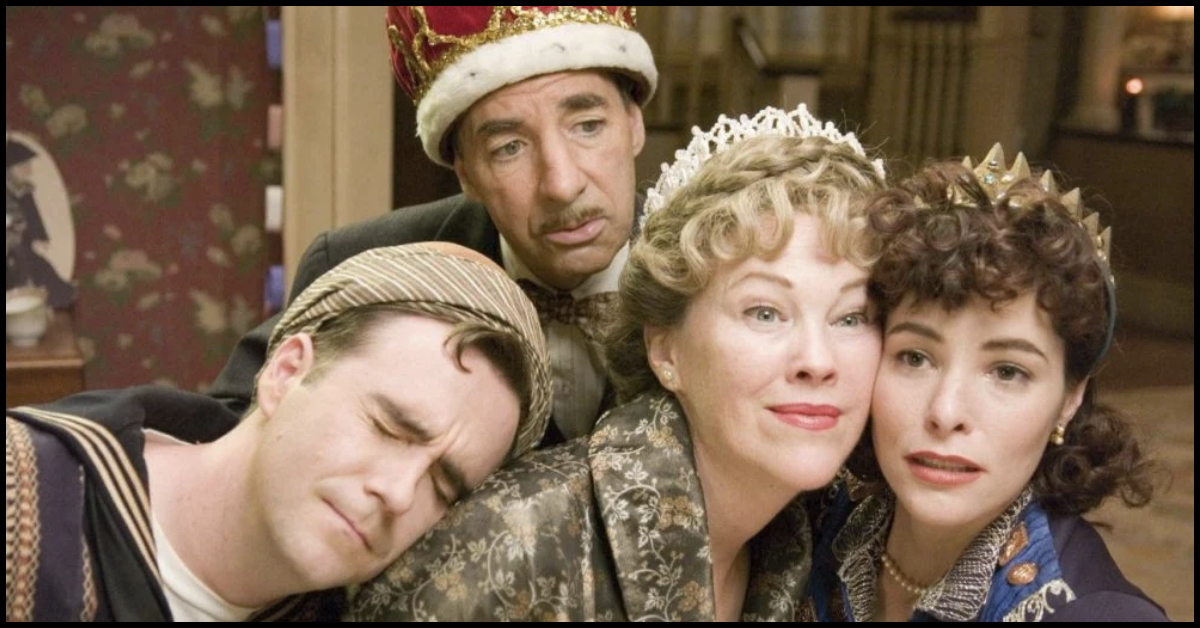
Christopher Guest and his merry band of pranksters are at it again, improvising a loving, teasing romp through a realm we love and love to hate, one bloated with its own self-importance full of people fascinating and repellent at the same time, simultaneously passionate about their work and clueless about how their drive can lead them to ridiculous extremes.
Or maybe not so much clueless here. Guest (Best in Show, A Mighty Wind) dumps the mockumentary format this time around in For Your Consideration, giving us a straight-up narrative that perforce offers a more oblique angle on his subject than we’re used to from him — and not looking head-on adds a layer of distress that makes it harder to laugh at the film, funny and pointed as it is, and easier to see the underlying pathos that has always been a part of his mockumentaries. Peeking in from the side, fly-on-the-wall style, we suddenly see the self-awareness, the hidden desperation, the happy face that falls away for a sadder one when the cameras are switched off.
Hollywood is Guest’s bitch here, and it’s an easy target, but neither he nor his usual gang go for the easy laughs… at least not all the time. Home for Purim is a boutique-studio film — not an indie, but one off the radar of the honchos until a snippet of Internet buzz predicts Oscar love for its star, Marilyn Hack. Catherine O’Hara is superb as Hack — her Hack isn’t a bad actress, and she’s only a little full of herself; the joke about a potential Oscar nom has more to do with the kind of overly sentimental melodramas that tend to get the Academy’s attention than with any particular unworthiness on Hack’s part. Likewise, Home for Purim isn’t so much a joke in itself — ha, ha! the movie about the obscure Jewish holiday with the funny name is actually, oh dear, something really rather sweet in spots — as it becomes a focus for the penchant of Hollywood to water everything down until it’s nothing but a pale shade of insignificance. (Those honchos who suddenly take an interest in the film can’t resist reworking it in their own image.)
I mean, sure, there’s all sorts of the usual fresh Guest humor in the barbed skewering of agents (Eugene Levy’s incompetent shark), of entertainment journalists (Fred Willard and Jane Lynch, wickedly sharp), of producers (Jennifer Coolidge’s dumb bunny). But there’s real weight in Guest’s own Jay Berman, the director of Purim, who has only gentle ribbing and a lot of genuine appreciation for the minefield filmmakers walk through. There’s not a lick of satire in Christopher Moynihan’s Brian Chubb, costarring in Purim without having gone native: his failure to embrace Hollywood bullshit is its own little tragedy, one that we witness in a way that we might not have in the mockumentary format. It’s only because we’re not so sucked into the perspective of the other characters so caught up in themselves that we are able to see him as strangely tragic in the first place.
It’s in two scenes that our subjects do appear on camera, while we watch from the wings, that the suddenly deeper poignancy Guest has uncovered in this new scheme becomes clear. In one, a publicist on the set of Purim interviews some of the cast and crew so she can create promotional material: her chat with the screenwriters played by Bob Balaban and Michal McKean is painfully inane, and the horrified stares she receives from them wouldn’t have worked in a mockumentary — they’d have to be far stronger sendups than they are to have justified their appearance, but they’re effective here precisely because we can see them, over the course of the whole film, as very slowly getting sucked into the Hollywood neverland.
But it’s the bit in which the cast of Purim is interviewed for e-television by Willard’s and Lynch’s bimbos that the real power of FYC shines through. Subtlety and nuance are not in the vocabulary of these two idiots, and though the actors keep up brave faces for their camera, we see, when the spotlight moves away, how dismayed they are. Because we’re not looking at them through the camera this time, we see how they really feel about themselves and the shallow world into which they’re immersed, and it’s not so good. Who was it who said comedy isn’t pretty? That’s more the case here than it has even been before for Guest and Co., and the upshot is that this may be their most affecting movie yet.