For the Discriminating Man
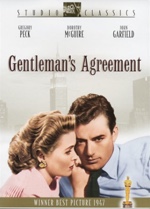
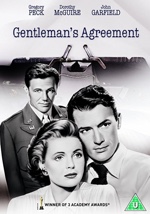
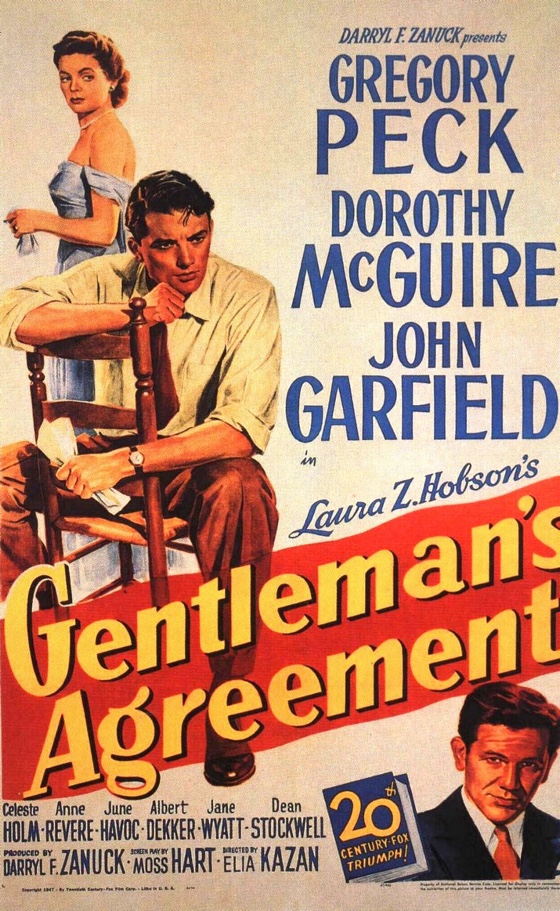
Gentleman’s Agreement proves that The Lost Weekend of two years earlier wasn’t an aberration — Hollywood in the 40s, while not abandoning sheer entertainment (though often with solemn underlying themes), began exploring serious social problems in an upfront manner. Gentleman’s Agreement may be a trifle too earnest at times, but it’s obvious that screenwriter Moss Hart and director Elia Kazan felt strongly about their subject.
The title refers to the unspoken agreement among gentiles to discriminate against Jews, and renowned writer Skylar Green (Gregory Peck) has been hired by Smith Weekly magazine to write a series of articles on the problem. Green is disappointed with the assignment and wonders what there is that’s new to say on the subject. He fights writer’s block until he hits on his angle — he’ll pretend to be Jewish, and then he’ll be able to report with a firsthand perspective. His pretense works — he’s new to New York City, so no one knows him. He introduces himself around as Phil Green, writer and Jew. Trouble begins immediately: His young son, Tommy (an adorable Dean Stockwell) gets into schoolyard fights with ignorant little bullies. Green’s new girlfriend, Kathy (Dorothy McGuire), society girl and niece of Smith Weekly’s editor, is in on Green’s secret, but because she can’t tell, there’s some upset with her ritzy Darien, Connecticut, set. He encounters prejudice on all sides, even from Jews.
Gentleman’s Agreement offers no solutions for conquering the kind of discrimination Green exposes, or even for handling the frustration it engenders in its victims. But ever hopeful in the face of unthinking hatred, Green’s mother says, “Wouldn’t it be nice if at the end of century they decided this wasn’t the American century or the Russian century or the atomic century but everybody’s century?” She, of course, was wrong. Not much has changed in the last 50 years.
In fact, I’m surprised Gentleman’s Agreement hasn’t been remade recently, with the writer character pretending to be gay instead of Jewish. Say, get my agent on the phone…
Oscars Best Motion Picture 1947
unforgettable movie moment:
Green tries to explain anti-Semitism to his young son.
previous Best Picture:
1946: The Best Years of Our Lives
next Best Picture:
1948: Hamlet