

I’m “biast” (con): nothing
(what is this about? see my critic’s minifesto)

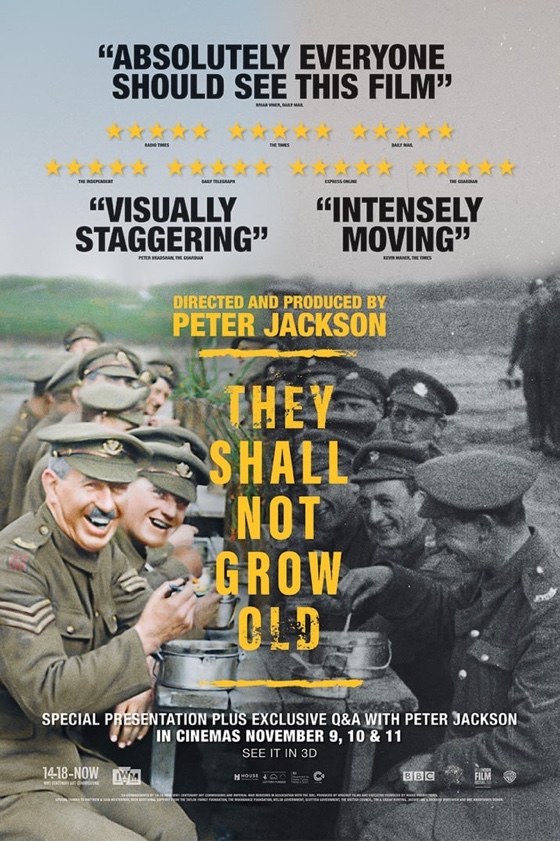
So London’s Imperial War Museum went to Peter Jackson and said, “Look, we have all this amazing archival footage from World War I, can you do something cool with it for the Armistice?” And the BBC was all, “Hey, we also have a ton of audio of WWI veterans talking — in, like, the 1960s — about their experiences during the war. You could use that…” And Peter Jackson (The Hobbit: The Battle of the Five Armies, King Kong) said, “You got it,” and They Shall Not Grow Old is now here.

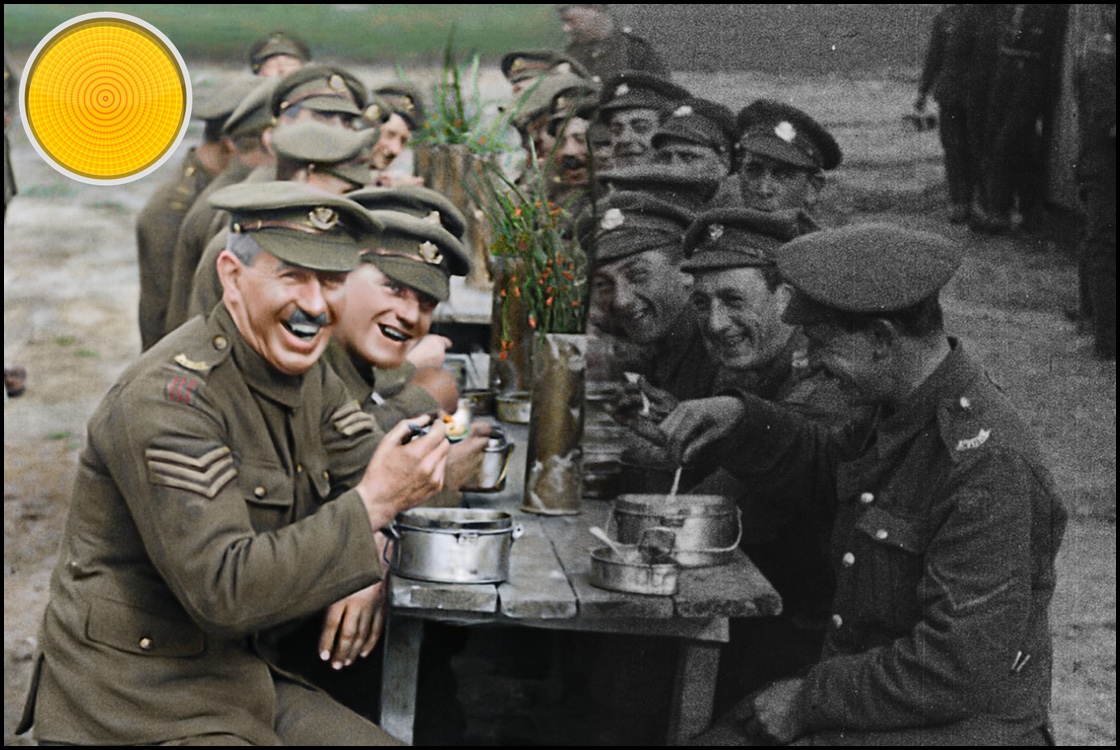
Technically, They is a marvel, a use of CGI and who-knows-what other computer wizardry to bring to life the world of a century ago, and in a way that feels more natural to our eyes today than the jittery, unaltered early film now appears to us. Footage of everything from soldiers queuing to volunteer for army service as the war broke out in 1914 to tanks rolling over trenches toward the end of the war has been colorized faithfully; the frame rate has been stabilized so that motion is smooth and realistic; and it’s all even been extruded in 3D for the theatrical versions. Ambient sound has been added, sometimes with actors providing dialogue extrapolated from lip-reading the faces in the original footage, which of course would have had no sound.

There’s an inevitable poignant eeriness to it all: we are looking into a past that suddenly feels touchably close and immediate like never before, looking at the faces of men that, many of whom, will not have survived the war. (The title comes from Laurence Binyon’s 1914 poem “For the Fallen”: “They shall grow not old… Age shall not weary them…”) But They never transcends its gimmick. And yes, it is a gimmick: one used respectfully and to honest, heartfelt purpose, and without overwrought sentimentality or any hint of tackiness. But this isn’t a movie: it’s a museum exhibit, one that you might sit and watch for a few minutes at, say, the Imperial War Museum, and be deeply moved by. And yet there are limits to that. There’s no story here, no narrative beyond the progression of the war itself. There are no characters to speak of. Even the narration — which comes solely from the reminiscences of survivors decades on describing everything from how they lied about their ages in order to sign up, to the camaraderie and the adventure of the war, to the discomfort of the mud and the horrors of the gas — is provided by voices that are not identified, and so we cannot even connect them from one sequence to the next (if indeed any are even the same from one sequence to the next). The complex messiness of the war has been flattened out into a video photo album.
They Shall Not Grow Old is an important document, but cinematically it’s a novelty. A solemn one, but a novelty nonetheless.
viewed during the 62nd BFI London Film Festival
















I can’t imagine finishing watching this and whining about a story.
“Whining”?
Oh please. She hit every thought and issue I had with the film. And so did many other critics and writers.
Terrific intelligent review. I could not possibly agree more. You hit every thought I had about it. I thought the same thing about it being a video that accompanies a museum exhibit. The footage in this film is fantastic and shocking to behold, but it is not a great documentary film by any stretch. There’s a reason it didn’t make the Oscar shortlist of 15 docs. The voices of the veterans were in an onslaught fashion where it was difficult to even dwell for a moment on what was being said, and they often didn’t match the footage. it would have been much better if they were identified by name, and slowed down with spaces of silence in between. Museum audio/video presentations are done exactly as in this film. This was a bit of a disappointment to me, and I’m not alone. And I agree with all your other points, and more. But like you said, It is a masterful achievement in footage restoration, and it deserves to be seen.
What did you want, a hero? As Stalin said, one death is a tragedy while a million deaths is a statistic, and World War I was in the realm of statistics. It is the illusion of young soldiers that each of them is the star of his movie and will live through it till the end of the last reel or, at least, die tragically. The reality is that they’re expendable, replacable commodities, like ammunition. There’s a reason that soldiers’ clothing is called a uniform. They Shall Not Grow Old captures very well the uniformity of Tommy’s experience in the trenches of the Western Front, a story that has been often told in these past 100 years but never shown as convincingly as by Jackson’s reconstruction of contemporary footage. The various narrators are anonymous precisely because their experience is interchangeable. The only narrative arc necessary is the movement from innocence, through squalor and horror, to exhausted survival. To me the most poignant element was the introductory voiceovers, in which old men, fifty years later, minimize the horror they survived with that distinctively British combination of stiff upper lip and its working class equivalent, musn’t grumble, calling it just a job or a day’s work because, you see, it just wouldn’t do to make a fuss about themselves as individuals.
She wanted a documentary with a story that she, as a critic, found more compelling, like this film:
https://www.flickfilosopher.com/2014/06/forgotten-men-documentary-review-antiwar-hopes-wars.html
As she said clearly in her review, she appreciated Jackson’s film as an important historical document but didn’t think it worked as a piece of storytelling.
You’ve articulated clearly why the film works for you, and other people in the audience may find they agree. But your experience is not universal, which is why there are so many critics on the internet.
The documentary described in the review you linked to has an explicit political point of view. MAJ is able to speak for herself, but are you suggesting that that is what she means by storytelling? They Shall Not Grow Old focuses on the pathos of the individual experience and leaves the viewer to draw his own political conclusion. I brought a lot of historical background to the movie. My friends who have only the general sense that the European countries blundered into the war, tended to have the same political reaction: what the hell was it all for, anyway? Since people have been asking that question about World War I for the past hundred years, I’d say that the political subtext is there, just not explicit.
Complete non sequitur response to my review.
You may feel this is the case. I do not.