

I’m not sure who this film is for. Starting at Zero: Reimagining Education in America is presented as a documentary, but it plays more like a slick PowerPoint presentation that might be shown in a breakout room at a political conference… aimed at policy wonks, not at ordinary voters and citizens.
Ostensibly, Zero is an argument for comprehensive, mass early childhood education, beginning in a child’s first year. That’s not about forcing toddlers into regimented scholarly learning: we’re talking about quality day care in which the youngest children are socialized with their peers via guided play led by expert teachers specially trained in child development. It sounds like a win-win all around: kids get a great start in life, and parents get a safe place to leave their children while they’re at work. Really, is there any debate about this?
Turns out, there is some question about whether the academic benefits of this kind of early childhood education carry over into more traditional schooling as kids get older. Zero all but ignores that question and only barely touches on the human benefits that do seem to endure, the ones that come from ensuring that kids are happy, curious, and cared for and that parents are able to go to work secure in the knowledge that their children are well looked after.
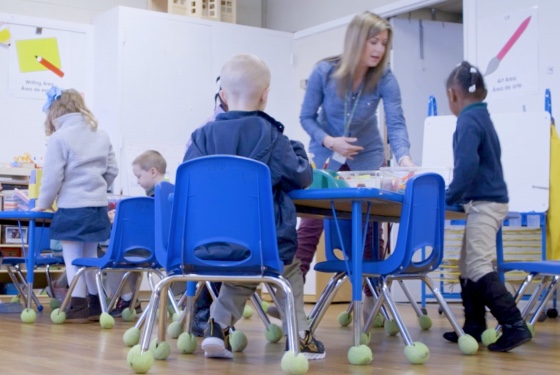
Zero opens with a statement that it is nonpolitical, and it certainly is nonpartisan. Yet its emphasis is on the large-scale economic benefits of early childhood education, the ones that supposedly come from well-educated citizens (the very matter that there is some question about) making better workers. The array of talking heads — mostly US state governors and other functionaries, academics, and the like — go on and on about “a more skilled workforce” and an America that can “compete against the world and win.” For all the glossy footage of laughing children playing in colorful classrooms, it’s a terribly reductive, cold way to spin the value of quality day care.
Of course, a “strong economy” is important, but the need to mold children into cooperative corporate cogs is hardly a message to resonate with a general audience. And perhaps needless to say, there is literally no exploration of whether it might be our economy that needs some reimagining, for how it consumes the waking hours of too many citizens and still too often fails to fulfill basic human needs. Starting at Zero has a running time of just over an hour, so it’s not as if director Willa Kammerer — making her feature debut, if just barely — had no room for more nuanced discussion of the issues at hand. One wonders why we don’t find that here.














I just saw the trailer – but on that basis I see exactly what you mean – the film looks like a lobbying instrument aimed at our corporatocracy
As a sales pitch, it seems framed in the language of those policymakers and sponsors who would be in a position to greenlight the reforms it’s calling for
Given our corporatized social and political climate, it’s entirely possible that these filmmakers could have been thinking in qualitative, humanistic terms – but may have felt this was a more effective way to present their case to the potential decision-makers in question
It is quite unsettling to consider, though – looking at this raised the question –
What Are People For?
What happened to We the People? The point of society is to serve US – to maximize our quality of life
– and yet we see here that, where the conversation has the most impact, it has to be framed the other way around, in this inhuman cost-benefit- analysis discourse
– for the decision-makers to actually listen, for them to regard us as fellow spirits, we’re expected to argue in terms of how much more we and our children will be serving THEM