Pairing older men with much younger women is so much a part of Hollywood’s standard operating procedure that it comes as a bit of a shock — albeit a pleasant one — to find a film that not only acknowledges the age gap between its leading couple but makes it part of the story. The nearly three-decade age difference between Emma Moriarty (Sally Field) and Murphy Jones (James Garner) isn’t all their relationship is about, but it’s an important thread that’s smartly woven into the gentle, warmly humanistic story that is Murphy’s Romance.
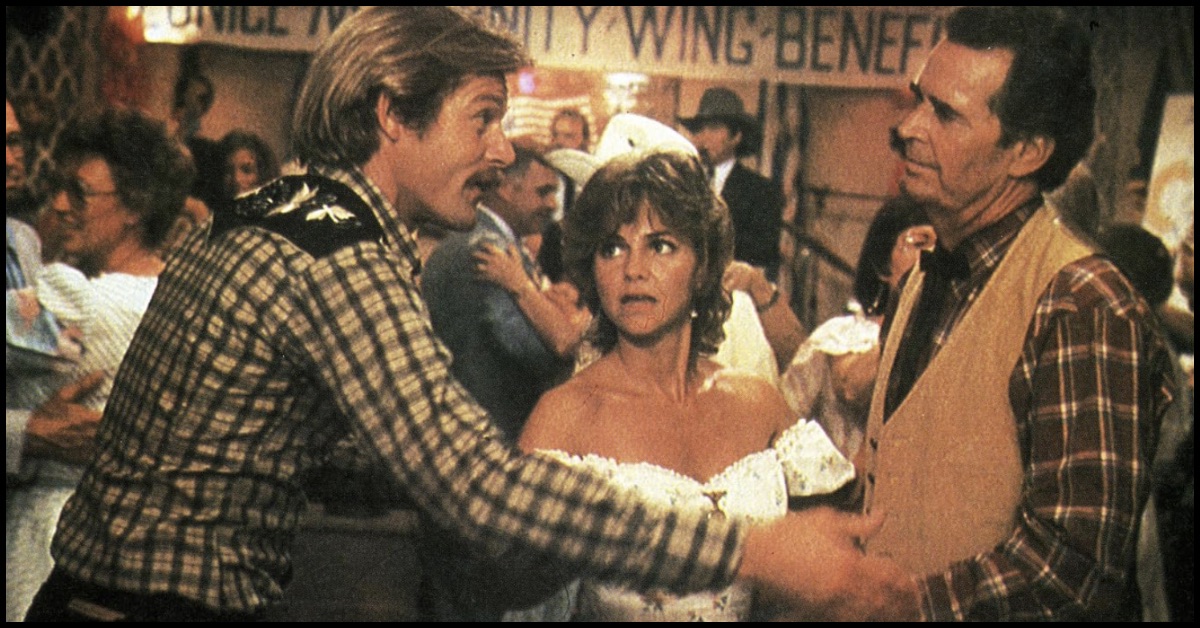
The recently divorced Emma moves with her adolescent son, Jake (Corey Haim), to rural Arizona, to start a horse ranch. Murphy, the local pharmacist, is her first new friend — a widower, charming and ruggedly handsome, he’s “like catnip to a cat” to the local ladies. He rubs Emma the wrong way, though, with his penchant for fighting city hall and his refusal to grant her a loan, as he has done for other townsfolk, when customers for her ranch prove hard to rustle up. He’s taken with her, though, and begins to court her in so unassuming a manner that she doesn’t even seem to realize she’s slowly being won over. But then Emma’s no-good ex-husband, Bobby Jack (Brian Kerwin), shows up and moves himself right back into Emma’s life, and he doesn’t like the old geezer hanging around her, not one bit. Of course Emma and Murphy end up together in the end. But how they get there is a delightful journey that’s worth taking with them.
Where other films try to pretend that a sixty-ish man with a thirty-ish woman is how the man/woman thing usually works itself out, Murphy’s Romance, happily, needs to give Murph a push in Emma’s direction. (How refreshing: the suggestion that perhaps this is not automatically a suitable coupling.) Instead of Murphy’s attraction to Emma seeming like a desperate midlife plea for attention and an attempt at validation of his manliness — as similar pairings in other films so often come across, usually unintentionally — we’re reminded that the need to love and be loved knows no boundaries of age. Murphy’s friend Amos Abbott (Charles Lane), a spry 89-year-old who’s about to be married, announces that “youngsters” like Murph hold no monopoly on romance. That, finally, is what seems to convince Murphy to fight for Emma, for it is indeed romance that draws him to her. He is, simply, in love with her, and merely for her spunky self, and not because of deficiencies he perceives in himself.
Murphy’s Romance is so wonderful and so rare a film because, ultimately, it’s not about anything more than two people falling in love. A profound experience, to be sure, but also one of the most uncomplicated, and one that this film depicts plainly, honestly, and — here’s a concept that often eludes Hollywood — with amiable realism.
This review originally appeared at the now-defunct Apollo Guide.