

I’m “biast” (con): really tired of manic pixie dream girls
I have not read the source material for Paper Towns
(what is this about? see my critic’s minifesto)
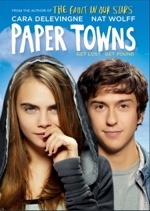
Here we go again. Lonely, misunderstood teen — a boy, of course — discovers life and adventure and excitement via kooky gorgeous “miracle” neighbor: who is a girl, of course. Margo (Cara Delevingne: The Face of an Angel, Anna Karenina) is prone to wearing black nail polish and saying things like “I’m a big believer in random capitalization” and climbing into the bedroom window of Quentin (Nat Wolff: The Fault in Our Stars, Palo Alto) in the middle of the night to take him on an “epic adventure” that she promises will be “the best night of your life.” And it is, because even though this epic night is mostly taken up with pranks on the level of toilet-papering someone’s house, they’re only 17 years old; they haven’t done much. (Plus, they live in Orlando, which is not the most thrilling place on Earth.) Gosh, boring ol’ Quentin is gonna be so transformed by Margo’s joie de vivre and quirky mysteriousness!
Margo might be the most manic, most pixie, most dreamy manic pixie dream girl ever. Infuriatingly, this is intended as a feature of this parade of forced charm and dreary adolescent angst, not a bug. Based on the novel by John Green — who also wrote The Fault in Our Stars, which made for a far more engaging film than this one — Paper Towns thinks it’s all about debunking the myth and the mystery of the manic pixie dream girl, by leading Quentin on a quest to find Margo when she disappears after their “epic adventure,” a quest that ends when he learns that Margo is a messed-up human being, not a “miracle” and not a fantasy object for him. This is not a spoiler, unless the notion that girls are people too comes as a shocking revelation, as it seems to for Quentin.
The problem with Paper Towns — from director Jake Schreier, who made the genuinely charming and funny and insightful Robot & Frank — is that by the time Margo’s MPDGness is debunked, she has already served the precise purpose that MPDGs always do: she is not a person in her own right in the story but a prompt for Quentin to grow and learn and change. The idea of Margo — not even Margo herself! — fosters and supports Quentin. The film explicitly excludes the possibility that its story could be about Margo by telling us that whatever is going on with her is “her story to tell.” And Paper Towns has absolutely no interest in telling it.
If teenaged boys truly do need to be sat down and have it explained to them that girls are actually people coping with their own personal disasters and detours, the way to do that is to let girls tell their stories, not continue to turn them into props for the betterment of boys’ humanity. Just let the girls have their humanity.
manic pixie real girl
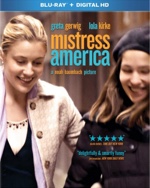
Greta Gerwig’s Brooke, in the marvelously fresh and funny Mistress America, isn’t a manic pixie dream girl, at least not in the cardboard barely-there sense that the term usually denotes. She is an inspiration to her soon-to-be-stepsister, Tracy (Lola Kirke: Gone Girl), and a prod for the quiet college freshman to get out and experience all the weird wonderfulness that New York City has to offer. But it’s absolutely clear from the get-go that if Brooke is a force of nature, she’s more tornado than summer breeze: as wantonly heedless and thoughtlessly cruel as she is confident, as full of herself as she is full of ambition. She is a whirlwind of creativity and a fount of possibility with, apparently, no idea how to follow through on anything.
Mistress America — the title comes from one of Brooke’s never-to-be-achieved ideas for a TV show about a female superhero — is very much what a story about a manic pixie dream girl might look like if it booted out the mopey guy trailing around after her and let the woman herself take center stage. And then pulled back the veil on her alleged perfection to reveal her complicated, contradictory humanity. Brooke is, Tracy eventually decides, “all romance and failure.” Which is one of the most bracing ways to describe a woman onscreen that I have heard in forever, because “failure” isn’t something we let women in movies be (unless they’re villains to be thwarted). Yet failure — and learning from it — is absolutely essential to a character’s growth and to any portrait of a believable person. That pop culture rarely lets women experience this is a huge problem, and contributes to the deficit of humanity granted women
But here is Brooke, all romance and failure, and a hoot to spend time with, even if she is a mess. Her mess is what makes her fun, in fact. Director Noah Baumbach (While We’re Young, Frances Ha), who cowrote the film with Gerwig (Frances Ha, Lola Versus), turns the adventures of Brooke and Tracy into something that feels like a mashup of, well, Baumbach’s usual bohemian caprice, a John Hughes-ish lark, and old-fashioned screwball comedy, all rapid-fire wit and snark and aching wisdom, though sometimes of the variety that the speaker doesn’t realize she’s hit on. There’s suspense, too, in wondering whether impressionable Tracy, who very quickly comes to adore Brooke, will mold herself in Brooke’s image — probably not the best idea — or find her own way.
Fie on those guys who need manic pixie dream girls to help them find themselves. These two women are muses and motivations for each other as they try to figure out where they fit in, what they should do with their lives, what they even want in the first place. Girls and women need help along the way just as much as boys and men do. More movies need to appreciate that, and show us that.
See also my #WhereAreTheWomen rating of Paper Towns for its representation of girls and women.
See also my #WhereAreTheWomen rating of Mistress America for its representation of girls and women.


















I actually enjoyed the book, it was well-written and very funny in parts and the central mystery was actually pretty engaging. It was still annoying as far as the “privileged white boy finds meaning in his life with the help of a kooky troubled girl who should have better things to do with her time” theme went, but at least it had the foresight to call its main character out and rip the rug out from under him in a way that felt weighty for a YA book. The film didn’t even do that. I’m pretty interested in Missus America, I like Gerwig and Baumbach a lot too. I wish their films had more racial diversity but at least they do right by their female characters.
Agreed. I reread the ending of Paper Towns after seeing the film, and it plays out quite differently. The film’s conclusion undermines a lot of what it thought it was about, even more so than the book.
What’s infuriating is that the director of Paper Towns HIMSELF seems to know what’s wrong with it:
“If you really want to solve the problem of Manic Pixie Dream Girls and male protagonists, the best thing to do is to make movies with female protagonists.”
He’s just not going to be the one to do it.
Well, that *is* infuriating.
Gurgh.
Baumbach is currently one of the most overrated writer/directors in
film. If I want to see a Woody Allen film I’ll rent
one. Whit Stillman’s writing about this crowd of people (what would be
white and hipster today) is far beyond Baumbach’s or Gerwig’s ability.
Neither Baumbach or Gerwig are that talented. Frances Ha was even worse
with its silly dialogue and overall pretension. The characters are
cardboard thin. But all that pretension and ‘quirkiness’ is welcome to
that largely white and hipster crowd that swoons all over stuff like
this.
One of the worst aspects of movies like Frances Ha and
Mistress America is the idea that these characters represent life in
NYC. I imagine anyone of color being completely bored watching this
typical white privileged nonsense.
So at least do it well and do something original.
Well, I enjoyed Frances Ha despite its extremely narrow scope, mainly because I like Gerwig. She’s cheerful and passionate without being overly twee and melodramatic as Zooey Deschanel often is. The characters in Baumbach’s movies do, in fact, represent life in NYC for a very small subset of people: young, white, overeducated, self-absorbed, entitled, jewish hipsters. The TV show Girls highlights a similar slice of humanity – the Wes Anderson demographic.
Classic Woody Allen films focus on a slightly older, more affluent group of jewish white people. I don’t mind that Baumbach is trying to put his own minor twist on Allen’s formula. Watching Frances Ha felt like sticking my head inside of a safe, comfy bubble – I feel similarly when I watch a fashion show or a football game. Everyone inside the bubble takes everything very, very seriously within their realm, blissfully unaware of anything going on in the world at large. Baumbach’s (and Dunham’s) characters are often “poor,” in the sense of being underemployed, but most of them have enormous financial safety nets cushioning their falls.
The trick I think Baumbach and Gerwig haven’t figured out is how to expand their films. Allen and even Soderbergh (sometimes) can tell stories that have a tight focus on a small group of characters and somehow gracefully lead the audience to something universal and essentially human. I don’t get that sense when I watch Baumbach’s movies (or Spike Jonze’s for that matter). The sense I get is: “these filmmakers know what it feels like to run out of money, but they’ve never been poor. They live like tourists in their own city.”
So long story short, I agree with most of what you wrote – in the absence of desperation, sorrow, or meaningful failure, Baumbach’s films can feel a bit like First World Problems: The Movie. However, I still
enjoy them, maybe because I am friends with a couple people that
resemble these characters (although I’m neither white nor Jewish). Also, there’s something about Gerwig – I feel as though her characters are better than the movies they’re trapped in. She’s still in the bubble at the end, but is on the verge of popping out into the real world. She doesn’t have the complete picture yet, but she’s trying.
It was good to read your thoughts, whereas mine certainly were a bit ‘drive-by’ in comparison. I don’t know where the quote is from but it’s said pretty well: “these filmmakers know what it feels like to run out of money, but they’ve never been poor. They live like tourists in their own city.” An understandable bubble yes, the acclaim afforded however is well, well over the top. Reminding one that those passing out acclaim are themselves sadly still a small subset both in composition and in vision.
Just saw PAPER TOWNS in second run. It was … okay. I didn’t dislike it as much as you did, and it made a token effort to convey the message about not turning real people into fantasy objects. But the book conveyed that message a whole, whole lot better. The book did everything a lot better. The movie condensed the story to the point where the plot and characters didn’t have enough breathing room to come into their own. Yeah, there has to be a certain amount of abridging in any adaptation, and I’m not film-savvy enough to say how they could’ve made this one work, but what they did wasn’t it.
Almost a spoiler: The one trailer I saw for PAPER TOWNS begins with the protagonist’s parents giving him a car—a minivan like the one his mother drives. This scene must have ended up on the cutting room floor, as it doesn’t appear in the movie proper. Movie Quentin doesn’t get a minivan. Which, fine, except that they never add anything to indicate that Protagonist Boy’s parents might be the teensiest bit upset that he took his *mom’s* car to go on his epic road trip without asking first. That lack of finesse sums up my dissatisfaction with the movie.
Oh, the whole road-trip thing is ridiculous. “Hey, let’s drive to New York!” How did they pay for gas?
They all seemed pretty well-to-do, and there were a lot of people splitting the costs, so I can give ’em a pass on that one. Not so much, “Hey, let’s all cut school for a few days! I’m sure our parents and teachers won’t mind a bit.” All of this was accounted for in the book.
As was Ben and Lacey going to prom. The book almost made you believe that they could wind up a couple.
Sigh. THE FAULT IN OUR STARS also wasn’t as well executed as the book, but at least when they took stuff out and changed it, as they had to do if they wanted a reasonable running time, the resulting movie still made logical and emotional sense.