Mad Mad Mad Mad World
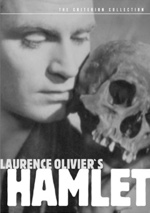
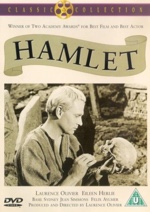
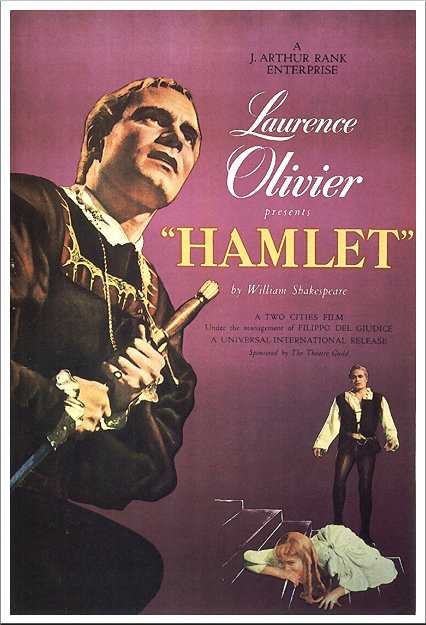
Hamlet’s been done on film at least four times (Laurence Olivier’s [this one], Nicol Williamson’s, Mel Gibson’s, and Kenneth Branagh’s), and while I don’t know if Olivier’s is the best (I’m inclined to go with Branagh’s), it certainly bears the indelible stamp of its director/star’s personality.
Olivier’s take on Shakespeare’s story of madness and murder most foul is unmistakably a filmic one — with its monologues recast as internal thoughts heard in hushed voiceovers and use of dizzying camerawork to show Hamlet’s inner turmoil, this could never have worked on stage. The emotional desolation of Elsinore’s inhabitants is conveyed with a roving camera that swoops down on characters plotting or moping in huge, empty halls.
Olivier’s Hamlet is of the more cunning/less mad variety, and it’s probably because his Hamlet is already on a somewhat even keel that Olivier felt he could do away with Hamlet’s buddies Rosencrantz and Guildenstern, who usually act as a bit of ballast for an increasingly mad Hamlet. And Olivier’s Hamlet ends on a rather less doomed note than most productions do: His mother, Gertrude (Eileen Herlie), drinks from the poisoned goblet of wine not accidentally but deliberately, sacrificing herself for her son, a spin I haven’t seen before, making her death more noble than tragic. And since Olivier also eliminated the warmongering neighbor of Elsinore, Fortinbras is no longer poised to steal the throne at the death of both the king and his heir, Hamlet.
This production suffers, though, from the bane of nearly every Hamlet: Gertrude and her son defy the laws of nature. Hamlet is basically a college boy: Olivier was 41. Herlie, playing his mother, was only 28 or 29 (sources disagree on her DOB).
My fellow science-fiction geeks will note that two future Doctor Whos appear in this production of Hamlet: Patrick Troughton (Doctor #2) as the nonspeaking Player King, and Peter Cushing (the Doctor in the 60s BBC movies, and also that nasty Imperial governor in Star Wars) as the flaming courtier Osric.
Oscars Best Motion Picture 1948
unforgettable movie moment:
The final scene, the brilliantly staged swordfight between Hamlet and Laertes.
previous Best Picture:
1947: Gentleman’s Agreement
next Best Picture:
1949: All the King’s Men