

I’m “biast” (con): nothing
(what is this about? see my critic’s minifesto)

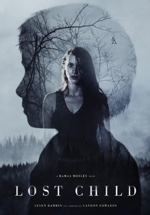
Military veteran Fern (Leven Rambin, from TV’s True Detective) returns home to rural middle America in the wake of her father’s death hoping to reconnect with her estranged brother. Instead, she finds herself saddled with Cecil (Landon Edwards), a little boy of around eight or nine, dressed in rags, who wandered out of the Missouri woods one day and latched onto her in a way that the local social worker, Mike (Jim Parrack: Suicide Squad), approves of: she’s a better option than the indifferent foster care the kid would end up in. Cecil won’t talk about himself, his family, or where he comes from, and he’s full of odd ideas and mannerisms. Is he just a sad lost abandoned child, or could he be a “tatterdemalion,” a demon of Ozark legend who preys on the kindly souls who take pity on it? And does that even matter if Fern, suffering from PTSD, and not only because of her army service, doesn’t have much pity to give?

With her second feature — after her insightful Twilight Zone-ish fantasy The Brass Teapot in 2013 — director Ramaa Mosley engages in an extraordinarily delicate balancing act between drama and horror, set in a very specific part of the real world where stories of monsters are not mere entertaining fun, and where superstition is not harmless. I don’t think I’ve ever seen a film that so exquisitely captures the damage that supernatural thinking wreaks on the psyches of individuals and communities alike, yet while also maintaining its own plausible deniability, its own ambiguity, for as long as it does. Whether or not demons are real here, the terrors that folk associate with them lead them to behave in appallingly inhumane ways. Magical thinking and appeals to — or active denials of — evil spirits are very much part and parcel, here, of nightmares that are all too real: abuse, neglect, trauma.
Mosley, who wrote the script with Tim Macy, does something miraculous, something I’ve never seen in a movie about the supernatural before: she shows how adherence to a philosophy that is supposedly about insisting that the world is something bigger than we can see in fact results in smaller minds and closed hearts. And she does that in a package that makes the absolute most of a clearly minuscule budget and limited locations. Terrific performances — young Edwards is a real find, exuding raw pain in a way that no child should be capable of — and a subtle, brooding style (the cinematography is by Darin Moran) lend a visual and a psychological expansiveness to the experience. Lost Child is as ambitious as craft as it is thematically, and it’s an outrageous insult that the film is getting only a tiny theatrical release. This is a bigger film than it appears at first. And it deserves to be seen by big audiences on big screens.
















I understand why people don’t get it. I WAS the lost child: invisible, silent, “ghost” child who sought privacy of my own company in family chaos. Same symptoms of POW plus normal childhood development is affected greatly. Lifelong struggle to find answers and overcome in a family and a society that is ignorant and in denial, again makes the child on their own to overcome the lies and misconceptions.
I was also, part lost child, part black sheep since I was also the only one who would be spilling any beans in future. For me adoption was not only a risk factor, it was a saving grace. I always knew I was adopted and always knew that to mom, boys were just all around preferable. To me it meant I was practically invited to see us as less connected, and to see myself as different. I never thought “I want to be like mom/dad”. And for me the 90s threw open the dialogue-door on the fronts I needed, so I had scads of info on various forms of abuse coming my way.
I did wonder in the reviews I read if Lost Child might also apply to Fern and/or her brother. I’d read reviews to see if I thought I could watch it but on the whole it’d have to be the right timing, and daylight.