
I’m “biast” (con): nothing
(what is this about? see my critic’s minifesto)

Happy Earth Day! And it’s not just any Earth Day this year, but the 50th anniversary of the first one, when eco-activists first organized to sound alarm bells over the destruction humanity was wreaking on our own environment, our very life-support system. How have we done over the past half century? Well, we fixed the hole in the ozone layer (which we also caused, of course), but not much else. We’re still on track to render our ecosystem damn near uninhabitable, because of all the carbon we have been throwing into the atmosphere since the beginning of the industrial revolution, within the lifespans of our children and grandchildren… and if not our own lifetimes.
I mean… I’m 50 years old. Same as Earth Day itself (I’m just a few months older), and it is very likely that I will live to see ice-free summers in the Arctic and a dramatic melting of ice sheets that cause the oceans to rise by meters, drowning huge swathes of currently inhabited land. And that’s the nice stuff. It’s not outside the realm of possibility that I will live to see a hothouse atmosphere — caused solely by our own actions; denialism bullshit posted in comments will be deleted — that makes the civilization we’ve built over millennia untenable.
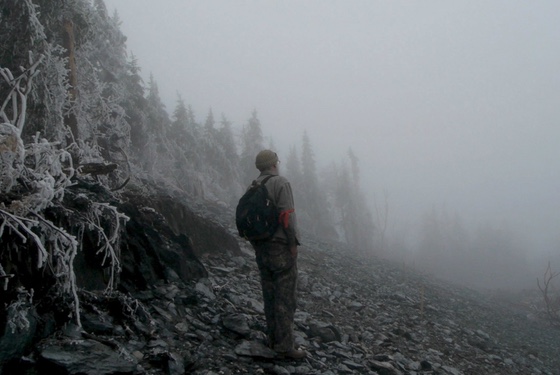
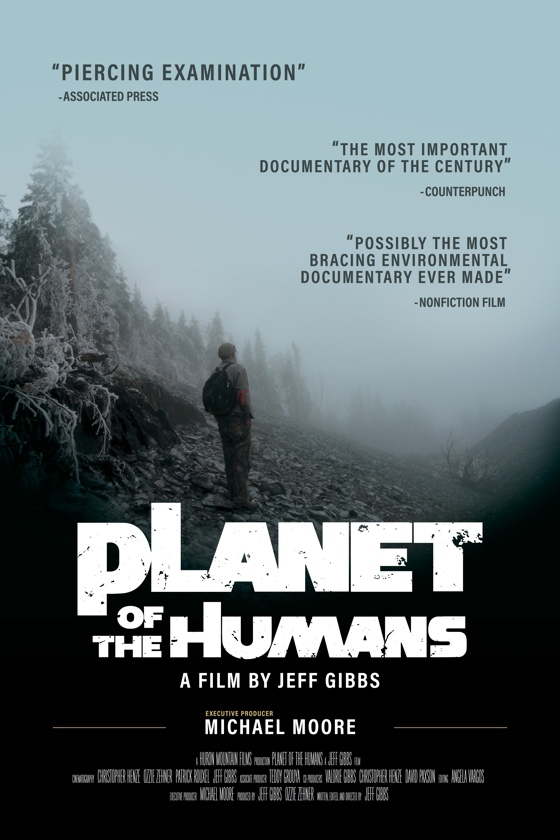
In honor of this dubious anniversary and humanity’s impending doom, muckraking filmmaker Michael Moore (Fahrenheit 11/9, Where to Invade Next) has made available — free for everyone on YouTube — a documentary he produced, written and directed by Jeff Gibbs, that takes stock of the current sorry state of the eco war. Planet of the Humans should have been an easy out-of-the-park, and I guess it is in one sense, in the headsmacking obviousness of what it has to say about how we upright monkeys continue to shit our own backyards with mostly carefree abandon. But it feels like only half the story.
Gibbs, a longtime ecoactivist, first gives us a brief history of the green movement, starting with the 1958 science film produced and written by Frank Capra — “The Unchained Goddess,” which you can also watch on YouTube — that warned that our unchecked carbon emissions would have bad results. (This aired on American TV when there was almost nothing else to watch, and later given free to schools. So we knew. We’ve known for 60 years.) Later we get to the 21st century and Al Gore’s 2006 Oscar-winning documentary An Inconvenient Truth; Barack Obama’s 2008 White House win and his promises to green the world; and the rise of solar and wind power and electric cars. All good, right?
Nope. Gibbs dives into the “profound limitations of solar and wind” — some of them are quite shocking, in how the technologies are incredibly dependent on really awful shit like environmentally devastating mining for rare minerals, for example. Electric cars that have to be plugged into a grid powered by coal or other dirty fuels is another. Turns out that “green” energy isn’t very green at all, once you start to delve into it, and the techno fixes some of us may be fantasizing about are probably not going to be the solution to global warming we need. Fossil-fuel use is simply too baked into all of our infrastructure, to the degree that even some of the biggest names in green seemingly have had no choice to buy into some very problematic industries. Is even Germany’s vaunted green revolution not all it’s cracked up to be? Does even Bill McKibben have to be cancelled? Damn.
This is a grim, pessimistic film, which is hardly surprising given that it’s all about the dire fate ahead of humanity. But what are our options? Planet of the Humans briefly discusses overpopulation as a root cause of our overtrampling of the planet, but has no idea what we should do about that (and also fails to mention that it’s Western-style consumerism that is the problem; would seven billion vegetarian bicyclists be okay, or could we grow enough plant protein to feed the whole planet?). It fails to indicate whether there might be other ways to deploy solar and wind that are genuinely sustainable. It discusses how lots of familiar bad actors — such as Goldman Sachs and the Koch brothers — have infiltrated green industries for their own nefarious ends, yet doesn’t even begin to mount a critique of rampant, unchecked capitalism as the culprit at the root of all of these issues.
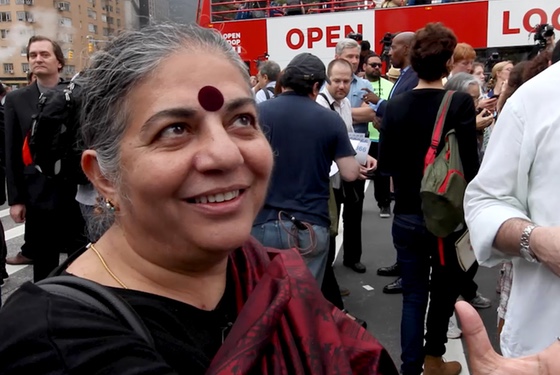
Is there no hope? If the movie feels that’s the case, I wish it had the balls to say as much. If it sees reason for optimism, there’s no hint of it to be found here.
Perhaps the biggest failing here is one that is no fault of the movie, but of appallingly bad timing. So many aspects of the current coronavirus crisis, as bad as it is, is showing seeds of hope for how we will deal with global warming. From pollution retreating above global cities as travel almost entirely shuts down to suddenly public support for collective action from national governments, it’s possible that whatever sense of doom-and-gloom might have been justifiable just a few months ago is no longer warranted. So maybe it’s a good thing that Planet of the Humans suffers from prepandemic myopia that it could not have anticipated knocking political and cultural inertia on its global ass.
There’s been lots of pushback against Planet of the Humans from some climate scientists and environmental campaigners. See “Climate experts call for ‘dangerous’ Michael Moore film to be taken down” at The Guardian for a rundown.
















Naomi Klein’s very well-researched book This Changes Everything: Capitalism vs the Climate, had all of the same depressing information on the co-option of the leaders of the Green movement, but with just a little bit of hope. Moore did the same, but without a shred of hope.
No longer warranted? This artificial and temporary lockdown will not change a thing. We know we are causing the climate crisis, we’ve known for a very long time now. We will go right back to our wasteful and destructive behavior, because Big Oil is running the show, not citizens. And our US President, working on their behalf is willing to kill off as many expendables as it takes, in the name of re-starting “the economy.
Well, I did qualify that “no longer warranted.” I think there is a tiny hope that things might change, for the reasons I mentioned. It’s not a certainty, of course… but it’s less outside the realm of possibility than it seemed. We’ve now all experienced mass collective change *on a dime.* We will need more of that to tackle global warming, but seemed impossible just weeks ago. Now that we’ve all seen that it’s possible, that does change things. Potentially. Big change suddenly seems more likely than it did at the beginning of this year.
I’ve read the Klein book, and you’re right. But clearly it all needed to be said again… and maybe without the hope.
On that note, here’s some potentially good news: renewable energy is about to overtake coal in the US.
https://www.nytimes.com/2020/05/13/climate/coronavirus-coal-electricity-renewables.html
Sadly, like Robert Bryce’s work (not that in anyway are Gibbs’ and Moore’s knowledge of energy issues as encyclopedic as libertarian, climate-dismissing Bryce’s), this film has the same fundamental flaws:
– it is too error-filled for non-educated/knowledgeable people to watch due to misdirection & embedded deceit that might not be evident as the viewer has to be knowledgeable to see the truthiness and deceit.
– For those already knowledgeable, the core thematics/points aren’t news and it just takes so much effort to wade through the falsehoods and truthiness for having thoughts/perspective that are already out there in discussion.
Additionally, Gibbs’ and Moore’s truthiness and falsehood-filled product isn’t helpful because they created something that is being leveraged by climate deniers/delayers to attack (not complete, need to improve, are improving) solution paths. (For examples, see Emily Atkin’s thought-provoking The wheel of first-time climate dudes.)