

I first saw Late Night with the Devil at London Film Festival last autumn, and it has been embedded in my brain ever since, like an itchy splinter. I thought: This is an astonishing movie: uniquely fresh and original while also deeply lodged in the history of cinematic horror, with a powerful breakout lead performance from long-time “oh, it’s that guy” David Dastmalchian, who has been, onscreen, the most delightful weirdo — perhaps most notably as “Polka-Dot Man” in 2021’s The Suicide Squad; he also has small roles in that year’s Dune and the recent Oppenheimer — and here exudes true movie-star quality.
I wish I had reviewed this five months ago, but I’ve been dealing with my own mental-health issues that aren’t a million miles away the crisis of confidence that Dastmalchian’s troubled protagonist is coping with here. I couldn’t manage it, so I was happy that the film had scored a theatrical release on both sides of the Atlantic, which meant another opportunity to review it. But it’s all been a bit soured by the recent news that the filmmakers — the writing-directing team of Australian brothers Cameron and Colin Cairnes — utilized “AI” “art” in their production design.
I suspect that the general public doesn’t yet understand how programs erroneously dubbed “AI” are being deployed and the capacity this has to inflict enormous damage in both visual and written creative arts. In brief, computer algorithms that are nowhere near artificially intelligent have been trained on the enormous quantities of written text and visual art (drawings, paintings, photos, etc) available online to spit out what are essentially remixes of that preexisting material. These “AI”s do this in response to human-generated “prompts,” such as, for instance, “image of a walkable city with lots of greenery and beautiful buildings” or “write a literary essay exploring the themes in George Orwell’s novels.” But resulting text meant to sound natural is often stilted and rife with factual errors and references, such as to supposed scientific papers or legal decisions, that are outright inventions. Visual results meant to look realistic are often full of bizarre nonsense, like human figures with too many limbs or fingers, or impossible angles or lighting.
If you’re Extremely Online, as I am, you’ve already come across numerous examples of human writers, voiceover performers, and visual artists complaining about losing paying jobs to “AI,” including so-called deepfake video technology. (One of the issues behind last year’s Screen Actors Guild and Writers Guide strikes was studio use of these “AI” algorithms to replace their members’ work.) Even though there is no authentic creative effort or considered thought behind the output of these programs — they are incapable of conceiving anything new — they are already substituting, if poorly, for human innovation and inventiveness.
This is where Late Night with the Devil utilizes “AI”-generated visuals:
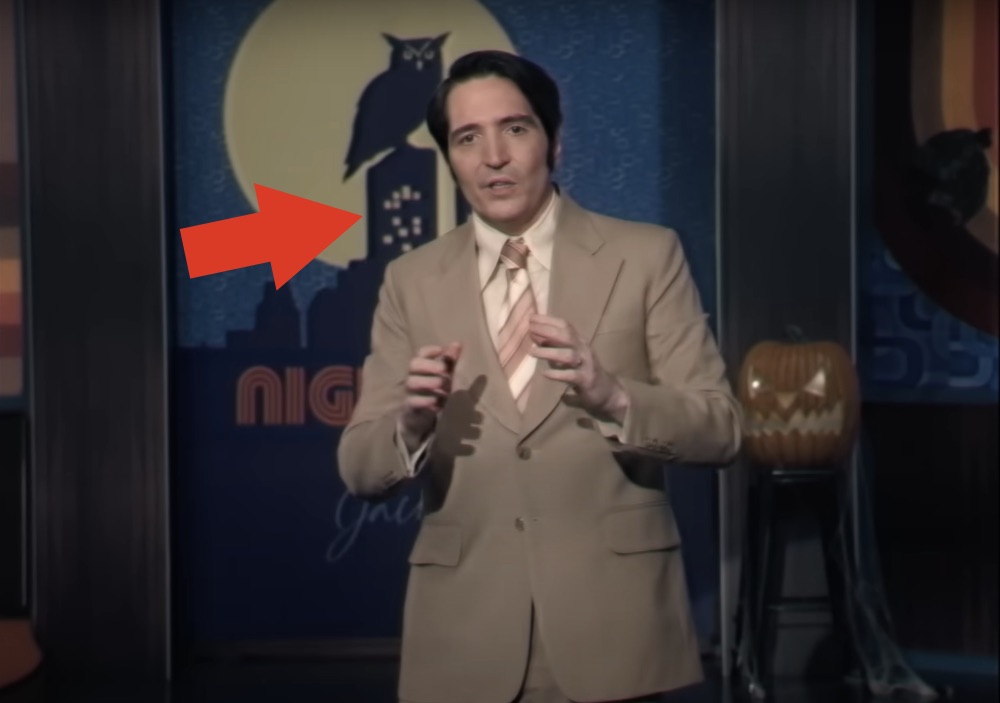
The movie is mostly set over the course of a single episode, which we’re told went out live on Halloween night 1977, of a (fictional) American late-night talk show called Night Owls, which aired on the (fictional) network UBC. The seasonally appropriate show logo (in this still from the trailer; it appears regularly in the film) was created not by a human artist but by “AI”: the wonky windows on the skyline building are a dead giveaway.
Here’s another of the show’s interstitials, a title card welcoming viewers back from commercials:

Here the missing fingers on the skeleton clue us in to the fact that the image has been generated by “AI.”
Now, you might be thinking, “What’s the big deal? It’s just a couple of images in the background.” There are many reasons why this is a big deal, perhaps not least: 1) the actual creative work of actual human beings was stolen without permission or recompense and repurposed by a computer program to concoct these images, and 2) actual creative artists were therefore not paid to work on this film in this capacity. It’s bad enough when money-grubbing, artist-denigrating megacorporate Hollywood studios do this — it’s not forgivable, of course, but it’s certainly well within their vampire-capitalist wheelhouse — but it’s far worse when a scrappy little indie production like this one does it. If the fire of human weirdness and invention is not appreciated by a pair of maverick brother filmmakers like the Cairneses, working so far outside of Hollywood that they’re literally on the opposite side of the planet — Late Night was shot in Melbourne — then what hope is there for anyone who just wants to be an arty freakazoid eking out a little living with their ingenious eccentricity?
I don’t know the Cairneses’ previous work, but I don’t understand how you can have the kind of deliciously disturbed imagination that rustles up the bonkersly off-kilter Late Night with the Devil and not understand that legitimizing the theft of bona-fide human imagination is so uncool. (Here’s a good Twitter thread on why this is a big deal and why it’s important to send filmmakers and studios the message that this is Not Okay.)

Dedicated movie fans are engaging in personal boycotts of this movie over the “AI” issue, they feel that deeply that this is a huge problem, and I am very much on their side. I debated with myself whether I should even give the movie what small exposure a review from me would bring it. I decided it was worth it in order to highlight this issue for the vast majority of movie lovers who are not Extremely Online. Because letting mindless computer algorithms built on the hijacked work of creative human beings is going to be very very very bad for anyone who cares about the work of creative human beings, such as movies. We are at the narrowest edge of a horrible wedge, and the time to push back is now.
Here’s the incredibly ironic thing about Late Night with the Devil: it is, at its heart, a story about a creative man who is, as I mentioned earlier, suffering a crisis of creative confidence and also, most likely, creative burnout. Dastmalchian’s late-night TV host Jack Delroy, a former Chicago radio personality, just cannot seem to make enough of a dent in the popularity of his competition: ur–late night TV host Johnny Carson and his The Tonight Show. We learn this in the mockumentary opening of the film, which sets the stage for the 1977 Halloween broadcast: Delroy is a man who has been on a roller coaster of personal tragedy and professional success and intrigue all around: he’s a member of an arcane secret society — of, natch, white men — known to make or break careers. Delroy’s career isn’t quite broken, but it’s not as solid as it could be. Maybe there’s a way he can bolster himself and his show? Via, like, some arcane stuff? *gulp*

Oh, so, why burnout? In 1977, The Tonight Show ran for 261 episodes, one for basically every weeknight of the year. It’s a grueling schedule. Night Owls would have had a similar run. (Watching this movie at London Film Festival was a surreal experience for me, as a transatlantic type, for more reasons than the uncanny stuff happening onscreen, because there is no British equivalent of the American late-night-talk-show ecology; perhaps the closest thing in the 2020s is the solitary example of The Graham Norton Show, which airs only once a week, not nightly, and then only typically for half the year.) Late-night is a meatgrinder of American television. Like, no wonder someone might turn to the supernatural for an assist.
Wait, what?
The faux-documentary-style narrator informs us that we are about to be treated to the “recently discovered master tape of what went to air that night, as well as previously unseen behind-the-scenes footage.” It was, we are told, “the live-TV event that shocked the nation.”

What we witness in its ersatz-70s glory is late-night American TV at its cheesy apex. Guests for Delroy and his goofy punching-bag sidekick Gus (Rhys Auteri) include Uri Geller–esque psychic performer Christou (Fayssal Bazzi: Peter Rabbit), who does hilariously terrible (from our 2020s perspective) cold-readings on the studio audience; paranormal skeptic Carmichael Haig (Ian Bliss: The Matrix Revolutions), clearly modeled on James Randi, who throws cold water over Christou; and parapsychologist June Ross-Mitchell (Laura Gordon: Foe), who’s just written a book about her work with teen Lilly D’Abo (Ingrid Torelli), a waif rescued from a “satanic cult” and allegedly in the grips of a “psychic infestation” — Ross-Mitchell prefers that term over “demonic possession.” It’s all so very late-70s: this was the era of Amityville Horror paranormal investigators Ed and Lorraine Warren, of The Omen and The Exorcist. This was the cultural stew from which the so-called satanic-panic bullshit of the 1980s would spring.
Now, the mockumentary conceit falls down in the behind-the-scenes stuff, which purports to show what is happening backstage at the Night Owls studio while the live feed goes to commercial break. But we never understand who is shooting this material, or why… and it certainly never makes sense that these people would be having the conversations that they’re having if there was a camera there recording them. I don’t mind that much, because a breakdown of the documentary style is necessary for the ambiguous ending to work… which it does.

I found it all a perfectly pitched nightmare of overegged ambition and an anything-for-success drive, and a sly twisting of the cosy familiarity of late-night TV, meant to soothe its viewers at home into sleep and not do, er, what this episode of Night Owls does. The entire cast is terrific, but this is Dastmalchian’s showcase, and he is marvelous: he nails the quirky but easy charisma late-night demands.
But the triumph of Late Night with the Devil is absolutely marred by the Cairneses own little deal with the AI devil. “It wasn’t supposed to turn out this way,” Jack moans as his Halloween episode goes to credits. It’s a shame that the same could be said about this film.
more films like this:
• The Last Exorcism [Prime US | Prime UK | Apple TV]
• What We Do in the Shadows [Prime US | Prime UK | Apple TV | BBC iPlayer UK | Shudder UK]
















I find myself, as with many things, in a place where I don’t entirely agree with either side of the debate over machine learning.
I’ve been messing around with machine learning-assisted imagery to illustrate storytelling on my DeviantArt account, strictly for fun. One, because I’m pretty sure nobody would be willing to pay for my nonsense, and two, because I know a lot of writers and artists who make excellent arguments for not doing that.
In the unlikely event that I’m convinced that my silly DeviantArt stuff would make money and be my ticket out of this hellhole, I would hire an actual human artist.
However, I also am a lawyer who knows something about intellectual property law, and I have trouble imagining the use of any machine-learning art I’ve seen being legally actionable. If my hired artist took the ML art I originally “commissioned” from the “AI” tool and reused it, while putting her own spin on it, I can’t see how any of it could be tracked to an actual individual artist who could recover damages for the use. (I’m talking specifically about visual imagery as opposed to written. Limiting it to just the text dimension makes copyright infringement more plausible and more legally provable.)
But looking at lots and lots of artwork and creating something new based on those influences is just how art works, period. It needs to be a pretty blatant lift (like Roy Lichtenstein stealing the artwork of talented comic book artists like Russ Heath and making millions off of it because he was doing “high art” and Heath was just scribbling on paper for some lowly commercial not-art purpose, I guess.)
Anyway, I think it’s a little more complicated than many on both sides of the extremely online arguments think, but in a case like this movie? Hire an artist! Not only is it the right thing to do, but it’ll make the work better. People do notice stuff like weird fingers and the wonky windows on the building, if only subconsciously. And other people get pissed off about it, and alienating potential ticket buyers is something a movie producer never wants, whether an indie or a big studio.
——
So on a whole nother side, this is the sort of movie that gnaws at me, as I love the subject matter, love late-night show pastiche type things (The Larry Sanders Show is an all-time fave), love Dastmalchian… but I’m also a wimp who doesn’t like being scared.
Oh, on British vs. American talk shows, it does strike me as odd that a Tonight Show-style show never really happened in Britain. Particularly as the Tonight Show was a huge money maker for NBC (at least in Carson’s time), accounting for some huge percentage of the network’s total revenue. I can’t track down what that percentage was, but I remember it surprised me.
But that is not what is at issue with this “AI” nonsense. It is being used — or threatening to be used — to eliminate the work of actual creative humans.
Then maybe the law needs to change. Plenty of things that were once legal now are not.
Yes. And there is plenty of room for debate over whether an artist has borrowed or stolen, whether they were unwittingly influenced or are paying homage, whether they have transformed the original into something new. There is NO scope for this with “AI,” because there is no creativity in “AI.” It’s nothing but a remix, often an outright nonsensical one.
I’m not sure why, either. It’s a mystery.