

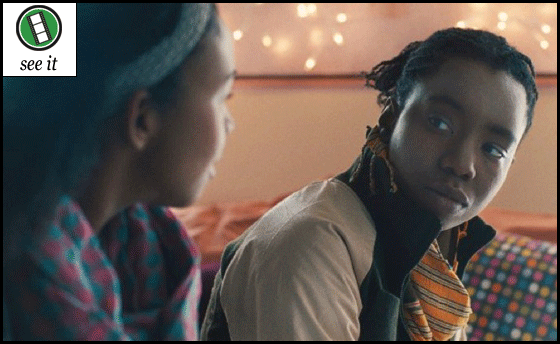
Writer-director Dee Rees, in an assured feature debut, expands on her award-winning 2007 short of the same name to tell a story all but ignored in pop culture: the coming out of a lesbian. Even more unusual: Alike (pronounced Ah-lee-kay) hails from a conservative black family — her father (Charles Parnell) is a cop, her mother (Kim Wayans: Juwanna Mann) a devout churchgoer — from Brooklyn, where urban black culture enforces its own brand of conformity. Star Adepero Oduye is magnificent as a 17-year-old whose teenaged sullenness is more hard-earned than some can claim, the usual adversities of adolescence that will be recognized by us all compounded by the secret she harbors: she likes girls. Rees’s eye for how Alike maneuvers between her notion of who she is and whom everyone else wants and expects her to be is intense and poignant, as in the brief sequence that opens the film, as Alike, on a bus ride home from a night out at a lesbian nightclub, morphs from her preferred “butch” look to one more “girly” merely by removing her flannel shirt to reveal the sequined tee below and popping on a pair of dangly earrings. Aching with despair and, then, marvelously, a keen air of hope, the little gem resonates as a slice of teen life in which growing up isn’t only about sexual awakening but about deciding to take the reins of our own lives, even if it means defying our parents. For all the tough places it goes, Pariah is a lovely film about a young woman learning how to blossom into her own loveliness.














I’m really late in my comments, but I look at it more as the difference between a genre film and a film that has genre elements, but, as you mention MaryAnn, is intended for a larger audience. For instance, the original Inglorious Bastards, from the 70’s, really had nothing to offer but standard war violence. It was a bit silly, but delivered what it’s intended audience expected… tough guys and guns. Tarantino’s “remake” delivered that, plus amazing dialog and performances, so it offered something to those who don’t automatically buy a ticket for the latest action movie.
I am not gay, but I don’t avoid films with gay themes. There is much gay behavior that I don’t understand, and when I do watch a film about gay characters, I hope to gain some understanding. So when I watch a film such as “And Then Came Lola”, that isn’t really all that well written, it feels like a Genre Film to me. I don’t know, but perhaps to a lesbian, it may validate something inside to watch such a film. Perhaps just having a movie that is about a lesbian relationship relates to something inside that a movie about straight people just can’t. But I don’t relate to that particular film.
However, a film like Pariah speaks to me. It deals with more than lesbianism. It deals with friendship, peer pressure, teenage issues, teenage sexual issues (When Alike experiences her first kisses, it recalled my own first sexual experiences), family issues, and issues of establishing your own identity aside from what your friends, parents, or society wants you to be. In a way, lesbianism is a mcguffin; Alike’s not-so-secret secret could have been anything.
It’s not just a coming out story. It’s a coming of age story.
I haven’t seen many coming out stories, so I can’t say whether this is a very original approach to it. But I can say that it’s well-done.
Early in the film, I mentioned to my wife that I don’t understand why dressing in a masculine way is so important to some lesbian women. I don’t mean to invalidate it, I just don’t understand it. I don’t care so much about how I dress; I dress the way I do more to fit into society than out of some other need (but society also accepts my heterosexual gender preference… so I don’t know what I might do if society didn’t accept it). But when I was a teenager, what my clothes said about me was much more important. So I could relate to the teen-aged Alike experimenting with a more-butch way of dressing early in the film. I could also relate to her resisting her mom’s pushing her to dress more girlishly… it just wasn’t her (plus it was her mom’s way of rejecting Alike’s gender-preference). Alike is definitely not comfortable in girly clothes, but watch her face when her friend Laura suggest clothes for her. It seemed to me that Alike doesn’t want to be butchy, as her friend Laura wants, or to be femmey, as her mother wants; she just wants to be herself.
Pariah is more than a Genre Film, so therefore, to me, it is not just a Gay Film. Several characters are gay, but it’s thoughtful and provocative, and amazingly acted. I’m not automatically a fan of the genre, but I’m a fan of Pariah.