


I’m “biast” (con): nothing
(what is this about? see my critic’s minifesto)
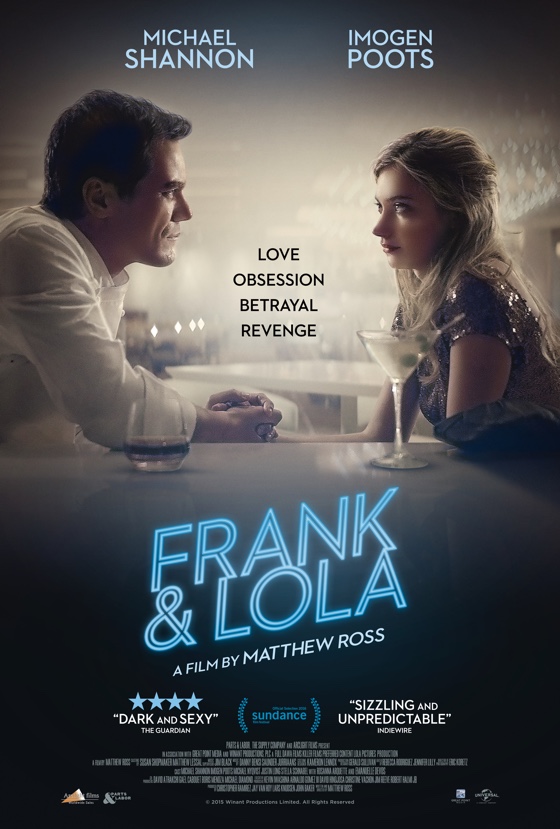
Is she in pain? Or is she a lying, conniving bitch? Her state of mind only matters to the degree to which it makes a man have feels, so, you know, *blergh.* Frank & Lola, the first feature from writer-director Matthew Ross, makes it a matter of suspense just what the heck is going on with Lola (Imogen Poots: Green Room) when it comes to her relationship with Frank (Michael Shannon: Midnight Special): the movie never calls into question his violent jealousy, merely examines how justified he is in it. (Perhaps someone should have suggested to him that, at 15 years his junior, she is simply too young to make a good partner for him.) Ridiculous coincidence drives the plot: the fact that Shannon is a hot restaurant chef is meant to justify getting him from Las Vegas to Paris at the drop of a hat, for one; later, Frank is suddenly an expert in forging handwriting. But it’s the film’s reliance on outdated notions of gender expectations and terrible ideas about the realities of women’s lives that make it such an infuriating experience. (It never seems to occur to Frank, never mind Ross, that a woman who has once had consensual sex with a man can also be raped by him.) Ross — who previously made a short entitled “Inspired by Bret Easton Ellis,” which could well be the title of this one, too, with its casual misogyny layered over emotional immaturity — wants this to be a neonoir sorta-thriller that creates tension around the supposed indistinguishability of a woman suffering and a woman manipulating. Really? These things look the same? Ugh.
















“Huh. Women. Who can understand them?”
“Have you tried having a conversation with one?”
That’s noir for you. Misogyny is a genera trope. Some are definitly worth subverting these days, casual sexism should be at the top of the list.
There’s nothing in noir that requires misogyny. Sure, most women in noir are wrong ‘uns, but so are most men.
Oh certainly, I’m simply speaking of classic examples of the genera.
Clearly the reviewer is bringing their “battle of the sexes” biases to this film. I’m not saying that it’s a great film, but Ms. Johnson has missed some obvious things, due, I suspect, to bias. First of all, and most obviously, Frank, who is presented as the stereotypical “good guy” who beats up misogynists, violently rapes Lola when he thinks that she is lying to him. This is presented as the obvious reason that she won’t take him back at the end. She knows that he is no different that Alan. Obviously the viewer is not meant to think that Frank would never consider the possibility that a woman can be raped by a man she has had consensual sex with, given that he is clearly one of those men.
This is basically a film about bad people being bad, and no one comes out smelling of roses, no one is justified or just. It’s not about men vs women; that is something you brought to the film yourself.
Hmm. So, I bring my own baggage into a movie, but you don’t? Interesting…
LOL. Ironic.
Oh please, straw men are a waste of time. I didn’t say “your own baggage”, I referred to a specific bias, and no, I don’t harbour that particular bias. If you have an actual response to the point I made regarding how I think that particular bias caused you to miss a very obvious plot point and its implications, or any actual counter argument at all, then by all means I’m interested in discussing it further. I really have no response to “LOL ironic”…
You’re so cute.