
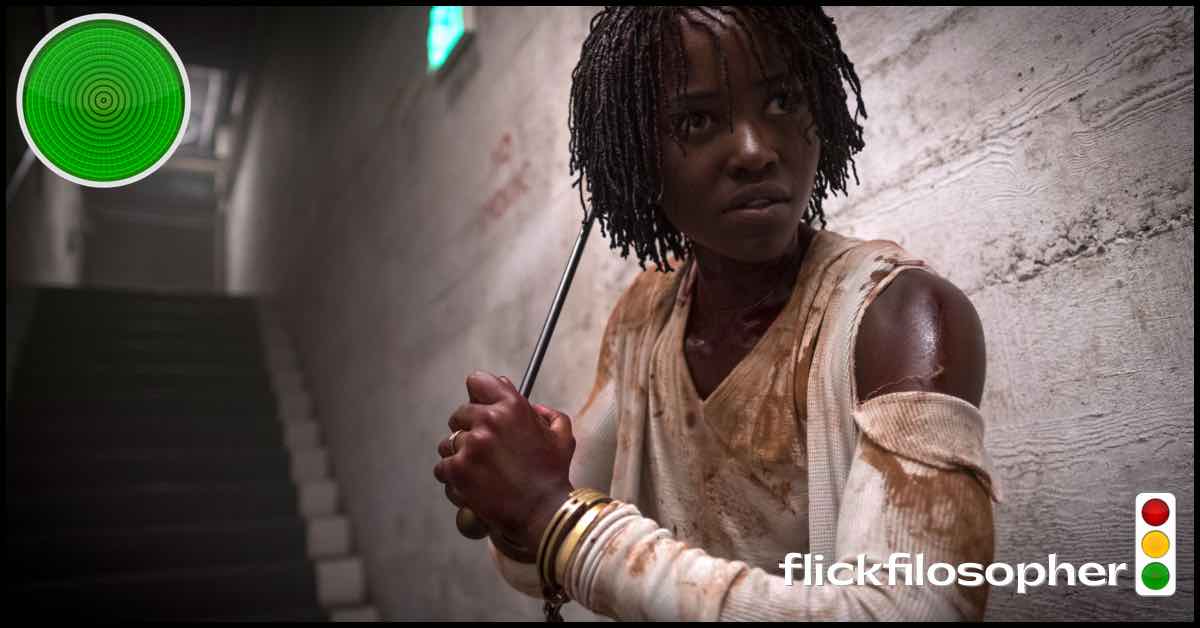
There are so many things to love about writer-director Jordan Peele’s second film, Us, and one of the most delicious is how it opens: with a positively early-Spielbergian flourish of childhood wonder smothered by sad reality. Little Adelaide (Madison Curry), who is perhaps seven or eight years old, is at a magical seaside amusement park, except with her parents: an indifferent dad and a mom frustrated and distracted by him. So she wanders off. And as a thunderstorm is ominously brewing in the twilit sky — and as maybe something ominous is drawing her? — she meanders alone into the creepy and deserted Shaman’s Vision Quest funhouse… where she will endure a terrifying encounter with a very unexpected figure.
Everything after that is… let’s call it post-80s-Spielbergian. Almost literally: that opening segment takes place in 1986, while the rest of the film — with occasional brief flashbacks — is set today. Us could be seen, in the sense that it is partly about the lingering aftereffects of childhood trauma, as a reply to early-Spielberg fantasies: How did the kids from The Goonies or E.T. grow up, and how did their experiences impact their lives? Looking askance at the pop culture of the past is all over Us with sneaky slyness: The Michael Jackson/“Thriller” T-shirt little Adelaide’s dad wins for her at a fairway game, and which she instantly dons, rings with a new kind of horror in retrospect, with the knowledge we have today about Jackson.

Not a spoiler: Peele’s take on how we should look back at otherworldly Spielbergian adventures of the 1980s is on a par with how we should look back at Michael Jackson.
And yet Peele has only gotten started, in Us, on redefining horror and reworking notions of what should terrify and unsettle us. This isn’t merely simply not a same-old horror movie about jump scares and blood-and-gore, though it does have a smattering of both. (They are not what is scary, though.) As with his previous genius movie, 2017’s Get Out, this one finds fear in places that are unexpected but which shouldn’t be, for they are right in front of us and around us all the time. We’ve just trained ourselves not to notice them. It all adds up to a deeply unnerving cinematic experience on multiple levels.
But that only just scratches the surface of what Peele is doing with Us. This is a movie that demands multiple rewatches — I’ve seen it just once so far, and I am itching for a return. And it is a movie that, I suspect, we will be debating and picking over for a long time, in the best sort of way that is about unpeeling the layers of its mystery and its perception.

A spoiler-free description of Us’s setup: Present-day Adelaide Wilson (Lupita Nyong’o: Black Panther, Star Wars: The Last Jedi) returns, unhappily and very reluctantly, with her family to the site of her childhood trauma, only to find herself in, ahem, what could be considered something of a sequel to it. That evening, the family — including her husband, Gabe (Winston Duke: Avengers: Infinity War, Black Panther), and their children, teen Zora (Shahadi Wright Joseph) and tween Jason (Evan Alex) — is subjected to a home invasion by a group of four people who are twisted mirror images of the Wilsons themselves. Who are they? What do they want? Where did they come from? How do they even exist? What the actual hell?
It’s so wonderfully rare for a horror movie to leave you unable to actually determine what sort of horror you’re in the midst of! Us does not fit into any existing paradigms, not even the home-invasion one it appears, at first glance, to be playing with. (Us is, perhaps, a smidge adjacent to the zombie movie, but more reminiscent, at least obliquely, of the Purge series in its social-justice resonances.) As Peele begins to answer the questions he has raised, things get weird, funny, uncomfortable, damning, and more disconcerting the more you think about them. Us is a movie of complex moving parts that fit together in ways that aren’t always clear at first, and some of which become more intriguing the deeper you start to worry at them. For instance, at first it seems that perhaps Adelaide’s return to the scene of her trauma is what prompts the events that follow. In retrospect, it’s plain that that’s not the case… so what did prompt those events? Is it mere coincidence? Or is there nothing “mere” about it?

It’s not much of a spoiler to say that the Wilsons’ attackers are members of an underclass that has been ignored and deprived and treated with cruel indifference, which is thrown into sharper relief by the fact that the Wilsons are seemingly quite well off; it is, in fact, their summer getaway home that is invaded. It’s not the bogeymen of “terrorists and perverts,” as Jason has been taught to worry about, whom they need to fear, but something much closer. The undercurrent of Us is an anxious moan, a looming disquiet of a reckoning coming for America… and particularly for Americans of wealth and privilege. Whatever other mysteries are unraveling here — and there are many — it is patently clear that Peele’s title is quite dauntingly literal: there is no Other, there is only Us.


















Ticket bought, looking forward to the next puzzle from Peele.
Our generation’s Hitchcock?
What a wonderful suggestion.
The potential is there, but remember when Shyamalan was going to be “our generation’s Hitchcock?” I’m gonna wait few more years to make sure no unforeseen Happenings happen to happen.
https://www.youtube.com/watch?v=cSI4nxdfaTs
I agree with this. Loved Get Out. Found Us an interesting watch, but too problematic (for me) to say it was great. A third film will give a better sense of Peele’s trajectory as a filmmaker.
Even Hitchcock didn’t get to be Hitchcock until after he made more than two movies. Give the guy time.
After all, there has been quite a number of directors who have been hailed as the new Hitchcock. (For example, Steven Spielberg, Brian DePalma, John Carpenter, and of course M. Night Shyamalan…) If he deserves the title, he’ll earn it eventually. If not, well, he wouldn’t be the first director to be overappreciated. Nor would he be the last…
Films like this and Get Out make me wish my tolerance for horror was higher. I feel like someone with a peanut allergy reading a rave review of a mouth-wateringly well-made peanut-based dish. :-(
I’m curious what it is that bothers you? The blood and gore? Tension? I’m just curious. Because you do miss out on the rare great movie this way. I understand, though.
Yes. :-)
I’m fine with blood and gore and tension in other contexts — say, action or fantasy films — but there’s something about the combination of those elements in horror that gives me anxiety attacks while I watch and nightmares afterward. Glad you enjoyed it, though.
Maybe I’ll risk a peanut allergy flareup for this one. When it comes out on Netflix. Which I can watch on an iPhone. Muted with subtitles. In a well-lit room. With some distracting 80s pop playing on the radio…
I’m the same way.
I hate when things jump out at you, but I had to see this in the theaters- this was my first R-rated horror I’ve ever seen. Each scary scene is diluted with both humor and mystery, and there aren’t many jump scares.
My wife and I say this yesterday. Great movie. I was expecting something different than what I got, but still very much enjoyed it.
I don’t think it was as deep as people are saying, but its definitely far more profound than any typical horror movie.
I so wanted to love this movie. LOVED Get Out. I don’t hate the movie, please understand. Definitely a green light to see it in the theater, as opposed to waiting for it to come out on DVD because it’s a film that needs to be seen on the big screen. On a small screen, I think it would have driven me nuts. The set up was great, with lots of tension built. BUT. There were so many ideas jam-packed into this movie, I felt bombarded and not in a good way. For me, the tension that had been built in the first act fizzled out and I was scrambling to keep up with the corkscrewing plotline. Get Out had a very clear throughline. Us, I felt, wanted to say something about several things in a way that left the storyline muddied. Still, it was beautifully shot and acted, and had some great lingering images: the little girl with the red apple, alternate momma croaking her threats, creepily applied lip gloss, the figures on the lawn). I felt it could do with a bit of editing and a sharper focus on one (maybe two) ideas for greater impact. Ultimately, I came away from the movie not entirely sure what the movie was trying to say, unlike with Get Out, which had a crystal clear message. The movie was also too long probably because, again, he was trying to jam all his ideas (race! class! allegory of the cave! changelings! artifice! doppelgangers! etc, etc) into one movie. I can tell you that people in our screening did not have the same reaction that they did to Get Out. If I had to give it a grade, I’d give it a B-. All that said, I eagerly await his third flick. Maybe re-watching Us will provide me with a better sense of what it was about. Unfortunately, I don’t know when I’ll have the stamina to re-watch it.
Completely agree with you!
I didn’t like this movie. It had no tension. Scenes were completely predictable, although the underlying reason for the “zombies” was not. There was nothing scary about this.
I like your analysis about class in America, and I think Peele meant to convey that. The movie just never drew me in. None of the characters were likeable. Nothing freaked me out. Nothing scared me.
That said, I think Jordan Peele is talented and I want him to make a great horror film (I love horror). Get Out was much better than this, but I’d seen it before. Get Out was the black Wicker Man. I hope, and think, Peele has some better scary stories for Us.