

I was not ready for the emotional roller coaster that is Together. It is funny and sad, sometimes in the same breath. It is a film so fresh and raw that it almost feels like you shouldn’t be watching it, and in more ways than one. It’s absolutely stupendous, a small — so very small — film that is hugely moving, and is so much bigger than it seems to be. So much more significant.
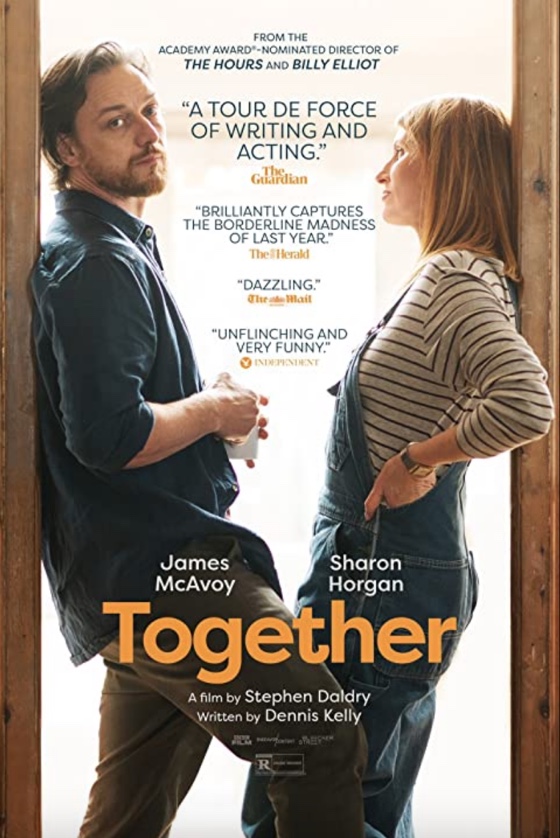
This is the tale of the first year of the coronavirus pandemic through the eyes of one London couple, who are never named and are referred to in the credits as merely He and She. Which could have come across as a cheap gimmick, except that the intimacy with which their lives are depicted never allows for that. Together is merely He and She (James McAvoy [It: Chapter Two, X-Men: Dark Phoenix] and Sharon Horgan [How to Build a Girl, Military Wives) talking to each other, and how often do you say someone’s name in such a context? (You won’t even notice that they never say their names.) They also, very frequently, speak directly to the camera, directly to us, laughing and joking and raging and crying about the love-hate relationship they have been enduring, or so they say, purely for the sake of their young son, Arthur (Samuel Logan).

The kid mostly hovers in the background, when he’s there at all. In this respect, Together has much in common with Horgan’s brilliant sitcom Catastrophe, both stories in which parenting is seen solely from the perspective of the parents, with no cutesy tykes hogging the screen, or our sympathies. This conceit also serves to underscore the reality, often forgotten in pop-culture depictions, that people are who parents aren’t only parents.
He and She are also talking to each other within their own home… and actually, only once beyond the confines of their big open-plan kitchen, dining, and living space. The exception: a scene in the little yard just off their kitchen. Together brings a new cosiness to the notion of the domestic drama.

All this intimacy, both physical and psychological, is like a shiv that cuts through the bullshit of many similar stories, making no bones about the fact that love and hate can be merely opposite sides of the same coin in passionate relationships like the one sketched here. These are two people who know how to hurt each other, and do. But how truly devoted they actually are to each other is something that is revealed only late in the tale, almost a matter of anti-suspense, a thing we didn’t even realize was in question.
But their personal and shared ups and downs are playing out against the most stressful, most turbulent of backdrops: the pandemic. Depending on how fragile your state of mind has been and may still be with how the world has been thrown into disarray, you might feel — as I did — that this was too soon, too soon. Together is inescapably about this very moment in time, about a slow-burning global disaster that is still in motion, and it pokes at psychological wounds that have not yet even scabbed over, never mind healed. It will undoubtedly be looked back upon as a valuable time capsule of March 2020 to March 2021, specifically as experienced in London, as the UK rolled in and out of some of the strictest lockdowns in the Western world over the course of the year. But for anyone who lived through this particular year in this particular place, as I did, and continues to struggle with anxiety over a pandemic that is still out of control, as I do, Together may be overwhelming, and not necessarily in a pleasant way.

That feeling of being deluged is only compounded by McAvoy’s and Horgan’s intense and cutting performances. Director Stephen Daldry (Trash, Extremely Loud and Incredibly Close) gives them long uncut takes in which anger, grief, fear, relief, and other extremes of emotion play out, often with the actors making direct eye contact with us, which is deeply compelling and empathetic. The film was shot quickly, in only 10 days, and is so immediate and honest that it feels improvised, though it is tightly scripted, by Dennis Kelly (Black Sea). Together combines the power of film with the immediacy of theater — this could easily be a stage play — for an experience that is so close to reality that it’s almost too much to take.
















I’d be thrilled if James McAvoy appeared in more independent movies. Lately, he’s been starring almost exclusively in Films I Don’t Want to See and, occasionally, Neil Gaiman audio dramas where he’s typecast to a hilarious degree.