

I’m “biast” (con): so far not a big fan of Peter Strickland’s films
(what is this about? see my critic’s minifesto)

It’s Sisterhood of the Traveling Pants, except the jeans are a dress (though it still magically fits everyone who wears it, women and — yes — men alike) and the dress is murderous, because LOLsob consumerism is killing us, or something.
I’d say it was “clear” that that was the “message” of the empty exhausting nonsense that is In Fabric, but that isn’t clear at all. Settling on that theme is merely the result of desperately trying to extract some meaning from this oh-so arthouse, infuriatingly wanky retro exercise in style at the expense of all substance.

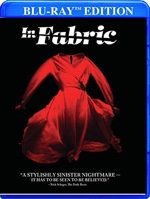
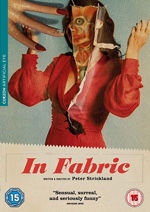
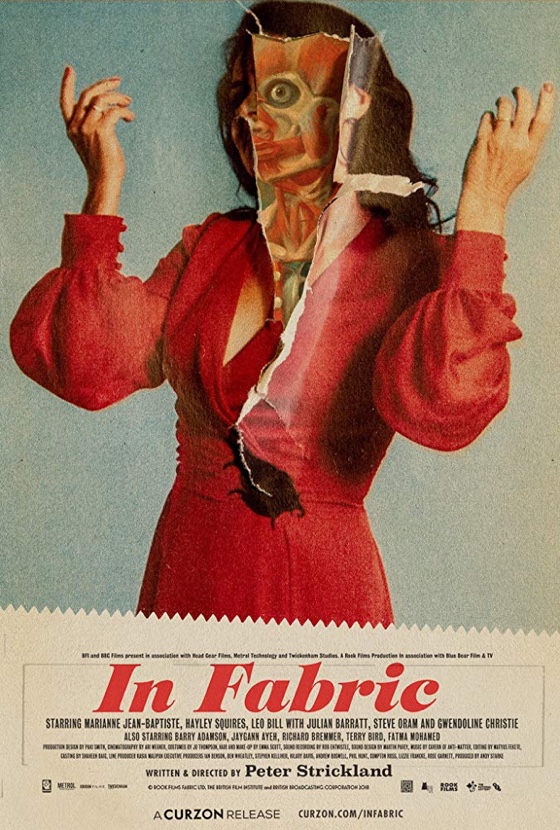
It’s a vaguely late-70s, early-80s suburban London world we land in here, as 50something divorcée Sheila (Marianne Jean-Baptiste [Peter Rabbit, RoboCop], goddess, and the best thing here) acquires a rather lovely red dress* in the post-Christmas department-store sales for a date with someone she has connected with via a newspaper lonely-hearts ad. The dress marks her with a rash and causes other insidious damage, like a washing machine that “goes bananas” when she tries to launder it. Later will come further savagery and atrocity.
But… Sheila seems like a nice, reasonable person. She doesn’t buy the dress out of any impulse that we can criticize, but literally because the only other dress that, as far as we can see, she owns that might have been suitable for a first date is actually, physically damaged, and hence inappropriate for making a good initial impression. I mean, we all need to cover our bodies with clothes that present us well to the world. Sheila’s motivations for buying the dress are hardly extreme or emblematic of consumerism gone crazy. It’s difficult to take a “consumerism is killing us” message from Sheila’s purchase. She doesn’t even partake in the gotta-grab-a-bargain madness that is hinted at with how British post-Christmas department store sales are depicted here (which are definitely a thing, akin to the 21st-century American Black Friday insanity, and has been for decades). And yet here we are.
Of course, the department store she shops at — which appears to be the only one in town — is a Hammer horror show crossed with a Jon Pertwee–era Doctor Who nightmare. The clerks are, it seems quite literally, mannequins come to life, Auton style, and speak in creepy, flowery ways. Fatma Mohamed is very effective as the head clerk, but, like, who would even enter this store, never mind linger here for the length of time one takes to peruse garments, try them on, and purchase them? This isn’t an appealing place, something that I and the (human) characters onscreen appear to agree on. If consumerism is killing us, no one is enjoying it. No one is embracing it. Not even in any shallow, surface way that serves as a momentary distraction from the anxieties, frustrations, and disappointments of the rest of daily life. You know, the self-medication that Buying Useless Stuff constitutes for so many of us. So… what’s the criticism here?
Writer-director Peter Strickland takes his In Fabric off on bizarre tangents that might have some satirical impact in a story that was able to weave them in well, but the most positive reaction I had to anything here was one of lamenting lost opportunity. I mean, washing-machine repairman Reg Speaks (Leo Bill: Peterloo, Alice Through the Looking Glass), who later comes into possession of the killer dress, suddenly has the power to send people into an ecstatic trance by droning on about how a washing machine has gone wrong and how he might be able to fix it. This seems seems ready-made for, at a minimum, connecting to Sheila’s appliance-related domestic crisis, but Strickland manages to make this feel like a wildly disconnected tangent, one utterly remote from the matter of the dress. (Also: What’s weird about needing a washing machine to work properly? What’s eerie about someone who can fix a machine that’s gone wonky? People who can fix essential machines are the best.)

I’d love it if there were something feminist here, maybe some commentary on how the pressures on women to conform to a certain narrow acceptable physical presentation can drive us insane. Instead, we get Strickland’s fetishizing of women: he thus wastes the awesome Gwendoline Christie (Welcome to Marwen, The Darkest Minds ) in a small role, and one scene with the mannequin shop clerks is inexcusably objectifying. There’s also weirdness for weird’s sake alone, and a certain dreaminess that is, I suspect, meant to justify its random meaninglessness. (It’s all actually less meaningful than the surreal “sleep dreams” a few characters go into quite a bit of detail about.) In Fabric left me underwhelmed and then actively annoyed: it is vacantly untethered from anything like a point.
*I would wear this dress, and rock it. It’s elegantly demure but also sexy. Make this a movie tie-in and I would buy it. Without the murder, though, please.
















Shopping in the 1970s could very readily be a chore, even shopping for something that should be fun. The stereotypes of the supercilious shop assistant and so on were rooted in reality, even though they vanished the moment there was anything like competition (and, even more, once it became acceptable to hire assistants who didn’t particularly know the stock but were young and cheap).
Not that this fixes any of the rest of it, but it’s possible that Strickland may have childhood memories of this kind of thing and have used it as a starting point.
I think there’s a division in horror between “bad things happen to bad people, or at least people who asked for it in some way” and “bad things happen to good people”; and the former has a wider appeal than the latter.
Oh, I don’t know. The various shopping scenes in the 1978 version of Dawn of the Dead seemed pretty cool — at least once they no longer had to worry about little things like zombie attacks…
If I want to see a creepy story involving a woman in a red dress, I’d either go here…
https://www.youtube.com/watch?v=BW3gKKiTvjs
or here:
https://www.youtube.com/watch?v=lbq4G1TjKYg
Of course, I’m generally biast in favor of the classic woman in red trope anyway but that’s a subject for another day.
FINALLY someone is honest about this pretentious garbage film.
I disagree with many of my fellow critics on this one, but I do think they were being honest in their praise. There’s no reason for any critic to lie about their reaction to a movie.
I was lucky enough to see In Fabric as part of the Art House Theater Day. I was left cold after seeing it and a bit frustrated. It didn’t seem to all add up. Your review perfectly summed up my feelings… creepily so! And what was up with the two managers at the bank? Oddly funny, but totally disconnected from the rest of the film. How does the cult of “customer service” and “employee/employer hierarchy” fit in to this supposed story of consumerism run amok? So many questions!
I know. Such a disappointment. So much squandered opportunity here.