
Cinematic Feast
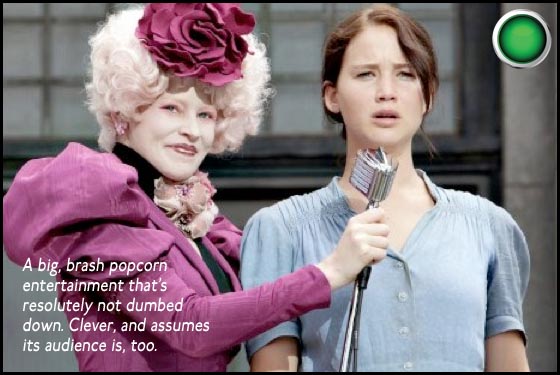
Every once in a while, just as I’m about to succumb to Hollywood-stoked despair and ennui, a movie like The Hunger Games comes along to rescue me: A big, brash popcorn entertainment that’s resolutely not dumbed down. A film that’s clever and assumes its audience is, too. A rollicking tale crammed with characters who sing with their own original voices, set in world distinct from our own that you’d love to explore more of. A movie that treads that fine line between being familiar enough to be archetypal yet fresh enough to feel like an undiscovered country.
I want to smack Hollywood with its own product! “See!” I’d cry, “It can be done!” And it all comes down to Story. It could have gone wrong, the adaptation of the first of Suzanne Collins’ gripping trilogy of bestselling science fiction novels. But Collins was along for the Hollywood ride — she helped write the script, with Billy Ray (State of Play, Flightplan) and director Gary Ross (Seabiscuit) — and somehow, some way, the core of what makes those books such sharp satire and such enthralling adventure was retained. The best bit: The Hunger Games, the movie, isn’t better than or worse than the novel — it’s the perfect accompaniment to it. It complements its source novel in a way that I can’t recall another Hollywood movie doing.
Here’s how: This is a postapocalyptic story set in a future North America now ruled from a tyrannical Capitol that lives high on the hog off the resources and the work of the surrounding twelve Districts. Once, decades ago, the Districts rebelled, and were defeated. Now, as punishment for their uprising, each year the Districts must send two Tributes — one boy and one girl between the ages of 12 and 18 — to fight to the death in a televised bloodsport, with only one teen coming out alive. In some Districts, Tributes train specially for the Hunger Games, and volunteer; in others, too poor to devote resources to such training, Tributes are chosen by lottery.
The novels are told, brilliantly, in the first-person voice of 16-year-old Katniss Everdeen, of coal-mining District 12, who volunteers for the Games after her little sister, Primrose, is chosen by lottery. And so, in the books, we get no outside perspective on the Games as spectacle and propaganda and entertainment (the latter for the Capitol only, which does not, of course, contribute Tributes). Now we get that stepped-back look in Gary Ross’s film, with stark visuals that contrast the poverty of District 12 with the glossy sheen of the Capitol — hello, huge wealth disparity! — and the particularly horrific, and horrifically mesmerizing, presentation of the Games on national television. It’s a pageant that looks grotesque to our eyes — Stanley Tucci’s (Captain America: The First Avenger, Burlesque) absurd TV host Caesar Flickerman is a spectacle all by himself — though it’s but a step away from what we see on our own TVs today. It’s a terrible thing rendered reasonable and logical in eyes of ordinary people.
Even in the eyes of our heroine! Jennifer Lawrence (X-Men: First Class, Like Crazy) is perfect as Katniss: she’s strong, brave, and smart, yet hardly perfect. (You know, just like male protagonists get to be!) She’s sullen, taciturn, quick to take offense… and she’s also accepting of the reality of her world. She’s no rebel, not in any way that would make a difference, until some accidental nudging from her fellow District 12 Tribute, Peeta Mellark (Josh Hutcherson: Journey 2: The Mysterious Island, The Kids Are All Right), makes her start to wonder if she doesn’t have to play the Game the way she’s supposed to play the Game.
This is powerfully humanist science fiction from a filmmaker who’s done something similar — and with teens, too — in his marvelous Pleasantville, in bringing characters to a realization that the world they live in is perhaps not inevitable in its stifling oppression. And yes, this is science fiction! Watch how plenty of people who don’t understand SF try to deny it. Sociology is a science, and futzing around with it counts. Ross tosses in little science fictional touches that could not appear in the novel, limited to Katniss’s perspective, such as Prim’s (Willow Shields) tiny, private act of tucking in the tail of her shirt as she approaches the Tribute platform in District 12 after her name is called, before Katniss overcomes her horror to volunteer. It echoes a moment earlier as the Everdeen sisters prepared for the “Reaping,” wanting to look pretty and presentable: they are terrified of being chosen, knowing full well that it means almost certain death, and yet they are also keenly aware of the honor it represents for them and for their District. It’s a dubious and perverse honor to our eyes, but we don’t live in this world.
There’s also a science fiction of fashion here that is thrilling in places and appalling in others, but all of which represents attitudes about entertainment and beauty that are distinct, to varying degrees, from our own. (Elizabeth Banks’ [Man on a Ledge, The Next Three Days] Effie Trinket, a Capitol advisor to Katniss and Peeta, is especially disturbing in her ideas about makeup and fashion.) It’s another thing that makes The Hunger Games the movie an intellectual pleasure to watch: even as it is depicting unpleasant things, it doesn’t look, in its grand sweep, much like any film we’ve seen before. It’s in how jarring it can be, in fact, that the satire and the speculation comes, by inviting us to reconsider how our own ideas about such things might appear to outsiders.
Ross has created a masterful film, one that kept me in suspense even though I knew, as a lover of the novels, what was going to happen. This is not a happy movie — the central premise of children killing children as a punishment for their forebears’ actions is not shied from — but it is hugely satisfying and deeply disturbing in a mix that few films get so right.
see also:
• The Hunger Games: Catching Fire review: reluctant heroine
• The Hunger Games: Mockingjay – Part I movie review: image manipulation
• The Hunger Games: Mockingjay – Part 2 movie review: breaking the blockbuster
















Star Wars is not science fiction, it is a space opera. 1984, Brave New World and Hunger Games is what real science fiction is all about.
I guarantee many would and would also go to a website when they knew doing so would hasten someone’s death as seen in “Untraceable”.
Sure she is. She’s in a fundamentally unfair, immoral and rigged scenario and does what she can to affect it. She throws herself into it in the first place when she didn’t have to, to protect her sister (ask Prim if big sis is a hero). She tries to assist and comfort someone who had the option of trying to kill her, she kills only when forced to. Some in the competition are psychopaths who would do it even if they weren’t required to.
She rebels against the system by refusing to engage in and complete the game in the prescribed manner.
She doesn’t have superpowers, she’s working with the resources and choices she has available to her.