

If you do not already know the story of Donald Crowhurst, who set off from England in 1968 in an attempt to sail singlehandedly and nonstop around the world, keep it that way. (I knew nothing, and was glad of it.) Don’t even watch the trailer for The Mercy, the genteelly brutal new movie about his adventure, before you see the film. Though his odyssey was global news at the time, he has mostly been forgotten… and whether or not he earned and deserves such obscurity is certainly a matter for debate, and it’s reasonable to suspect that some may look at the events depicted and decide that he should have remained a footnote in maritime history. That may now be moot: In the way of these things, there’s another movie about the man, entitled simply Crowhurst, though it’s a much smaller indie, also opening soon in the UK. So he’s on the cultural radar once again. But even without that second film, The Mercy on its own is an unsettling story smartly told, one that explores profound matters both personal and societal that have powerful resonance in hindsight: its moment in time is at once uniquely its own and a harbinger of things to come. We are going to be talking about The Mercy and Crowhurst anew for a while.

And we’re going to be talking about Colin Firth’s performance here, coaxed and fostered by director James Marsh (Shadow Dancer). Firth is subtle yet unflinching in crafting a portrait of a man pushed to his limits, and then beyond, and cracking under the pressure of that. Yet this is not a man-versus-nature story: Crowhurst here is not being tested by the dangerous waters of the open ocean (or at least not only that). It doesn’t take much shaping by screenwriter Scott Z. Burns (Contagion, The Informant!) to mold The Mercy into a condemnation of the cultural forces that push men to take risks that they might otherwise not, and not the ones that pop first to mind. This Crowhurst is not an adrenaline junkie chasing thrills to make his heart race: he’s a man chasing financial success to ensure that his family is comfortable. Firth breathes and sweats the horror of the possibility of his failure at that, as well as the sort of mild-mannered, stiff-upper-lip stubbornness that is supposedly so cherished a part of the English character. But maybe sometimes you shouldn’t keep calm and carry on. Maybe sometimes you should just freak out and give up. Firth’s delicate resolve here is only just barely subsuming a freakout of the only kind he can allow himself under all the hopes and anxieties piled upon him.
What happened is this: In 1968, the Sunday Times newspaper announced that it would sponsor an around-the-world sailing race, the Golden Globe, for solo sailors who would not put foot on land the entire time. There would be a money prize for the first man to do it, and another prize for the man to do it the fastest. (Of course it was all men who would participate.) Just about the only rule was that entrants had to set sail sometime between June and October 1968, so that they would be navigating the wild Southern Ocean in summertime.
Donald Crowhurst (Firth: Kingsman: The Golden Circle, Bridget Jones’s Baby) was a weekend sailor who decided that he would enter with a trimaran of his own design — one that did not yet exist — that featured new innovations, including massively higher achievable speeds. He figured if — when — he won, he’d have proven the design, and proven that his trimaran could be handled by an amateur, then he’d go into business selling it to hobbyists like himself. His previous venture, hawking a sort of proto-GPS device of his own invention called the Navicator, had failed, so he really needed a success. He went all in, financially, including putting up his family’s home, to build his boat, the Teignmouth Electron. He had to win. He’d be ruined if he didn’t.
Except… He was inexperienced at this type of sailing, and not only was the Electron untested when he was finally forced to set out on October 31st, the last day for eligibility, the boat wasn’t even finished. He figured he’d finish it at sea, which is so WTF that you can’t even believe he’d dare it, but Firth’s Crowhurst is so casually insouciant about it that you get sucked right into his confidence. Maybe we viewers are the unrealistic ones? He knows what he’s doing, surely…
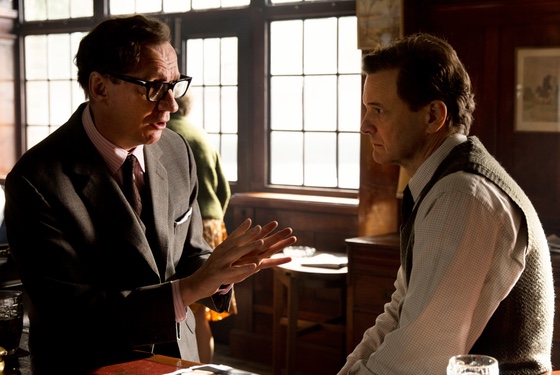
But it gets worse. “You’re a story of derring-do waiting to be told!” enthuses PR agent Rodney Hallworth (David Thewlis: Wonder Woman, Anomalisa), whom Crowhurst hires to represent him. For this race is huge in the British and global press: there is marketing and advertising to be done, sponsors to be acquired. The BBC gets onboard, almost literally, engaging Crowhurst to keep a diary at sea, written and filmed, for them. There aren’t many other entrants, and they are all being closely watched… or as closely as a lone sailor in the middle of the world ocean can be in the days before satellite phones and GPS. A man like Crowhurst is really and truly alone out there on the water, with only a few brief ship-to-shore radio calls offering contact with his family — including his wife, Clare (Rachel Weisz: Denial, Youth) — and the rest of humanity.
There’s a brief scene of Crowhurst alone on the Electron on Christmas Eve 1968, and this is not mentioned, though I’m sure it’s what we’re meant to think of: that’s the same day that three astronauts are orbiting the moon for the first time, and sending back that famous photo of Earthrise over the lunar landscape. Those men are barely more alone than Crowhurst is. Less so, actually: they have one another, at least. Crowhurst has nothing for company but the weight of the expectations placed upon him by himself, his family, and the whole world. And those are not escapable.

















Hmm, nobody’s made Fastnet yet, as far as I know. That was the big thing when I was young; this one had largely been forgotten only a few years later.
What’s Fastnet?
I saw a documentary about this a while ago, and use it as one of many potential topic-starters for my writing classes. The gender aspects are definitely interesting, not just the forces that push men to do dangerous things, but the image of masculinity that allows them to leave wives and children to chase ephemeral dreams. This was perhaps more obvious in the case of one of the other sailors, however.
I really was looking forward to this but Colin Firth just like Hugh Grant is so emotionless with that same bored look in every movie they make so it´s unbearable to watch. Bad casting destroyed this one for me :(
I think Crowhurst found himself in a situation that lots of other people in real-life might have when they signed a contract to do something they haven’t thought through the consequences. He signed up to something but then realised he couldn’t back out without ruining himself financially by losing both his house and his business. It’s also because of his wife’s passionate declaration at the end as well on the media. They would explain why he took the plunge.
Anyway, Firth was great in making the audience sympathetic to Crowhurst (despite how irresponsible it seems on the surface) and Weisz played her role as the supportive wife really well as well.
Anyway, good review.
But people make mistakes that ruin them financially all the time, yet few choose the “solution” that Crowhurst did.
True, but in his case it’s not just himself that’s ruined. His entire family, including his three kids, will have to go into miserable poverty for a very long time (it doesn’t appear to me that his wife has a paid job in the movie) at the very least. That got to hurt really bad. Not to mention he’ll mostly likely become the town’s laughing stock if he “chickened out”. It looks to me like in his mind he thought that sailing around the world is a way out for him and he’s blinded about the hazards by being in the situation. That happens in real-life quite a bit, especially among men.
I am mostly trying to understand why he made those irresponsible choices.
This is also often the case.
That’s… literally the text of the movie. But that’s not the “solution” I was referring to.
I’m talking about the fact that he kills himself rather than face the financial ruin and public embarrassment that he is still leaving to his family. At least he didn’t become a family annihilator and do a murder-suicide, as men facing ruin and/or embarrassment sometimes do.
Toxic masculinity. Textbook example.
Ah I see we were talking about 2 separate events. I was thinking about why he decided to start sailing at the start of the movie instead of admitting defeat and acknowledging the reality he simply couldn’t do it, whereas you were talking about why he chose to take his own life later on. Everything is clear now. Thanks.
I agree. Although I’d say the media also had a part to play just like Claire said at the end. Claire’s statement is still very relevant in 50+ years later.