There are movies — rare as they are — about women who do not compromise and make no apologies. And then there’s Funny Cow, as blistering and caustic a film about a no-bullshit woman clawing her way through a man’s world as I’ve ever seen.
This faux biopic of an unnamed (fictional) famous stand-up comic (Maxine Peake) “presumes” that the audience is already aware of who she is, and so it’s not about her work; this is most definitely not a comedy. Instead, this is a bitter portrait of how one girl survives a brutal childhood in 1950s northern England to become an adult misfit in the 1970s and 80s, a time and place even more unkind to women and to nonconformists — doubly true of nonconformists who are female — than is the case today.
Defiant derision is how her resilience manifests itself in the face of a violent father (Stephen Graham [Journey’s End, Pirates of the Caribbean: Salazar’s Revenge], who, in a brilliant bit of casting, also plays her brother as an adult): “Get yer own tea,” snarls the maybe eight-year-old “Funny Calf” (a firecracker Macy Shackleton) even though she knows it will earn her a beating; it’s worth it. She deploys similar snarkiness with her abusive and future ex husband, Bob (Tony Pitts: Rogue One: A Star Wars Story, Triple 9), who is a virtual clone of her father; “thuggish misogynist” is one of the few flavors men come in here. One of the others is “snooty intellectual,” which she encounters in Angus (Paddy Considine: Journeyman, The Death of Stalin), who will snidely inform her that “sarcasm doesn’t suit you”… but what he means is that it doesn’t suit him, that he doesn’t like it. (Angus isn’t violent, but he does expect things from her, like children, that she isn’t willing to give. It earns her his enmity. Or maybe it’s pity. Either is appalling to her.)
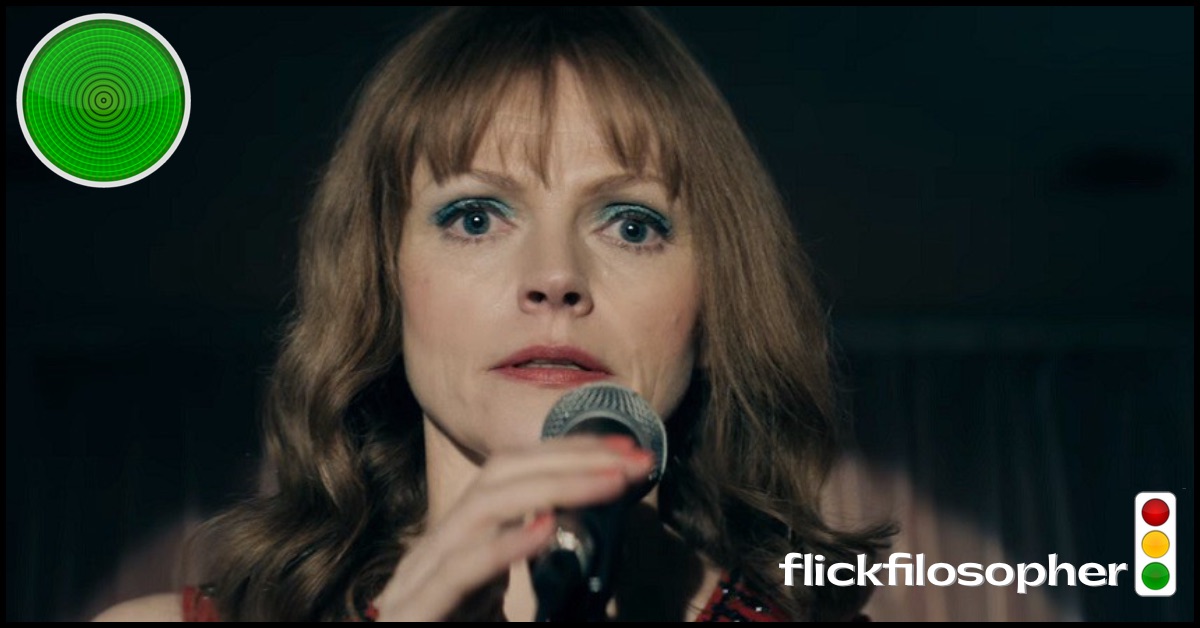
Acrid humor is pretty much all she has: it’s almost her sole method of interacting with the world, and it doesn’t do much to render her likable. She doesn’t care to be likable, though, and neither does the movie feel this is important, which shouldn’t feel so shockingly radical, but does. She is who she is, not whom we or anyone else would like her to be. Peake’s performance is absolutely incendiary and utterly unashamed — and rightly so — of this hard woman navigating a hard life, who fits in nowhere and with no one and refuses to pretend otherwise.

Everything here is skewed and uncomfortable, from director Adrian Shergold’s dreary palette to Tony Slater Ling’s (Doctor Who) cigarette-smoke-hazy cinematography to the film’s structure. (The screenplay is the feature debut of Pitts as writer.) Funny Cow isn’t a straightforward faux biopic: its narrative skips around in time, as if, perhaps, she is recalling in scattershot fashion the moments of toughening pain throughout her life that built up the layers of her defensive outer shell. Indeed, the film opens with a clearly 80s-glam star “Funny Cow” returning to visit the rough streets she grew up on, so the whole movie could be considered a series of flashbacks.
Because the story jumps around, her very first time onstage delivering a comic monologue, which we might expect early in the film, comes very late, almost at the end. (She takes a slot abandoned by her reluctant mentor, Lenny [Alun Armstrong: Eragon, Oliver Twist], a sad, drab, unfunny man who is eventually crushed to find himself competing with a woman.) And it pulls the rug out from under the viewer in a way that is startlingly anticlimactic: her routine is horribly racist and homophobic, very of the period and what her audience wants — they roar with laughter — but difficult to listen to and most definitely not something that many of us would consider funny today.
It’s a savage cap to a tale that is constantly challenging us to find moments of grace and triumph among the misery, cruelty, emotional frugality, and wary mistrust that have been this woman’s entire life. It’s not always easy. This is scorched-earth cinema that will not be to everyone’s liking. But it’s not a film I will soon forget.