


I’m “biast” (con): nothing
I have read the source material (and I am indifferent about it)
(what is this about? see my critic’s minifesto)

In a distant future, London is a “predator city” roaming a postapocalyptic landscape on giant caterpillar tracks, devouring smaller wheeled towns in order to fuel its voracious appetite for power both literal and figurative. But now there are almost no little towns left, and London turns its sights on faraway lands “across the land bridge” where the “Anti-Traction League” has rebuilt settled civilization and is just sitting there ripe for the plundering. It’s a risky proposition: “We should never have gone into Europe,” the Lord Mayor of London moans. Meanwhile, Tom Natsworthy, a Londoner lost outside the city, falls in with mysterious outsider Hester Shaw, and is discovering what life is like for what’s left of humanity in this hardscrabble world…
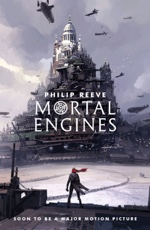
The metaphor of Mortal Engines is screamingly obvious. No, it’s not Brexit. No, it’s not urban political elites destroying the lives of ordinary folk. It’s this: Predator Hollywood studios continue their trawling for whatever YA SF/F properties they can scoop up, and they’ve finally gotten to the steampunkish 2001 novel — first in a quartet — by Philip Reeve. It’s not a terribly good book: its worldbuilding is intriguing, but its characters and story are strictly cliché.
And so it is with this big-screen adaptation, a project of Peter Jackson’s WingNut Films (the Hobbit trilogy, The Adventures of Tintin), which expends so much effort on its visuals — see it in IMAX or 3D! *groan* — that it forgets that we need well-drawn characters doing things that are meaningful to them if we are going to care, or indeed even notice, how cool it all looks. Even the FX here operates in a bizarre mode of diminishing returns: the opening sequence, in which we witness London chasing down a town and consuming it, is the freshest thing we will see onscreen. By the time we get to the finale, it’s as if everyone behind the scenes is so exhausted that they just figured they could treat us to Star Wars’ attack on the Death Star again and we’ll be good with that. We’re not.
(The director here, Christian Rivers, is a veteran FX artist from Jackson’s stable making his feature debut. He’s yet another example of a white man with no experience directing a feature film being handed the keys to a big-budget blockbuster because of who he knows, not because of any demonstrated experience. And it’s even more infuriating when we see now that he obviously doesn’t have a lot more to offer than fantastical eye candy.)

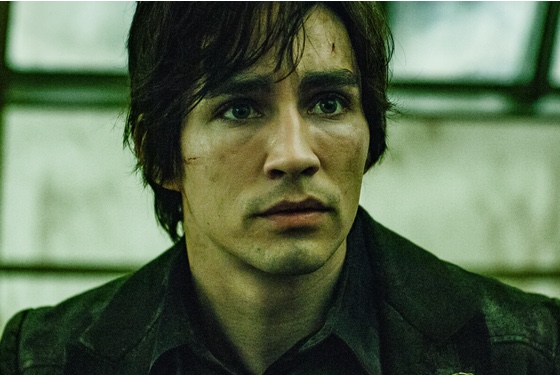
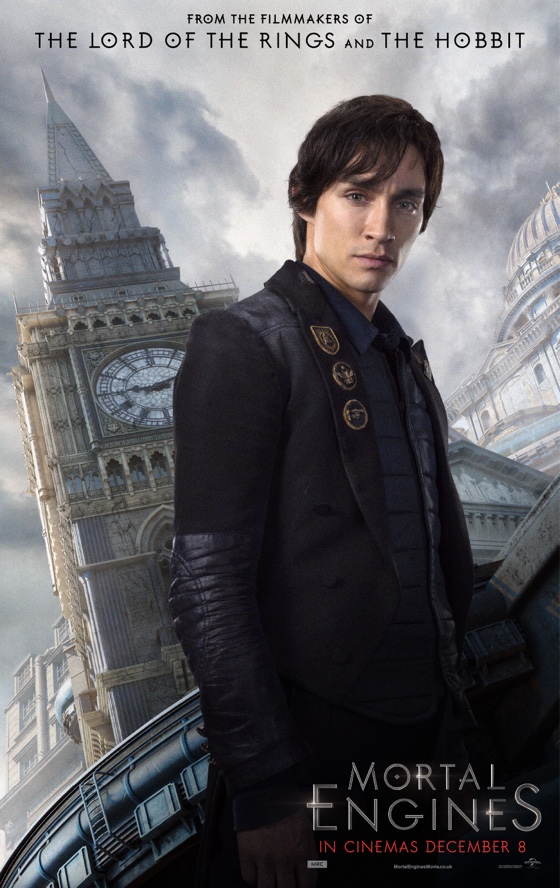
As a story, Mortal Engines is an absolute disaster. The kid protagonist of the book is now an adult, played by Robert Sheehan (Geostorm, The Messenger), who is 30 years old and looks it; this is most definitely not in the tradition of baby-faced actors playing teens despite being well into adulthood. But Tom Natsworthy the character has not been aged up at all, so he comes across as yet another feckless dolt, useless, aimless, and bland: a half-formed person waiting for someone else to show him the way to some sort of personality. But he’s cast as the hero despite all the far more apparently complicated and genuinely heroic characters — who are, ahem, women — around him merely because he’s the guy and that’s what the guy gets to do. Why doesn’t ragged survivor Hester (Hera Hilmar: The Ottoman Lieutenant, Get Santa) or enigmatic “Anti-Traction” aviator Anna Fang (Korean pop star Jihae) get to be the hero?
To be fair to the script — by Jackson and his regular collaborators Fran Walsh and Philippa Boyens — Engines doesn’t seem to know who its protagonist is until literally the last 15 minutes or so of the movie, when suddenly Tom shows signs of having been on a personal journey of learning and growth; previously he had just been getting dragged around by the plot without any sign of wanting much of anything beyond pouting about getting back to London. But it’s not like either Hester or Anna get much in the way of motivation, either, at least not motivation that drives any story; the thing that drives Hester, in fact, is something she achieves (at least as far as she knows) in the first few minutes of the movie, and we’re left wondering why she’s a character in the goings-on at all. Later, Anna shows up via a contrivance that is both preposterously coincidental and also connected to knowledge it seems impossible she could have. Almost nothing that would seem to be fuel for, you know, a story happens until far too long into the movie. I spent most of the two-hours-plus runtime muttering, “What is the story? Where is this going? Whose story is this, even?”

Mortal Engines is lazy, confused, and derivative (apart from Star Wars, there are plot points and visual and thematic motifs stolen from the Terminator series as well as The Hunger Games). Its idea of drama is having characters suddenly sacrificing themselves for no discernible reason out of loyalties that seem random. It cannot be bothered to develop its own mythology besides tossing out phrases like “municipal Darwinism.” There’s no humor to speak of here (and the movie desperately needs some), no romance of any kind (though when it tries to inject some of the lovey-dovey kind, it’s laughably implausible), no urgency or relevance. It is an exercise in production design in search of a reason to be getting in our faces this aggressively. And it never finds one.
















The trailers definitely made it seem like Hester was the protagonist of this film. Reminds me a little of “The Croods”, where all the trailers were about the rebellious daughter, but the film itself was all about the dad.
Indeed. Main reason I was curious to see this is because the trailers made it look like it was about her. Blonk boy barely says a word, while Hester and Anna are shown to interact, and my interest rose. Was there a plan in that? Make it seem like it’s about the women to lure people in? I think I’ll just watch Nausicaa of the Valley of the Wind or Castle in the Sky again. Or Heavenly Creatures, to be reminded of what Peter Jackson and Fran Walsh were once capable of.
Hester and Anna are definitely more interesting characters, so they make for a better trailer. But they take a backseat to Tom, who is so dull that even they can’t do much for him.
In other words, it’s the return of bait and switch cinema. (Not that said cinema ever went away. But still…)
Oh, not just me, then. I thought Hester would be the main character as well.
The trailer made the movie look incredibly stupid, though, so I guess it got that much of its truth in advertising right.
My reaction to the film changes with my mood. I’ve made three entirely contradictory plans of action:
(1.) Skip the movie. Read the book instead.
(2.) Skip the book, ignore the story completely, and just watch the images on the largest screen possible.
(3.) Skip the movie. Wait for Robert Sabuda to adapt the novel into a pop-up book.
#3 appeals to me!
Ouch! I think I’m the one who recommended the book to you. I read it years ago when I was wowed by the premise and more tolerant of cliche, and recommended it based on residual good feelings about it rather than any specific memories of the story. I did think the series got progressively more interesting, with Hester clearly its focus, exploring her backstory and twisted relationship with Shrike and relegating Tom to hapless lover/sidekick. (Anna Fang has a continuing role as well, despite her fate in Book 1.) And I have a feeling that, flawed as the books may have been, the film probably dilutes and flattens the characters even more.
Like Danielm80, I’m torn about seeing this. I don’t want to waste time on a badly told story, but the worldbuilding of the books has stayed with me and I’ve always wanted to see it brought to life onscreen. Guess I’ll have to decide if it’s worth a ticket to look at cool imagery, even if in service to a derivative slog.
At least I got turned on to Jihae’s music because of her involvement in this. :-)
But it looked so intriguing in the trailer, I was looking forward to it.
Based off your knowledge of the books, do you think team Jackson left out vital storytelling/character development in the theatrical to include in an extended edition?
No. The book is not deep or all that interesting.