


I’m “biast” (con): nothing
I have not read the source material
(what is this about? see my critic’s minifesto)

I’ve said it many times before: I’m stunned at how it seems we will simply never run out of previously untold stories of World War II. And that’s even given how narrow the perspective of Western cinema tends to be, prioritizing the POVs of white men. (My god, if we suddenly decided that the stories of nonwhite nonmen were worth telling, we’d be finding new tales of the war for the rest of human existence.) It’s a measure of the all-encompassing devastation that conflict created, of how wide its impact was, that we are able to continually rediscover horrible new angles on it. That’s no bad thing. We shouldn’t forget how awful this war was. Stories of the specific human impact are important, and need to be heard, as widely as possible.
And here we have — ostensibly — yet another of those new stories, one fictionalized from reality, but still. British novelist Rhidian Brook was inspired to write what would become his bestseller The Aftermath by his grandfather’s experience in Germany in the immediate postwar period. Apparently it was not common for British officers to be billeted the homes of German nationals during the reconstruction, but it did happen at least occasionally… and that’s the setting for this cinematic adaptation of the book (which I have not read).

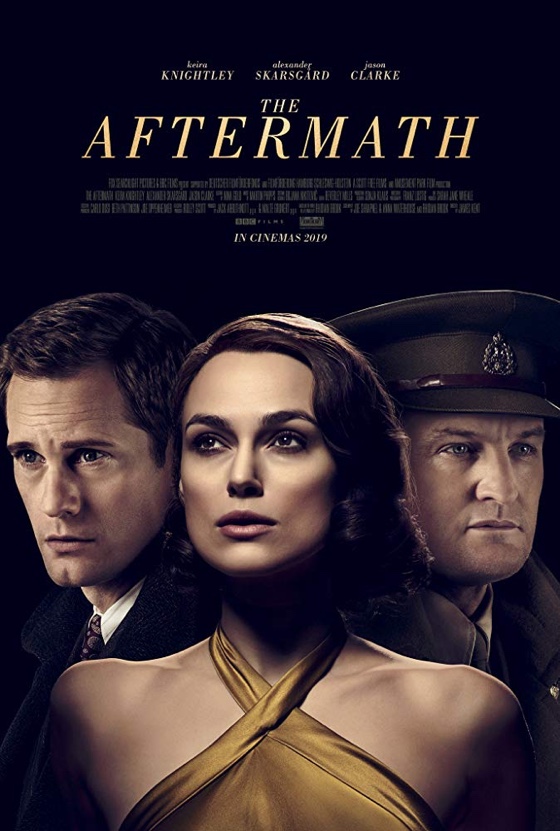
The film opens with Rachael Morgan (Keira Knightley: Pirates of the Caribbean: Salazar’s Revenge, Collateral Beauty) arriving in Hamburg — reduced to rubble by the war — in 1946 to join her British army officer husband, Lewis (Jason Clarke: Serenity, First Man), who has something to do with the British cleanup effort (it’s never really clear what his job is, and this will be part of the problem with this movie; stay tuned). The Morgans will be living in the stately manor of architect Stefan Lubert (Alexander Skarsgård: Big Little Lies, The Legend of Tarzan) and his teenaged daughter, Freda (Flora Thiemann); his wife, Freda’s mother, was killed in the firebombing of the city, but the beautiful house, in the forested countryside, survived. (The house will be fetishized by the film in precisely the same way that the suffering of survivors in the city will be all but ignored.) Initially Stefan withdraws with Freda to the bigger-than-any-apartment-you’ve-ever-lived-in (so: hardly awful) attic while they wait to be moved to ominously referenced “the camps” (another thing that is rather oblique here, and another problem), until the evidently softhearted Lewis suggests that the Luberts just stay, and that they all share the house.
Rachael is appalled by this, and who can blame her, for not wanting to live side by side with an only-just-defeated enemy who was bent on world domination? Although, also, who can countenance this, what with Stefan being no Nazi, just a poor hapless defeated bystander?The Aftermath exists in a strange limbo between winners and losers of the war, and yet it doesn’t want to deal with such matters as happenstance of birth — no one gets to choose which country and which culture they’re born in — or the vagaries of conflict. It’s just waiting to get down to the sexytimes between Rachael and Stefan.
I mean, it’s not even a matter of suspense that this is what is in the offing, that this is what the movie is going to be about, in the limited sense that it is about anything at all. You can practically feel director James Kent (Testament of Youth) and screenwriters Joe Shrapnel and Anna Waterhouse itching to get to the soft-core nonsense of Rachael and Stefan being so drawn to each other in spite of all the bad feelings on both sides that they just can’t help themselves. The postwar upheaval feels like nothing so much as a cheap backdrop to two beautiful people getting it on. I mean, I would be one hundred percent — one thousand percent — into a legit sexy, romantic, tormentedly tragic movie about Keira Knightley and Alexander Skarsgård enjoying hot steamy unapproved bedplay. But The Aftermath ain’t it. The Aftermath don’t know what it is.
There is way too much going on here, rushed through by way too many characters who are way too underdeveloped… which is not at all unexpected when a novel is adapted for the big screen. (So, like, don’t adapt novels into sub-two-hour movies. They are meant to be prestige BBC or HBO series, ten or twelve hour-long episodes at a minimum. I thought we all understood this by now.) The Aftermath is trying to tell too many stories all at once, and they all suffer for it. The film only just touches on the deprivations of ordinary Germans after the war, and the lingering resentment of being on the losing side; we need more than just Rachael and Lewis staring sadly from their passing car at starving children scrambling over rubble. We need to feel a bit more the loss that poor Freda is experiencing, not just of her mother at such a vulnerable age but why she would also latch onto Albert (Jannik Schümann: Barbara), the desperate young man clinging to Hitler’s ideology even now that it has been so utterly crushed. Albert — who is barely a character at all — will set in motion a chain of sidebar events that should feel a helluva lot more important and have a helluva lot more emotional impact than they do.

Even if The Aftermath is going to end up, by default, being primarily Rachael’s story, about her having to choose between the husband who isn’t a bad guy but from whom she has become estranged over the long course of the war, and the exotic and putatively socially dangerous new lover… well, then, The Aftermath also lets us down there. Rachael is a very passive character who is more pushed around by others, and by events, than a woman who makes decisions on her own. (I love Keira Knightley. I wish this movie was worthy of her passion and her power.) There’s little genuine romance in this, and way too much laughable preposterousness. None of that is sexy. And it ends up feeling like a betrayal of the complexity of the, you know, aftermath of the war. It’s also a reduction of women’s realities, and of reality’s realities, to imply that Rachael’s torn-between-two-men decision is a microcosm for *checks notes* war-ravaged 1940s Europe.
I almost hate to suggest this, but it’s glaringly, obnoxiously, depressingly obvious: The Aftermath’s central conundrum is, pathetically, a depressing analogue for the current Brexit cliffhanger: Shall we choose an exciting Continental romance or stodgy stiff-upper-lip British conservatism? (No shade on hottie Jason Clarke, who is actually Australian anyway.) You’d think it was an easy choice, and yet The Aftermath acts like it’s a difficult decision. Even with how it stacks its own cards, The Aftermath cannot act like a goddamn grownup with this. At least the film might have a legacy, if a sad one, as an artifact of yet another awful moment in time, three-quarters of a century after the moment in which it is set.

















White people making movies about White people based on books written by White people!!!
That’s not why she gave it a negative review, but it’s clear you never made it past the third sentence.
Nope, read the entire review…just pointing out that she led with a personal/political comment that has absolutely nothing to do with the film. Is that clear?
Just checked your comment record. You’re a liberal-basher and misogynist AOC-hater, and there’s no point having a reasoned discussion with you. Let’s skip to the end where I (accurately) call you a troll and you call me a PC libtard or whatever, and then we can get on with the rest of our day.
So flattering of you to show interest…sorry it never occurred to me to check you out…just not interested.