

I don’t think I’ve ever seen a better depiction of the internal monologue that many, perhaps most, modern women have with ourselves than what Mouthpiece does. How do we navigate all the many contradictory expectations the world throws at us? How do we balance being the sort of “nice” we’re “supposed” to be while still allowing ourselves the rage that we’re not “supposed” to have but cannot deny? How can we make our true selves work within in the conventional conformity we are pushed into, or how do we cope with the disappointment of those who frown on us coloring outside the lines? It’s exhausting and, worse, it’s invisible. It’s just the voices we live with in our heads, all the time.

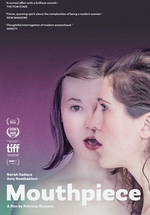
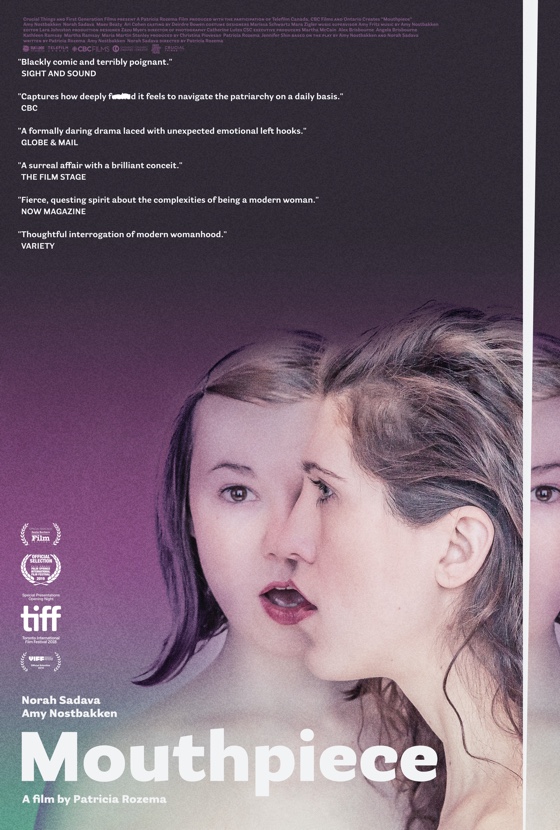
It’s not invisible in this absolutely brilliant Canadian film, which deploys the audacious conceit of having two women play Cassandra, a 30-year-old Toronto writer, in the 48 hours between when she learns that her mother has died and when she delivers the eulogy at her mother’s funeral. Amy Nostbakken is “Tall Cassandra” — she of the bitchy resting face and the angry feminism — and Norah Sadava is “Short Cassandra,” the peacekeeper, the one who doesn’t rock any boats. As they bicker and soothe, comfort and challenge “each other,” Cassandra’s internal monologue becomes an external dialogue. It’s almost shocking, in the best possible way. (Everyone else just sees one Cassandra; I’m not sure the world is quite ready yet to see the warring factions within a woman actually out there brawling. There are comedic elements here, but it’s not that kind of movie. There are a couple of terrific musical sequences, though!)
But Mouthpiece is also about the generational conversation between women, because Cassandra is struggling with how best to eulogize her mother, Elaine (Maev Beaty), who subsumed her own professional ambitions and desires into her maternal role, which adds a layer of fury to Tall Cassandra’s grief. Flashback memories of kid Cassandra (there’s just the one of her, played by Taylor Belle Puterman) getting her first glimpses of awareness of her mom as a person in her own right, not merely Mom, haunt the adult daughter now, in the wake of Elaine’s death: it seems to Tall Cassandra that Elaine, who died very young, was only diminished by motherhood, and that her mother’s life seems to have been wasted. Short Cassandra isn’t so sure it’s as bad as all that… and so perhaps, just as the two Cassandras might be able to find a middle ground about the best way to memorialize Elaine, both at the funeral and in their own mind, daughter will find one with mother, too, even if it’s too late for daughter to tell her? Perhaps what seems like contention and strife between the generations… isn’t?
Nostbakken and Sadava developed this story as a play, and then worked with director Patricia Rozema (Into the Forest, Kit Kittredge: An American Girl) to adapt for the screen in what feels, in so many ways, like an incredible act of generosity all around: among artists and creators, among women young and older. It feels like an admonition to be kinder to ourselves, and to those voices in our heads. The space that Mouthpiece gives to Cassandra’s emotional and psychological struggle with the world and with her mother is extraordinary, and poignant, and vulnerable, and so damn refreshing. Women are so rarely heard with such candor.


















Sounds wonderful. Is it getting a U.S. release?
It was released in the US in 2019, and it’s on iTunes now. Link above!
A movie I saw at Virtual Sundance called How It Ends has a similar conceit, with the main character (Zoe Lister-Jones) having a similar dialogue with her younger self (Cailee Spaeny) that you describe here. The movie isn’t great, because it doesn’t fully commit to that premise, but the dual personality part is interesting, so I’ll have to check this one out.