

Disaffected misfit teen saved by rock ’n’ roll? Woo-hoo! It’s a tale as old as time… or at least as old as, what, 1955? (This one is set in 1987.) Is this ever not good stuff? Is this ever not a story that most weirdos who came of age in the late 20th century can identify with?
There is a comforting familiarity for this GenXer in Blinded by the Light, but I also welcome the hearty rejection of the idea that nostalgia is universally a positive thing. Among all the feel-good danceableness here in the joy and the solace and the sense of being seen that pop music can bring, there’s a reminder for those of us who were teens in the 1980s — *waves hello* — that some important stuff really has not changed much since we were kids, despite that brief respite we got in the post–Cold War, pre–9/11 1990s. That might be a tad depressing, but it is at least authentic. We Xers may never get any decent retro reminiscence, what with everything that was once awful turning up new again these days, but hey, that’s just reality. We don’t need it sugarcoated, and we’ve never expected or wanted that.
Anyway. *sucking it up*

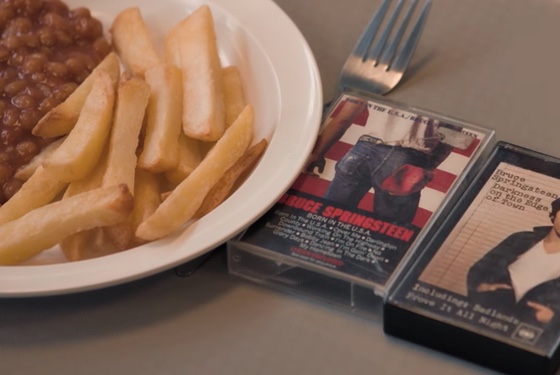
Luton, England, a working-class town north of London, may today be best known as the location of one of the greater-London-area airports. In 1987, when sensitive, creative 16-year-old Javed (Viveik Kalra) is trying to escape its suffocating suburbanity, its then-great claim to fame, as home to a Vauxhall automobile factory, is primarily notable to him when his Pakistani-immigrant dad, Malik (Kulvinder Ghir: Gone Too Far!, Bend It Like Beckham), is laid off after a long tenure working there. Javed is positively primed, then, when a new school pal, Roops (Aaron Phagura), introduces him to the blue-collar wisdom of Bruce Springsteen. Oh, baby, this town rips the bones from your back…
Look, it’s not that you don’t know in advance pretty much everything that will happen in Blinded: Javed finds his writer’s voice via inspiration from Bruce, finds the courage to stand up to his domineering father, and finds a girlfriend in the equally passionate and creative Eliza (Nell Williams). But foreknowledge cannot ruin one tiny iota of enjoyment you will get out of this deliciously cheesy, wonderfully goofy movie. This is not another song-and-dance revue like Mamma Mia! or another misconstrued ode to the power of pop like Yesterday; there’s way more Springsteen here than there is Beatles in that other movie, for one thing. This is simply a coming-of-age story set to some terrific tunes — tunes the movie appreciates the meaningfulness of — and running on a charming adolescent awkwardness that is often missing from such movies. Relative newcomer Kalra is seriously adorkable as Javed, and at 21, he’s only a few years older than his character; this isn’t another 30-year-old trying to play a teenager. But there’s a gratifying, even endearing lack of Hollywood polish in director Gurinder Chadha’s (Viceroy’s House, Bride & Prejudice) approach, as with a couple of pseudo dance numbers whose odd abortiveness truly mirrors Javed’s confused and conflicted state of mind.
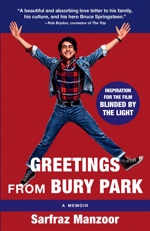
The freshness amidst Blinded’s familiarity comes in the why of Javed’s confused and conflicted state of mind: he’s torn between his life in Britain, which is all he’s ever known, as a culturally British kid, and the desires of his Pakistani parents — mom Noor is played by Meera Ganatra — for him to adhere to their customs as much as possible. (Javed’s younger sister, Shazia [Nikita Mehta], is also straining against the short leash they have her own; his older sister, Yasmeen [Tara Divina], seems to have given in: the family is about to celebrate her wedding to a groom their parents have chosen for her.) It’s a typical immigrants’ dilemma, moving across the planet to ensure a better life for oneself and one’s children, but then finding it difficult to let those children make that better life in their own way, in the way of the adopted country. This dilemma has informed all of the Indian-British Chadha’s films, most particularly 2002’s Bend It Like Beckham — about a Sikh teen who has to fight her immigrant parents so they’ll let her play football — to which Blinded is a sort of thematic sequel. (This film is based on Greetings from Bury Park, the memoir of Springsteen superfan Sarfraz Manzoor, a Pakistani-British journalist.)
It’s the immigrant motif that leads it to the unfortunately appalling relevance Blinded has for today (separate, that is, from the clearly terrific relevance of the continued popularity of the working-class poetry of Bruce Springsteen). The economic despair of Thatcher’s Britain is a heavy weight here, as Malik’s unsuccessful attempts to find a new job impact the family and Javed battles his own feelings of guilt in choosing to pursue an education rather than going to work to help out at home (though he can’t find even a part-time a job, either). Even worse is the racism Javed and his family must contend with, which isn’t only small and personal but outright organized: swastika-sporting skinhead National Front members are marching through Luton demanding “their” country “back,” and spraypainting slurs on the homes of the people who don’t look like them. It not very far from today’s Brexit-era Britain, nor even Trump’s America.
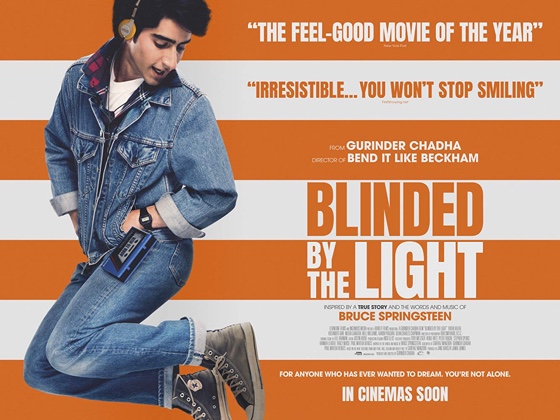
We may chuckle at Javed’s Walkman, at Eliza’s Bananarama hair, and at all the oh-so 80s clothes, and we may laugh out loud at Eliza’s Basil Fawlty–esque proud-Tory dad. But there’s plenty here, plenty that’s hateful and horrible, that we haven’t left behind, and from which we can still enjoy the bit of escape and the temporary comfort that art — of the music and the movie kind — offers.


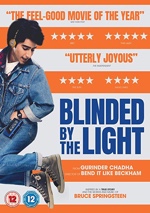
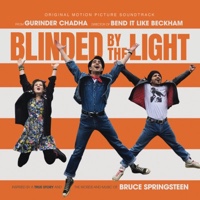















Yeah, I’ve been wanting to see this for a while…ever since I stumbled over the trailer.
It took me hearing Springsteen’s music out of context…not being played on stations that also played Billy Joel and ELO…to appreciate it for itself; which didn’t happen until the 1990’s. But, yes, his lyrics are poetry.
I listened to my share of Springsteen songs when I was younger and even number some of his more famous tunes among my personal favorites.
And yet…
Something about the premise of this film turned me off. Especially after I saw the trailer. Which I found myself hating. For reasons that are probably too complicated to explain here…
What I found iffy about the trailer was that it seemed to be a story about how art made by a white Western artist is universal (of course), and even brown people in far-flung countries can identify with it. And there never seems to be a movie about, say, a working-class white kid in New Jersey who takes Spanish classes and discovers and fiercely identifies with the songs of Victor Jara. :-)
But I watched the film ’cause, uh, I’m a brown person from an immigrant family who likes Springsteen, and hey, turns out I thought it was a pretty great film, for all the reasons MAJ points out. I also liked how it never ultimately sets up one set of cultural values over another, and finds a way to show how they can mirror and enrich each other.
We definitely need many movies like this.
Ideally art is universal. We borrow from them; they borrow from us. And you can never really tell what type of art is going to speak to you until you actually experience it.
That said, I’m glad to hear the movie is more balanced than the trailer suggests.
I have no problem with anyone appreciating any kind of art. But the way we talk about and teach different kinds of art, made by different kinds of people, often reveals our biases. So art by female or queer or POC creators is often discussed as embodying those specific experiences and cultural milieus, while art by white men is more often framed as “universal.” Even growing up in Southeast Asia, I was somehow taught to think a white English guy who lived 500 years ago was the greatest writer who ever lived, long before I read or saw any of his works. As Jasmine Cho says, “Privilege is when your culture is taught as a core curriculum, and mine is taught as an elective.”
Anyway, as I said, I did enjoy the movie – and it IS based on a true story, after all. But I’d also love to see more stories about people being inspired by nonwhite nonmale nonwestern artists for a change.
Now that I’ve actually seen the movie:
I was relieved to find it was more nuanced than I expected. Granted, it would have been unrealistic to expect a film in which the conservative Muslim father got the lion’s share of sympathy — especially in light of certain events of the last two decades.For that matter, it was nice to see a sequence in which one of the protagonist’s siblings was using non-British music to rebel against the system in her own way.
But I do give the film credit for being fair to both sides of the conflict between father and son and resisting the temptation to simplify the conflict like Bohemian Rhapsody did.
Granted, there were times when the film came close to being too heavy-handed for its own good. (Yes, I get it already. Thatcher was evil. But after seeing how some of my factory worker relatives have fared under far more liberal politicians on this side of the Atlantic, I’m getting a bit tired of people who keep repeating that point as if it means something.)
On the other hand, it made a lot of points that most recent movies rarely make and while it might be argued that denouncing Thatcher-era Paki-bashers in the year 2020 isn’t really all that daring, it beats seeing a cinematic sermon on how much more enlightened the Brits are about racial matters than us Yanks. (After all, most of America’s hang-ups about race were inherited from the Brits so most arguments about Britain’s more enlightened attitudes about race seem as convincing as a former chain smoker’s sermon about the evils of tobacco.)
Anyway, I liked what the film accomplished far better than what it did not accomplish. And I especially appreciated the lagniappe of seeing Peggy Carter play a key role as one of the more enlightened goras.
Mind you, I find it funny that one musical sequence reminded me more of a scene from West Side Story than a Springsteen song. Then again the soundtrack from WSS helped me get through high school the same way Springsteen songs helped the protagonist of this movie so no wonder…
There are NO “far more liberal politicians” in the US. The Democrats are about as liberal as the British Tories are.
Well, I suppose I could have said “allegedly more liberal politicians” but I’m already cynical enough about American politics as it is.
They cannot even allege it, though. There are some Tories more liberal than some Democrats. Merely the fact that almost no Tory would *publicly* diss the NHS (privately is another matter), while almost no Democrat comes out in favor of universal single-payer health care, is proof of that.