


I’m “biast” (con): nothing
I have not read the source material
(what is this about? see my critic’s minifesto)

I recently said, after seeing the terrific joint Finnish-Estonian production The Fencer, that I was curious to see more of what is coming out of Estonia’s newly revitalized film culture. I may have spoken too soon. November — Estonia’s official submission to this year’s Oscars (it was not nominated) — is an all-style and very-little-substance exercise in random oddity and weird imagery, mind-fuckery for mind-fuckery’s sake, except it doesn’t actually fuck with your mind, or with anything at all, at least not in any way that challenges us. This is a movie that dispenses with characters who engage us on any level, and doesn’t bother with a setting or situations that make any sense, not even on a fantasy level, yet this is also a movie that believes that invoking fairy tales and magic means all bets are off and no rules apply. November isn’t only the opposite of intriguing: it revels in its own meaninglessness as if emptiness were deep and significant.

Working from the bestselling Estonian novel Rehepapp, by Andrus Kivirähk (which does not appear to have been translated into English), writer-director Rainer Sarnet is ostensibly telling the story of 19th-century peasant Liina (Rea Lest), who longs for fellow villager Hans (Jörgen Liik), but he’s in love with the beautiful young baroness (Jette Loona Hermanis). But even that simple description of the plot is more cohesive and more cogent than anything we get onscreen. Liina and Hans live in a nihilistic faux-pagan culture in which love is “insignificant,” in which little animates anyone beyond rampant superstition, and where survival in their harsh, cold forest is a desperate struggle… or it would be, if anyone bothered to do a damn thing about their own welfare. I mean this: no one here seems to engage in any sort of work the likes of which we would associate with peasants trying to scratch out a living. They seem to focus their efforts, such as they are, on stealing from their neighbors and making deals with the Devil, literally, in order to bring to life robotic “kratts” assembled from farm implements that no one uses for actual farming. And then the kratts do some other work that also mostly doesn’t seem to do with putting food on the table.
I’m making it sound more sensible than it all is.
What’s left is Mart Taniel’s cinematography, which is truly beautiful, and some striking, even unsettling imagery, such as the creepy kratts — some of which are insectile; others are like demonic robots dreamed up by medieval alchemists — and a sequence in which the spirits of the dead, dressed in white, move through a spooky nighttime graveyard. But while November may have atmosphere to spare, it is pointlessly bleak, with nothing consequential to say about all the significant matters it glosses over: family, class, greed, sloth, religion, death. It’s so hollow that it’s not even repulsive, even with a rape scene, another of attempted rape, a bit in which people eat their own shit as part of a magic potion, and other grotesqueries.
A pox on it, I say.


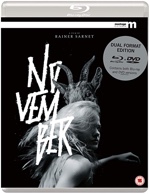














And next, Hans will write a dissertation: On the Uselessness of Everything…
Not so much mindfuck as mind-topless-bar.
Watch three billbourd outside ebbing,missouri online streaming, on web site:> FMOVIES9.BLOGSPOT.COM
just from the photos, i think the writer-director had a bad experience with some fellini movies after being forced to watch existential german expressionist movies.
I think you might get something out of it if you look at through a Lacanian lens, that desire never satisfies itself.
It’s a fairytale about what brings us into being, desire, which also ultimately extinguishes us. Desire is a fire that consumes itself.