

I’m “biast” (con): nothing
(what is this about? see my critic’s minifesto)

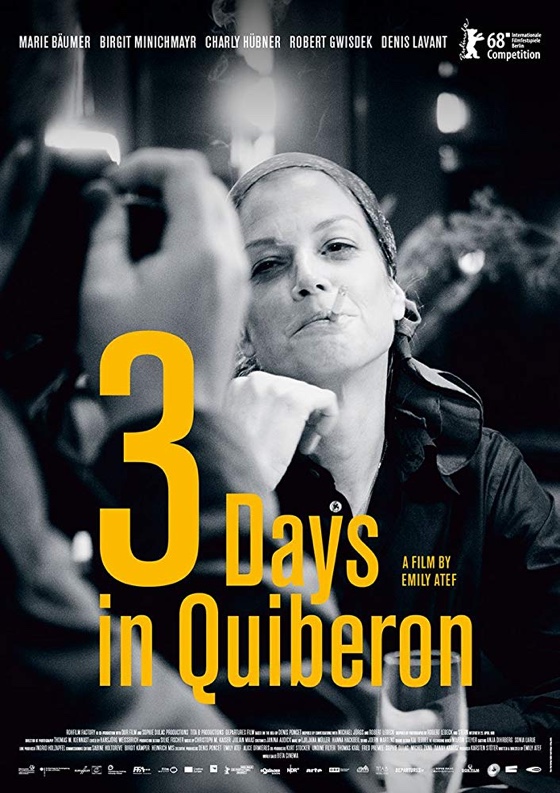
My film education continues: I had never heard of Austrian actress Romy Schneider before 3 Days in Quiberon crossed my radar, but now I know that she was one of the biggest European film stars of the mid 20th century, with a long string of prominent roles that made her a household name and recognizable on the street in Germany and France, and also subject to endless and often malicious gossip in the press. In this raw and uneasy film, German writer-director Emily Atef paints of portrait of tortured celebrity, extrapolating from Schneider’s last interview in 1981, just a year before her apparently unexplained death at age only 43.

As Schneider (a riveting Marie Bäumer: The Counterfeiters) is detoxing and trying to relax at a luxury spa hotel on the Brittany coast, with the support of her close friend, Hilde Fritsch (Birgit Minichmayr: Downfall), Stern magazine journalist Michael Jürgs (Robert Gwisdek) and photographer Robert Lebeck (Charly Hübner) arrive. She doesn’t often speak to the press, but she has invited them for what they hope will be an intimate conversation, and turns out to be, as Jürgs confides later to his editor over the phone, the most open she’s ever been with a reporter. Schneider’s freewheeling conversation with them — formal, informal, and frequently booze-fueled even though abstaining is meant to be part of her detox — is indeed rife with her anger over how her career has been defined, unfairly, by one iconic role; how she is constantly conflated with her characters; and how difficult it is for her balance her work, which she adores, and her family life, which she feels guilty for neglecting for that work.
Ironically — and rather depressingly — approaching this film with no awareness of Schneider and her movies only serves to highlight how Schneider’s predicament is in many way that of all women who want to break free of the small boxes our culture tries to keep us confined to, and how little that has changed in almost 40 years. The black-and-white cinematography, by Thomas W. Kiennast, isn’t only melancholy: it also lends the film a timeless feel. This could all almost be taking place today.

















The wonderful actress of 60s movies (GOOD NEIGHBOR SAM) was a child in wartime Germany. Her mom was an actress beloved by Hitler. Romy can been seen romping at the Eagles Nest with the baddie. The Wolf, man.
This is mentioned in the film.