

I’m “biast” (con): nothing
(what is this about? see my critic’s minifesto)

In May 2000, Joan Stanley (Judi Dench: Tea with the Dames, Murder on the Orient Express) is arrested by MI5 as a longtime spy for the KGB. Who, this sweet little elderly librarian?! Under interrogation, we get the details in extended flashbacks: From her years as a student at Cambridge in the late 1930s through her work on Britain’s atomic-bomb project during World War II, young Joan (Sophie Cookson: Kingsman: The Golden Circle, The Huntsman: Winter’s War) becomes enamored of Marxists, both politically and sexually, via an intense romance with radical Leo (Tom Hughes: Madame, About Time), and absolutely convinced that the Russians — who were, recall, allies with the West against the Nazis and Japan — needed to be kept up to speed with the bomb development. So she started passing on the scientific secrets she was privy to…

There’s a lot of hot-button stuff going on in Red Joan, which is loosely based on a true story. Marxist oneself or not, it’s difficult to disagree with Joan’s contention that only by sharing the A-bomb technology could such weapons be “defused,” and of course this supposition has been vindicated by the fact that we have not had a nuclear war since. There’s some terrific undercutting of entrenched sexism at play here, including how women make great spies because “nobody would suspect us,” as Joan’s friend and coconspirator Sonya (Tereza Srbova: 360, Inkheart) snarks. (Yes, the sweet little elderly librarian is perfectly capable of being a spy. Also consider the possibilities of smuggling microfilm in baby carriages and among sanitary napkins.) It’s so heartening to see the support that Joan’s boss at the A-bomb project, physicist Max (Stephen Campbell Moore: Burnt, Man Up), is constantly offering her, such as when he proclaims publicly to their colleagues, who are exclusively male, that Joan is not a secretary but “one of the finest minds in atomic physics”; sometimes being an ally really is that simple. And while it shouldn’t be notable, it is worth pointing out that screenwriter Lindsay Shapero never depicts Joan as any kind of patsy of Leo’s or anyone else’s making, that she was never being used but was always fully aware of what she was doing, and that, for Joan, the personal, the professional, and the political are all tied up together, as they often are in passionate people.
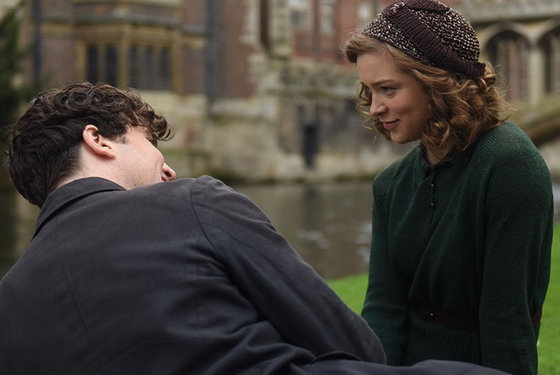
All that said: Red Joan is surprisingly inert, certainly for the momentous decisions being made and all the drama you’d think would be inherent in them. This is truly fate-of-the-world stuff, and yet you’d barely know it. This is solid filmmaking but stolid, too, as if director Trevor Nunn is afraid of giving full-throated voice to the emotion and the intellect he just barely touches on, and instead lets slip coolly by. (Nunn is better known for theater, and maybe he should stick to that?) Huge chunks of story are missing, too, such as all the decades during which older Joan kept her secrets from the son she would go on to have, Nick (Ben Miles: Woman in Gold, Ninja Assassin), who in 2000 is a lawyer now stunned, horrified, and embarrassed by his mother’s arrest. Nick’s mentions of his father, Joan’s husband, who appears to no longer be around, become a matter of some suspense — which of the men we see younger Joan with did she end up marrying? or was it someone else entirely? did whoever he is ever know what she did? — but a pointless one, certainly in how the story is structured here. Cookson is terrific as younger Joan, but there’s not enough Dench here, not just because Dame Judi is always a joy to spend cinematic time with, but because older Joan’s story is important, too.
Red Joan might have worked better as a ten-episode series, one that could take a lot more time developing not only its characters but its ideas about the morality and ethics around scientific exploration and the literally awesome power that human discovery has unleashed. Because we’re not done with that, and our capacity for destroying ourselves continues to be something we grapple with — and not only in regard to nuclear weapons. Joan’s dilemma belongs to all of us, and it deserves more than the eliding it receives here.














Would have been more interesting if it had stuck closer to the real life model, Melita Norwood. Far from a posh innocent at Cambridge, Norwood was what we used to call a red diaper baby. Her father was a Latvian immigrant who published a socialist newspaper and her mother also a socialist. She dropped out of a provincial university after a year and got a job as a secretary in an industrial company that later became a front for British atomic research. As the boss’s secretary, all the important papers came across her desk. She joined the Communist Party in 1936, and was spying for the Soviets a year later, well before the outbreak of World War II. Oh, and her husband was also a Party member.
Norwood lived long enough to see the USSR collapse in 1993, but to the end of her life in 2005, she believed she had done the right thing because Soviet Communism was good for the ordinary bloke and needed to be protected from Western hostility. She told the BBC, “I did what I did not to make money but to help prevent the defeat of a new system which had at great cost given ordinary people food and fares which they could afford, good education and a health service.”
That story would have made an interesting movie.