
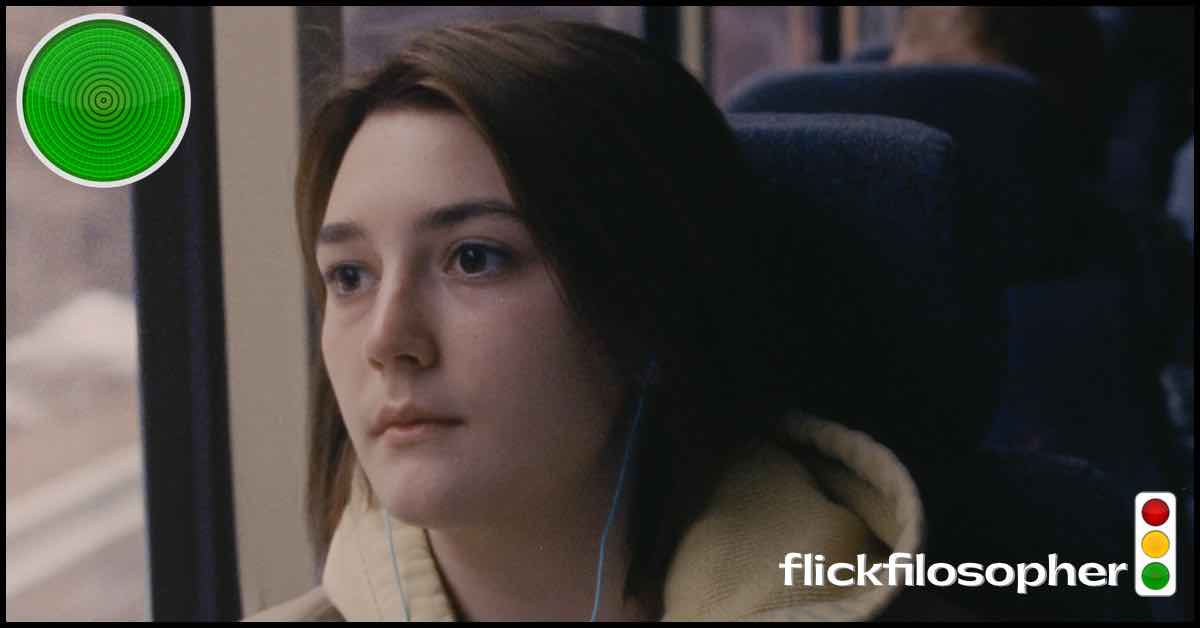
There’s a moment early in the softly savage Never Rarely Sometimes Always in which an adult woman dresses her husband — a grown-ass adult man — in precisely the same way she has just dressed her toddler child. Coaxing arms into sleeves, etc, with much cheery encouraging of this basic need to ensure that one’s physical body is equipped to deal with winter weather.
So the good thing is that this shattering movie isn’t just pro–women struggling through some tough shit, it’s also anti–useless men who make the lives of women so much more burdensome than they need to be.
All of this is unspoken subtext in the life of 17-year-old Autumn (Sidney Flanigan), who is secretly pregnant and does not want to be. It is also unspoken subtext in how writer-director Eliza Hittman tells Autumn’s story: filtered through the eyes of a high-schooler who cannot yet quite grasp all the nuanced contexts that have shaped the life she finds herself wading through the muck of. We see the fuck out of it, though, and seethe with rage and futile empathy on her behalf.

It’s Autumn’s mom (Sharon Van Etten), for instance, whose husband, Autumn’s dad (Ryan Eggold: Fathers & Daughters), is like another of her children. Bad enough that Mom barely looks old enough to be Autumn’s mother… and not because of the usual movie shenanigans that cast too-young women in too-old roles. Because she probably is too young to be Autumn’s mother, or would be in a world that gave women solid options over their fertility: we may presume that she herself was a teenaged mom. We may presume that Autumn has seen her mother’s struggles and internalized the notion that this is not a life she would choose for herself if she had any other option.
Now. We don’t know the circumstances by which Autumn has fallen pregnant, and it mostly doesn’t matter. She doesn’t want to be pregnant, and it is her decision what to do about that, no matter how it happened. But we also glean clues — I will leave them to you to discover — that those circumstances may not be of the happiest sort. Autumn’s world — our world — is one in which her teen boy peers and the older men with which she must regularly interact are awful excuses for human beings. (I stress that nothing we see here is unusual or in any way outside the realm of the shit that girls and women have to cope with on a daily basis.) Behaving in wildly inappropriate ways is just ordinary. There is always a creep who will take whatever advantage he can, because he holds the tiniest bit of power over a girl or a woman. There is always a man who doesn’t care if a girl or a woman is just barely tolerating his presence, his touch: he will take what he can anyway.

It’s impossible to believe that boys and men have no idea how often girls and women find them disgusting and repulsive for acting like they are owed our attention or access to our bodies. But either they don’t realize this… or they just don’t care.
Yes, Never Rarely Sometimes Always is an Abortion Movie, and it is so very essential for the matter-of-fact way in which it depicts Autumn’s abortion journey — carried out with the redoubtable support of her cousin and best friend Skylar (Talia Ryder) — as an easy decision that is difficult to carry out because of all the barriers thrown up at her at every step, some deliberate, some inadvertent. For how Autumn’s experience is not tragic or traumatic in and of itself, yet is made overtly and intentionally convoluted by a society that simultaneously sends her mixed signals about female sexuality, castigates her for acting like she owns her own body, and punishes her when she attempts to take responsibility for her own actions, even if those actions have been warped by her cultural programming.
Cringe at how Autumn’s father throws around words like slut and easy in such a way that makes it clear he would have little sympathy for his daughter’s situation. Double cringe at the reminder that, yes, sometimes women are also complicit in making the lives of other women more stressful than they need to be. Extreme cringe at the gentleness with which the abortion-clinic counselor asks the tough questions to which Autumn should choose from among the words that make up the title of this film… the questions that highlight, for those who don’t already know this, the knotted existence many women are just barely surviving.
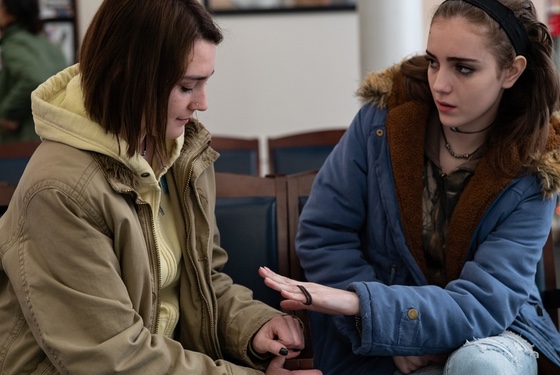
No, Never Rarely Sometimes Always isn’t about abortion: it’s about the constant low-level abuse and denigration that girls and women endure, the brutal heartbreaking aloneness that is only briefly alleviated by solidarity with (some) other girls and women. This movie is about the garbage that gets piled upon girls and women, utterly mundane but usually ignored, often covert. Men have no fricking idea about much of it. Plenty of women know but would like not to.
Here it is. Look at it. See it. Autumn is a remarkable character, unforgettable for her pragmatism and her resilience; newcomer Flanigan has the tender vulnerability and pragmatic steel of a young Mary Elizabeth Winstead. But ask yourself why such a young woman must be so strong, and so almost entirely on her own. Ask yourself why our world must treat girls and women this way. Don’t let yourself off the hook as you reach for answers.




















kind of interesting this review showed up today, since i have been catching up on 90s /early 2000s shows i had no time or attention for at the time. They mostly feature strong, complicated women: In Plain Sight with Mary McCormack, who i really like (where is she these days?) as a US Marshall. she is prickly, protective, practical and the rescuer and concrete support for her alcoholic mother and her ditzy, probably drug using sister (they aren’t just that, though, they are interesting in their own right). So what happens? Mary *finally* takes a vacation after umpteen years, has glorious sex on her own terms… and a little while later finds out she’s pregnant. Everyone is so excited for her, except Mary herself. she decides to give it up for adoption BUT NOT ONCE does anyone raise the possibility of abortion… not mary, not her friend, not her boss… not her mother, who was obviously a single mother after the husband left when mary was like 8. Not saying she necessarily had to have an aborrtion but the possibility could have been *raised*. The other show is Crossing Jordan, with difficult, tormented, bitter ex-catholic girl, but capable and practical medical examiner and pathologist. One of the women who works with her gets pregnant… she goes to Jordan for advice… does Jordan — a medical doctor in Boston — even suggest that this is one of the other woman’s choices? NO! it pisses me off that the same message has been going on even when there was less of a hysteria over birth control (another option never discussed) at least in the news every day. so, the message was still, “you made the mistake girl. Now you know you have to give birth.” that’s a choice, i know, but it would be nice to hear at least someone say, “well you do have *another* choice….” and when they say they’re going to give the baby up for adoption … THEY NEVER DO! they get all gooey and accepting and all that. i guess movies, because they aren’t in your living room, an be a little more daring…or at least the ones made by women can. not on television. maybe now.=? but i don’t really watch much of today’s television….
sorry for the very long comment…
It’s fine!
Oh, there are lots of movies in which abortion should be a choice but never is. (Side eye at Knocked Up…)