

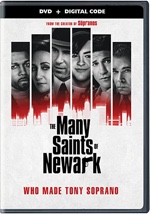
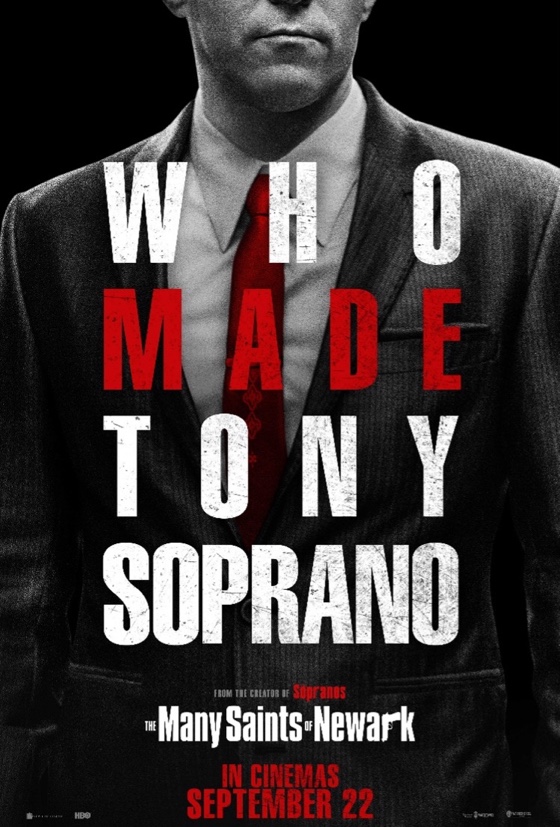
It’s a great title: The Many Saints of Newark. It’s memorable, unusual, and most of all ironic, because this is a movie about mafia gangsters, and mob guys are the furthest things from saints. But it’s also just plain factual, in a way, for this movie is specifically about Dickie Moltisanti, criminal mentor to Tony Soprano and father to Christopher Moltisanti, central figures in the legendary, much-loved, and highly praised 1999–2007 HBO TV series The Sopranos. “Moltisanti”? It’s Italian for “many saints.”
Here’s the thing, though: Did we need a Tony Soprano origin story? For that is also what Many Saints is, a fleshing out of Dickie — who was dead by the era the TV show is set in yet whose spirit loomed over it in numerous ways — so that we may see how he influenced young Tony. But wasn’t The Sopranos itself pretty much all about Tony trying to unravel, with the help of his therapist, where he came from, psychologically, and why he was the way he was?

So, alas, Many Saints feels redundant, and in more ways than one. Series creator David Chase is back — he wrote the script with Lawrence Konner (The Sorcerer’s Apprentice, Mona Lisa Smile) — and director Alan Taylor (Terminator Genisys, Thor: The Dark World) also directed a bunch of episodes of the show, yet this feels more like GoodFellas-lite than The Sopranos. There’s little of the introspection and intriguing self-awareness that made the series such an unexpected joy to watch, which is perhaps not surprising: a movie is not a TV show. But there’s several TV seasons’ worth of story crammed into Many Saints, to the point where the elisions needed to make it all fit into two hours sometimes become distractingly confusing or, more often, simply exasperating.
One big example of the confusion: Is it Dickie’s wife or his mistress who gives birth to baby Christopher? It’s the sort of thing that knocks you right out of the story as you attempt to decode the clues the script has littered up to this point… but it’s not intended to be a mystery. It doesn’t help that the actresses in the roles, respectively, Gabriella Piazza and Michela De Rossi, look very alike. And it’s indicative of the exasperation, too: the female characters get short shrift, even when they’re meant to be key to understanding the unexamined hypocrisies and explosive violence of Dickie’s personality and the all-around mess that is Tony. The women here are sacrificed to men’s journeys, literally and figuratively, in a way all too familiar onscreen… which was not the case with The Sopranos (or with GoodFellas, either, for that matter).

There are saving graces to this often trying movie. The terrific cast turn in spectacular performances. Alessandro Nivola (Selma, American Hustle) is riveting as Dickie, giving him more depth than the script does. Ray Liotta (Kill the Messenger, Sin City: A Dame to Kill For) does some of his best work since perhaps GoodFellas itself as an elder Moltisanti who becomes an unlikely sounding board for Dickie. Vera Farmiga (The Conjuring: The Devil Made Me Do It, Godzilla: King of the Monsters) as Livia, Tony’s mother, elbows her way into a bigger role than the movie wants to give her room for, letting quiet moments speak to Livia’s frustrations and disappointments with her husband — mobster Johnny Boy (Jon Bernthal: Ford v Ferrari, Widows), who is often away in prison — and how her unhappiness affects Tony. And it is beyond poignant to see Michael Gandolfini (Ocean’s Eight), son of the late Sopranos star James, damn near bring the gone-too-soon actor back to life as the teenaged Tony. Gandolfini not only looks like his father, embodying Tony in a way that avoids impersonation, but he manages the same roiling depth of feeling in his baleful, angry glare, which does more to make Tony real that almost anything we see happen here. (William Ludwig plays a gradeschool Tony early in the film.)

The evocation of the period — the mid 1960s through the mid 1970s — is striking, too. (There’s a scene with a Mister Softee ice cream truck that slammed me right back to my 1970s suburban New York childhood, just for how right it gets the look and feel.) But the volatility of the era — there a long sequence during the first half of the movie set during Newark’s 1967 race riots — is a story in itself, and is perhaps the most unforgivable shortcut the movie takes. Much of the conflict in Dickie’s journey comes from clashes with a former criminal colleague, Harold McBrayer (Leslie Odom Jr: One Night in Miami…, Harriet), who decides to go into rival felonious business on his own. Odom is mesmerizing, and Harold deserves his own movie, not least because white filmmakers using Black pain as a backdrop and an opportunity for the growth of white characters is yet another tired cinematic cliché that The Many Saints of Newark indulges in. Anyone who loves The Sopranos and appreciates how it continually upended stereotypes is excused for expecting more from this film.
















Very interesting article –
I’m curious about this film, but also sort of squeamish – casting Gandolfini’s son as Tony felt to me like the wrong kind of sentimental for a series like this – like casting Christian Brando as Vito in Godfather II – even if we discovered in watching that he was a wonderful actor, it would just be too distracting (all the more so if his father were no longer alive) – I just find it hard to get fired up at the prospect of a kid effectively evoking his own father’s spirit in a role
– but casting DeNiro was analagous in the right way, a kinship purely in terms of the craft itself, because he was already being viewed as a potential “heir” to Brando (the fact that he looked so different from Brando even added to the impact – drew more attention to the magic of his performance that we still felt they were the same person) – that’s how I’d hoped an iconic role like young Tony would have been cast – but if you say it works, that does make me more curious to see it
As far as a reason for this movie to exist, I have the same impression – especially given your point about how the women are being sidelined
Now if this prequel had been Livia’s story – THAT’s a movie I’d have wanted to see – and I would NOT want to see this role played by Nancy Marchand’s daughter (it turns out she actually does have a daughter who’s an actress – Katie Sparer – and who’s even appeared in the Sopranos – and she may be fantastic for all I know, but this doesn’t change my point)
David Chase told Peter Bogdanovich his Livia was influenced by the wife of Augustus in I Claudius – and Livia Drusilla OWNED that series – Claudius was just trying to survive, whereas Livia was the driving force making all the events happen – and Sian Phillips was so strong that her character still held the center even as her power declined – it’s astonishing that Phillips somehow even managed to lure the audience into sharing this sociopath’s self-pity even after all we’d seen)
Vera Farmiga strikes me as the right kind of casting – the kind I wished they’d applied to Tony – she’s played straight man and nursemaid to so many of our leading male talents – I’ve been waiting to see her in a role that she could grab by the teeth – the kind of role that’s usually given to male actors in projects like this – it’s funny that in the 1970s they could give Livia such a central role in what was basically a gangster saga – but in 2021 nobody can envision a female-fronted Sopranos revival
Now that I think about it – the series had so many fantastic female roles – this genre is predicated on institutionalized (albeit spectacular) male self-absorption, and I’d be most interested in seeing a revival focusing on Edie Falco, or Aida Turturro, or Drea DeMatteo, or Jamie-Lynn Siegler – or even Annabella Sciorra, Oksana Lada, or Julianne Marguiles (not so much Lorraine Bracco’s character, though she was the best thing in Goodfellas – and I thought Dr Melfi needed more fangs here – like Diane Keaton had with the Corleones – an implacable moral reality check on the entire rigmarole)
If I do end up seeing this new film, it will be to see what Vera Farmiga does as Livia
It really isn’t sentimental… or at least, it’s not only sentimental. The young Gandolfini is a really good actor.
That said, much of the point of this movie is about fan service.
Me too.
I agree the movie was not great at all. But I completely disagree with what you’re saying about exasperation of female characters, all the characters felt short lived, I’d argue Livia had more to say than Junior and Johnny Boy combined.
The other thing I disagree with is how white filmmakers use black pain as backdrop for the growth of white characters, sheesh I really don’t know what to say to this but please come on chill out.
The movie was interesting but it was bad, as a lifelong Sopranos fan I didn’t like it, but defiantly not for the reasons you mentioned.
Yes. But Junior and Johnny Boy are barely even characters here, and there are other male characters who are much more developed.
No, I’m not gonna chill out.
So why don’t you tell us your reasons for not liking it?
The movie had more focus and emphasis on characters not seen but talked about in the show (Like Dickie and his father) hence why Tony, Junior, Pussy, Sil, Paulie all did not appear much as expected and yet Livia had a more a prominent role than all of them. Out of the characters talked about in the show but not seen, Johnny Boy was completely underdeveloped which is one of the reasons why I didn’t like it. Another being is Junior did not seem very convincing to me, in the show he supposedly ran his own crew opposite his brother’s crew and yet he felt very unlike the character Junior who supposedly ran north Jersey with his brother in the old days.
For me the main reason to not liking the movie was simply how raved about Dickie was in the show and how much influence he had on Tony but when translated in the movie it just did not seem right. It didn’t feel he had enough influence to Tony to make him that legendary of a figure to basically turn him to a ruthless gangster at the end of the movie (symbolized in their pinky swear and Sopranos theme song coming in)
The movie simply wasn’t good enough, but it definitely wasn’t good enough for the reasons you mentioned. Have a good day SJW.