

Man, am I glad that I did not risk my life during an airborne-virus pandemic to see Tenet in a cinema.
What the actual hell is this? I mean… it’s a Doctor Who episode. A Very Special one, sure. Maybe a Christmas one, even. “Temporal cold war”? Yay! (For extremely limited values of war being cool.) Except it’s timey-wimey in a way that everyone who has previously had the slightest exposure to time-travel stories can anticipate. “Predictable” is certainly not something I imagined having to say about a Christopher Nolan flick. (We know exactly how Nolan’s Dunkirk ends, and yet that is an almost unbearably suspenseful film.) But honestly, there’s a mysterious, secret-keeping Big Moment early in Tenet that is very clearly signposted as Something Important that will be circled back around to later — in this case, circled back to in a literal narrative sense, because Time Travel. It was immediately apparent to me that, “Oh, yeah, obviously X is happening here,” so much so that the only ultimately surprising thing about it is that anything was intended to be eventually surprising about it.
*pinches nose extremely*

But if my geek sensibilities were to be disappointed by Tenet, that’s nothing to how my feminist sensibilities would be outright offended. The villain who must be stopped, the dangerous madman keen on stomping out humanity forever is Russian arms dealer Sator (Kenneth Branagh: Murder on the Orient Express, Mindhorn), a wannabe family annihilator on a whole-civilization, whole-species, whole-planet scale. Sator is almost cartoonishly savage toward his much-younger wife, Kat (Elizabeth Debicki: Vita & Virginia, Widows), and his abuse of her is teased, is tantalized, is threatened — will he or won’t he kick her, strangle her, shoot her at this point? — in a way that disgustingly undercuts what I presume is the point Nolan, screenwriter as well as director here, wants to make about male violence, that it exists across a spectrum from the domestic to the societal. I’m not saying that that concept is wrong. It’s just that the way it plays out here, with the abuse of a woman treated as a matter of plot-point suspense, her fear and pain dangled before us as would-be emotional bait, is utterly hamfisted. Humanity as an abused woman? A helluva lot more sensitivity is required to pull this off. Here, it’s a faux-woke feminism the likes of which movies do not need… and no, the fact that there are minor female characters here — Clémence Poésy’s (Final Portrait, Harry Potter and the Deathly Hallows Part 2) scientist; Dimple Kapadia’s arms dealer — with a bit of autonomy and authority, who are pawn to no man, does not offset that. Because the movie ain’t about them, and they ultimately have no agency in the story anyway.
*screams into the void*

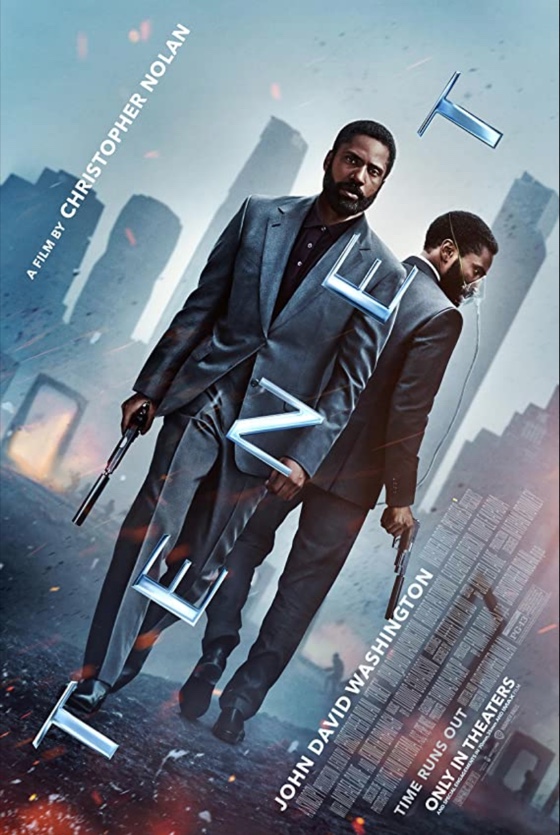
No, Tenet is steeped in some real damsel-in-distress shit as elite-operative The Protagonist (John David Washington) — yeah, that’s how he’s credited *groan* — is at least as intent upon saving Kat from her husband as he is upon saving humanity from obliteration. (And don’t even get me started on the offensive myopia of how Kat only seems roused to express the slightest interest in saving the world because her small son would be among the obliterated. What a complete fucking waste of the goddess that is Debicki. I thought she was gonna be, like, another badass time agent or something. She is not. Damn.) This is lazy-ass writing of the highest — or, rather, lowest — order, and is indicative of a shocking lack of imagination, especially when Nolan very plainly thinks he’s done something special and unique here. But it’s just more of the same old bullshit.
I am so so so so tired of male storytellers who seem to be more able to fantasize about destroying the world — even if they also dream about saving it from their invented doom — than they can begin to think about a better world. It’s fatalistic and exhausting and so un-fun.
This is extra despairing because, as a science-fiction fan as well as a movie lover, I’ve been a big devotee of Nolan’s movies. I have been very much here for all the many ways in which he has played with cinematic time, from telling a story in reverse (Memento) to interwoven timelines playing out, disconcertingly, at different paces (Dunkirk). He has messed around with time dilation (Interstellar), and now, with Tenet, he messes around with temporal inversion, the idea that, with a bit of jiggery-pokery, objects and people can move backwards in time while everything else around them moves forward in the normal way.

But Tenet is a cold, sleek puzzle that draws you in with mechanistic temporal nonsense only to reveal that none of it matters in the end. Nolan fails to make us genuinely care about a single character – Debicki’s caricatured abused woman is the best-drawn of the lot, which is damning with the faintest of praise — and so, for the first time in a Nolan film, the lack of a truly human element means that Tenet has almost nothing to say about human nature. We learn nothing about Washington’s Protagonist and his sidekick, Robert Pattinson’s (The Lost City of Z, Life) Neil, the sorta-spies operating across time — they are worse than cardboard, despite the palpable presence of the actors. There’s little incentive to solve the puzzle the film poses. And science fiction that forgets people in the pursuit of ideas is pointless. (Even the would-be big emotional payoff is directly lifted from one of the greatest Doctor Who concepts the series ever deployed. I won’t say more in order not to spoil. But click through here and here for the episodes it is featured in. Please add spoiler warnings if you want to discuss the similarities in comments below.)
Ooo, does the clichéd ticking clock of the finale go in two temporal directions? *yawn* Washington and Pattinson do have real movie-movie charisma — I could, no kidding, see either of them as the next James Bond, or maybe just let them buddy up again in another spy thriller — and I want to unabashedly love a movie in which a suave dude drops “I have a masters in physics” as a thing. But Tenet ain’t it. It’s not even interesting to look at. The car chase occurring simultaneously in two temporal directions? The wrong-way car chase in John Frankenheimer’s Ronin, 20 years ago, did it better.
“Don’t try to understand it,” says Poésy’s scientist early on. “Feel it.” Well, I don’t feel Tenet. At all.
















I agree with all your points above. I’d also add that I found Tenet quite confusing at points, something that was made worse by the fact that trying to follow the “moving backwards in time” bit, which involves some things/people moving backwards while everything else moves forward, was hard. Other Nolan movies have bits that are hard to nail down exactly on first viewing, but this one had too much of that.
No way was I ever going to risk my whole family to see this in the theater (and screw you, Nolan, for wanting people to think any film was worth it). But now I’m not going to waste my precious preschooler-is-finally-asleep time on this, either.
I watched this last week because I wanted to give it a fair shot before hearing any reviews. Sadly, I agree with most of this review. The claim that Nolan makes intricate clockwork movies with no emotion is a cliche, but this is the first time I’ve agreed with it. I’ve liked every Nolan movie I’ve seen (except maybe Dark Knight Rises, and real life events may have hurt that one), but Tenet just bored me. I didn’t follow all the plot gimmickry, but I caught enough that I assume it all holds together on closer inspection. But to quote Roger Ebert, “to the degree that I do understand, I don’t care.” None of the characters are interesting enough for me to want to spend more time with them. It’s a shame, because I really like the core idea of reversing time by decreasing entropy (I’d coincidentally just learned this concept a few weeks ago in a YouTube video), but it’s presented in a dull way.
So, let me get this straight. Nolan finally has an African-American lead…but the secondary white guy lead is a more interesting character? Sheesh. Talk about baby steps…😛😛
I’m bothered that I sat through a movie about time flowing in both directions and come out feeling that the unaccountable anomaly was the role of the female character. I’m outraged that Nolan had so little respect for narrative possibilities of time travel that he felt he had to throw in a horcrux to keep his audience interested..
I agree exactly with your take on the scenes between Sator and Kat – “the abuse of a woman treated as a matter of plot-point suspense, her fear and pain dangled before us as would-be emotional bait”
– and there was something else about this that disturbed me – the way the film seemed to be framing Branagh in these moments as some kind of lion-like “bad-ass”, as if we’re supposed to regard this character’s scary volatility and his capacity for violence as “impressive and formidable”
– I don’t think I’ve seen another film use scenes of domestic abuse to pump up a James Bond-style supervillain this way, not nearly to this extent, not in the last 20 years
– we know how easy it is for a film to present an action as presumably negative while at the same time glamorizing it – this seemed to be feeding into some kind of horrific macho fantasy – if we see Branagh starting to land action roles now the way Liam Neeson did after Batman Begins, then that will be the reason, I think
To be honest, I was unable to finish watching the film – much of it was cold and boring, and the scenes that had any impact, like these, just revolted me – whatever happened to the filmmaker who gave us Memento?
Trash review written by someone desperate to be offended. Damsel in distress offends your feminist sensibilities?! As someone who watched, and, by happenstance, understood the film (more than can be said by aforementioned offended feminist), said damsel plays a rather pivotal role in taking ownership and control of her life back. Hardly a distressed damsel, more like feminine bad*$$!
You seem great.