

In 1977, in the midst of the still-unwon fight for ratification of the Equal Rights Amendment to the US Constitution, feminist activist and progressive politician Bella Abzug famously said: “Our struggle today is not to have a female Einstein get appointed as an assistant professor. It is for a woman schlemiel to get as quickly promoted as a male schlemiel.”
Her point was that if women were ever to achieve parity with men, mediocrity in women must be as casually accepted as that of men. Where are the women who fail upward? Where are the women who succeed even though they’re not very smart or competent? We could say the same about movies: Where are the movies about extraordinary women that just sort of sit there and coast on the awesomeness of their subjects? Where are the just-pretty-okay movies that celebrate women’s accomplishments in the same vast quantities we get those about men and their deeds?

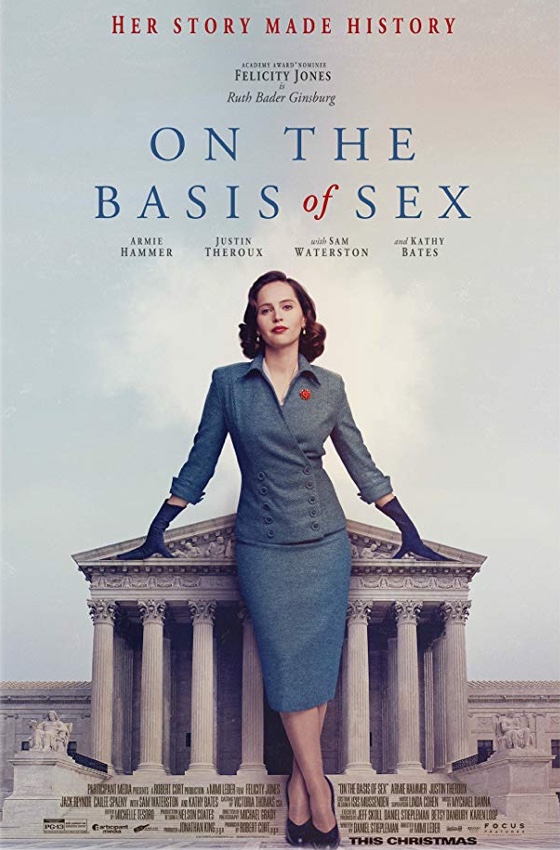
We might see On the Basis of Sex, then, as a move — a movie! — in the right direction, its hint-of-racy title fronting a just-pretty-okay cinematic experience that coasts on the awesomeness of Ruth Bader Ginsburg. Of course there is nothing remotely schlemiel-like about Bader Ginsburg, nothing mediocre; nor is there about director Mimi Leder, who has been directing and producing — mostly television but also some films, including Pay It Forward and Deep Impact — for 20 years, in a field in which mediocre women are not tolerated. I might wish that Sex was, well, sexier — more adventurous, more challenging, more meaty, more demanding of the viewer and of its terrific cast — but I’ll take this. Coasting on Notorious RBG is some incredible coasting indeed; the ride here is of the solidly crowd-pleasing variety, and there’s nothing wrong with that.
Bader Ginsberg, of course, is now a US Supreme Court justice, and at the time only the second woman appointed to that august court, but in the years of this movie — from the 1950s through the 1970s — she is a young law student, a university professor, and, once she finds her groove, an activist for gender equality. Her origin story, written for the screen by her nephew, Daniel Stiepleman (his debut), is a familiar David-and-Goliath tale of a dogged outsider battling her way into an entrenched, rigidly conservative system that doesn’t want her. The wonderful — and not-at-all-mediocre, decidedly unschlemiel-y — Felicity Jones (Rogue One: A Star Wars Story, A Monster Calls) is smartly turned out as the young Bader Ginsberg, who is already married to fellow Harvard law student Martin Ginsburg (Armie Hammer: Final Portrait, Call Me by Your Name) as the movie opens. Obscene sexism is the rule at 1950s Harvard Law, where the dean, Erwin Griswold (Sam Waterston: Miss Sloane, Anesthesia), stubbornly continues to talk about “Harvard men” even though there are, in fact, a few women in Bader Ginsburg’s incoming class.

Griswold’s — and America’s, and the world’s — casual misogyny is the villain here, and with Griswold’s face, will rear its ugly head again in Bader Ginburg’s career. The gender-discrimination case she will later shepherd toward the Supreme Court is, Griswold will fret, a threat to “the American family.” (Women with self-determination are a menace to society, doncha know.) Before that, she will find it impossible to get a job in any prestigious New York law firm, or even any less illustrious one, because women lawyers weren’t wanted. It’s easy to cheer against the outright, blatant, in-her-face bigotry that Bader Ginsburg faces, and to applaud Jones’s chin-in-the-air defiance in the face of it. A little too easy, maybe: I’m frankly a bit tired of movies about sexism that cast battles such as the ones Bader Ginsburg fought as remnants of the past, as if such matters have been resolved and we’re all equal today. Spoiler for men: sexism still exists, and women still deal with it every day, though in more insidious, more subtle ways that don’t always look like a Hollywood knave like Griswold twirling his metaphorical moustache.
Still, On the Basis of Sex has me clinging to the joy of seeing yet another instance of the gender-flipping of a familiar story resulting in a gratifying busting of clichés. (It’s not a coincidence that we do not have a David-and-Goliath metaphor that centers a mythic and triumphant lone woman.) There is intense feminist satisfaction to be found here in the depiction of the Ginsburgses’ marriage. Whatever dramatic license Stiepleman may have taken in telling his aunt’s story does not extend to the reality — portrayed here with romantic yet also practical sweetness — of Marty as incredibly supportive of Ruth’s career, and of her life on the whole. Gently amusing scenes of domesticity here include Marty cooking dinner so Ruth can practice her lawyerly oratory in preparation for appearing before the Supreme Court. I’ll venture to guess that few people who aren’t fretting about “the American family” would say that Armie Hammer bustling around the kitchen isn’t sexy as hell.

Ruth had, we see, previously supported Marty through a life-threatening illness in their law-school days, but there’s no sense that this is tit-for-tat arrangement, and not just because they both agree that he’s just a better cook than she is. The case that brings her to prominence — that one that here allows her a Mr Smith Goes to Washington–esque scene of speechifying conquest! — is one that he calls to her attention, one in which gender intersects with his wheelhouse of taxation. (It’s about a man being denied a tax benefit for caring for his elderly, infirm mother because tax law presumed that carers would be women. That Bader Ginsburg choose to take this on is an indication of her genius, and of our culture’s sexism: she was probably slightly more likely to have her point hit home in a court of law if she could prove that sexism was hurting a man. And she probably knew this.) Marty is simply behind Ruth 100 percent, and a portrait of a male/female couple that focuses on the woman while the man encourages and helps her is in itself remarkable. Toss in the fact that both partners share household duties without fuss or argument and give emotional and physical room for each other’s work, and it’s nigh on unprecedented.
We’re so used to seeing movies about men doing important work whose onscreen wives are quiet helpmeets, or sometimes women slightly perplexed by their husbands who eventually come around to being quiet helpmeets. It’s difficult to come up with even one example of a wholly supportive husband character to a wife doing important work. It’s so unusual that Stiepleman has said (in The New York Times) that the movie had trouble attracting financing because its Marty was allegedly too implausible! Even though, by all accounts, this onscreen Marty is very true to life. But that’s precisely why, however otherwise pedestrian On the Basis of Sex might be, we need to see more movies like this one.
see also:
• RBG documentary review: though she be but little she is fierce
On the Basis of Sex is the Alliance of Women Film Journalists’ Movie of the Week for January 4th. Read the comments from AWFJ members — including me — on why the film deserves this honor.



















See, for instance, the latest noises to come out of Tucker Carlson’s face hole.
Does this film offer sufficient insights and pleasures worth watching if I’ve already seen and been wowed by RBG? I recall getting a pretty vivid impression of the Ginsburgs’ marriage and Marty’s constant unwavering support for Ruth there.
Yeah, it’s a great companion to the documentary. It covers plenty of stuff the doc doesn’t.
Apart from the dinner scene, which was overly dramamticized and inaccurately portrayed, none of the words spoken by Erwin in this film can be attributed to him in reality. Please don’t believe everything you see on a silver screen, though remember every story has to have a villain or you don’t sell tickets:
https://www.forbes.com/sites/peterjreilly/2018/12/31/on-the-basis-of-sex-how-a-tax-case-became-a-victory-for-gender-equity/
https://en.m.wikipedia.org/wiki/Erwin_Griswold
Are you related to Erwin Griswold? Can you offer any firsthand evidence that the attitudes the Griswold character expresses in this film are wildly inaccurate? Because neither of your links would appear to refute anything I wrote. This film is not a documentary. I think I made it pretty clear in my review that the misogyny of our culture is the villain here. And if you don’t think that’s a real thing, I don’t know what to tell you. This movie did not invent its villain.
If you are attacking misogyny then I misunderstood and apologize.
Did you note that Armie Hammer was born in 1986 and Felicity Jones in 1983? Little out-of-the-ordinary casting.
A few years difference between onscreen couples, even with the man a little younger, isn’t all that unusual, in fact.
I hadn’t noticed the man being younger very often.
But it’s not something that’s noticeable unless you look up everyone’s ages. It certainly isn’t in this case. Yet while noticeable older men with very much younger women is a cliché, the opposite is almost nonexistent.
“It’s so unusual that Stiepleman has said (in The New York Times) that the movie had trouble attracting financing because its Marty was allegedly too implausible!”
It’s amazing how often reality is deemed “implausible” for the movies. Movies are full of men doing impossible things, while women so rarely even do possible things. I just wish we could have more movies that imagine worlds where sexism doesn’t exist. I always thought the best way to counter sexist cliches was not to directly call them out, but to carry on making films where they simply don’t happen.
It’s not quite the same issue, but, coincidentally, I was just reading an essay about ageism in Hollywood, which encourages older actors to act like they’re much more frail and impaired than they are in real life.
https://www.newsfromme.com/2019/01/03/first-rant-of-19/
In an interview about the new Mary Poppins movie, Dick Van Dyke remembered telling his makeup artists: You realize you’re making up a 90-year-old man to look like a 90-year-old man?
Of course, many aging women in Hollywood don’t have to deal with the issue, because they don’t get cast in movies at all.
“It’s not about adding diversity for the sake of diversity, it’s about subtracting homogeneity for the sake of realism.” –Mary Robinette Kowal
https://twitter.com/MaryRobinette/status/545428674812465152
Gee, has it been that long since Sarah Palin was in the news? Come to think Carly Fiorina managed to run for President despite an allegedly less than successful career at Hewlett-Packard. Since she was the first female presidential candidate to challenge Donald Trump, one would think that she would be more famous. Instead she appeared to have been thrown down a memory hole by all the Democrats who prefer to believe that only one woman ran for President in 2016.
You mentioned two women. Keep going. Let’s see if you can come up with a list as long as all the men who’ve failed upward. :-)
Also, those women arguably didn’t fail upward, they just failed. Both Palin and Fiorina (as well as Clinton) were hit with craploads of sexism mixed in with legitimate critiques of their policies, and they all LOST their campaigns. None of them are the president right now. Instead, the most incompetent and unqualified MAN in history is.
Come on, Tonio. I seriously doubt you can prove this is anything beyond an assumption on your part. We all know Fiorina ran — she doesn’t get talked about as much because she never made it past the primaries.
Neither did Ted Cruz and he’s in the news all the time. He just doesn’t get talked about here even though he had attitudes about health care that made Trump seem liberal by comparison. (Yeah, I know. Scary.)
I could be cruel and mention certain female celebrities who despite not seeming particularly talented also managed to become famous but I’m sure you’ll mention the fact that there are a lot of mediocre male celebrities out there as well. One of whom is, unfortunately, our current president.
As for Trump, well, I didn’t vote for him but then you don’t vote for kings. Oh, wait! Is that where we’re heading? Ay Dios, I hope not.
Because he’s a sitting Senator with a say in policies that affect a large state and the entire country. Fiorina isn’t. Come on, Tonio.
Once again, you have a tendency to implicitly blame commenters for not bringing up things you think we should bring up; and you assume that if we don’t mention it, that means we don’t know about it or aren’t concerned about it. We don’t have to talk about EVERYTHING on a movie review site. Come on, Tonio!
You’re right, I would mention that fact. I would say that they outnumber successful mediocre women. I would say they OUTLAST them too, as mediocre female celebrities age out of sexist expectations of desirability, while men don’t. I would also point out that beyond public celebrities, if you consider directors and below-the-line jobs, Hollywood is still overwhelmingly a male-run industry and is therefore more likely to be filled with mediocre upward-failing men. COME ON, TONIO!
Touché!
What Bluejay said. But this isn’t just about famous women, or women in politics. Men who fail upward are all over our culture, in every workplace, in every field.
I’ve worked with my share of mediocre bosses, some of whom were male and some of whom were female. I also worked with a lot of bosses of either gender who were the exact opposite, and judging from what I’ve read online from various male and female bloggers, my experiences are not that unusual.
If you want to argue that that doesn’t negate the need for a fight against sexism, well, I agree.
But then I wasn’t arguing against such a fight.
Based on what she herself endured, it seems rather hypocritical that…ever since Justice Ginsberg has been on the Supreme Court…she has consistently ruled that it IS legal to discriminate against people based on gender or race.
I guess she just figures that…while equal treatment is required for ME…for other people, it’s going to be some are “more equal” than others.
Sad…
Could you give specific examples of what rulings you’re referring to?
In case Lakeisha doesn’t reply, my guess would be she means ruling in support of affirmative action. But of course she can come back here and speak for herself if she wants.
As Anna points out, Justice Ginsberg has consistently ruled in every affirmative action case she has heard that discriminating against people on the basis of race, gender, ethnicity, etc. IS legal. (Even though the Civil Rights Act of 1964 SPECIFICALLY forbids it.)
I’m afraid I don’t understand. Affirmative action helps ALLEVIATE systemic discrimination experienced by women, African Americans, and other disadvantaged groups trying to gain access to higher education and the workplace. RBG has to my knowledge consistently ruled to support it, which would be consistent with her experience as a woman encountering sexist resistance in her education and career. So how do you see her rulings as hypocritical?
I hope you’re not about to argue that affirmative action unfairly disadvantages white people and men. That notion is wrong, but it would take a whole extended discussion about “Equality vs Equity” to show it, and our host probably wouldn’t appreciate this thread being hijacked for such a debate.
The tax case in this movie is “Moritz v. Commissioner of Internal Revenue” from 1970 if anyone wants to know.
Bella Abzug’s point about what equality really means was first used about baseball in the 1960s — where are the black .240 hitters?
I loved the movie, possibly more than it deserved, but I have to admit that this makes me even happier:
https://ew.com/movies/2019/01/19/ruth-bader-ginsburg-the-lego-movie-2/